
Inquiry Basket
 Loading ......
Cyanobacteria are an ancient group of photosynthetic prokaryotes that exist in diverse ecological niches ranging from desert soil to the deep ocean. Each habitat presents unique challenges, including how to respond to light conditions that fluctuate and are often suboptimal for photosynthesis. Cyanobacteria have evolved several photoreceptor-controlled mechanisms-particularly in their photosynthetic activity-that enable them to sense and respond to environmental light conditions. Given the global contribution of cyanobacteria to oxygen production, nitrogen fixation and carbon sequestration and their potential applications in industrial processes, there are widespread implications for understanding how cyanobacteria respond to light in order to improve photosynthetic efficiency and overall fitness.
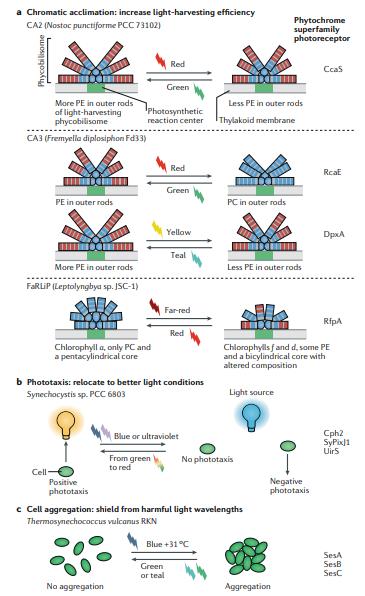 Fig. 1 Common physiological responses controlled by cyanobacterial phytochrome superfamily photoreceptors. (Wiltbank LB, et al., 2019)
Cyanobacteria rely on sunlight for growth and survival, so they have evolved to optimize sunlight capture. For this, many cyanobacterial species construct large lightharvesting antennae called phycobilisomes. These capture light of wavelengths that are poorly absorbed by chlorophylls and channel the energy to photosynthetic reaction centres. The substantial fitness benefits of producing phycobilisomes that effectively capture light are underscored by the resources dedicated to their synthesis, as they can constitute as much as 60% of the total soluble cellular protein. Additionally, many cyanobacteria modify the production of phycobilisome proteins and/or chromophores so they can continue to maximally absorb the ambient light colour spectrum as it changes. This photoreversible process is called chromatic acclimation (CA).
Photosynthetic organisms such as cyanobacteria must carefully balance harvesting sufficient photons to maximally drive photosynthesis while avoiding the damaging effects of excess energy capture. Therefore, it is important for these cells to monitor the amount of light being received (irradiance level) in addition to the ambient light colour spectrum. It is also essential that these two signals are integrated to create the optimal conditions for photosynthetic activity. Cells can control irradiance levels if they have the capacity to move towards or away from light-a process known as phototaxis. Positive phototaxis is cell movement towards light, and negative phototaxis is movement away from light. Phototaxis and its regulation are complex90, as some colours of light promote positive phototaxis, whereas others promote negative phototaxis, and different irradiances of the same light colour can cause opposite phototactic responses.
One method for discovering the physiological effect of cyanobacterial bilin photoreceptors is to compare growth rates for a photoreceptor mutant versus wildtype during illumination with specific light wavelengths. IflA (a CBCR discussed earlier in the CA3 section) has been investigated in such experiments. Wild-type cells were found to have a higher growth rate than mutant cells when exposed to higher ratios of red to far-red light.
Cell aggregation has a role in transitioning from a planktonic to a sessile lifestyle and appears to provide the shading required for protection of photosynthetic machinery from damage by excessive light. This must be tightly regulated so that when light conditions change, single cells can be released to optimize light capture for photosynthesis. Regulation of cyanobacterial cell aggregation involves extracellular glycoprotein biosynthesis in some species. The thermophilic species Thermosynechococcus vulcanus RKN has recently been developed as a model system to study light colourdependent regulation of cell aggregation. In this strain, aggregation is cellulose dependent. Whereas aggregation may occur in response to many environmental cues, in T. vulcanus, cellulose-dependent aggregation occurs when cells are exposed to relatively low temperatures (31°C versus an optimum temperature of 45°C). This is also dependent upon light conditions that are sensed by CBCRs: cells aggregate when grown in violet to blue light but not in green light. It is likely that selfshading during cell aggregation protects T. vulcanus cells from photodamage that would otherwise occur when photosynthesis occurs suboptimally at a lower temperature, while relatively high-energy, damaging violet and blue light continues to be absorbed.
| Target | Cat. No. | Product Name | Host | Isotype | Application | Inquiry |
| PIF3 | CABT-Z112R | Rabbit anti-Arabidopsis thaliana PIF3 (C-term) Polyclonal Antibody | Rabbit | IgG | WB | Inquiry |
| PIF3 | CABT-Z113R | Rabbit anti-Arabidopsis thaliana PIF3 (Middle region) Polyclonal Antibody | Rabbit | IgG | WB | Inquiry |
| PIF4 | CABT-Z114R | Rabbit anti-Arabidopsis thaliana PIF4 (C-term) Polyclonal Antibody | Rabbit | IgG | WB | Inquiry |
| PIF4 | CABT-Z115R | Rabbit anti-Arabidopsis thaliana PIF4 (N-term) Polyclonal Antibody | Rabbit | IgG | WB | Inquiry |
| PIF5 | CABT-Z116R | Rabbit anti-Arabidopsis thaliana PIF5 (C-term) Polyclonal Antibody | Rabbit | IgG | WB | Inquiry |
| PIF5 | CABT-Z117R | Rabbit anti-Arabidopsis thaliana PIF5 (N-term) Polyclonal Antibody | Rabbit | IgG | WB | Inquiry |
Loading ......
