

Inquiry Basket
 Loading ......
Phase separation acts as a basic process that organizes cell functions and operations within biological systems. The article examines phase separation by explaining its definition and biological significance while discussing how small-molecule drugs can manage this process and its therapeutic applications.
RNA molecules together with intracellular proteins generate membrane-less organelles through liquid-liquid phase separation when specific conditions are present. The fundamental system of biomolecule organization in cells depends on this phenomenon which enables numerous biological functions.
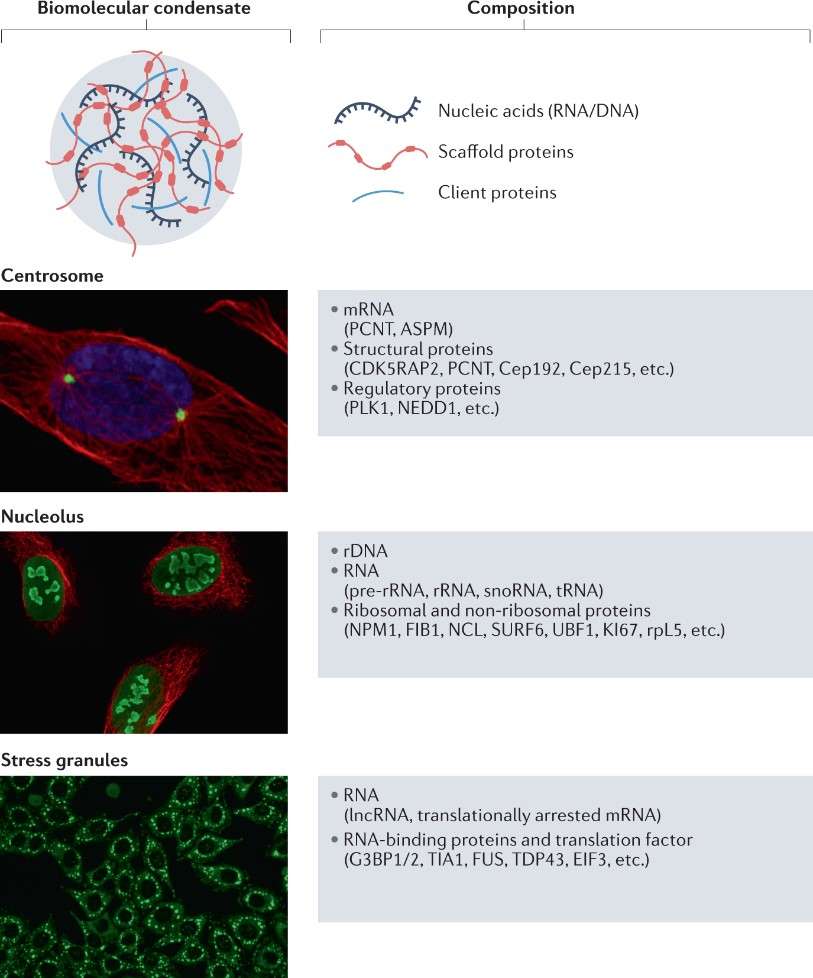 Figure 1. Examples of complex composition of biomolecular condensates. (Sources: Mitrea DM, et al. 2022)
Gene Expression Regulation
Phase separation promotes the local enrichment of transcription factors and other regulatory factors by forming condensates, thereby enhancing gene expression efficiency. For example, phase separation in the super - enhancer region can activate the transcription of specific genes.
Chromatin Structure and Function
It regulates the three - dimensional structure of chromatin, influencing chromatin remodeling and gene expression. Chromatin phase separation can regulate gene expression by dynamically adjusting the density of heterochromatin regions.
Organelle Formation
The formation of membrane-free organelles like the nucleolus, P granules and stress granules involves phase separation processes. These organelles control important functions in RNA metabolism while they degrade proteins and respond to cellular stress.
Disease Mechanisms
Abnormal phase separation is associated with various diseases, including neurodegenerative diseases (e.g., TDP - 43 disease), cancer, and immune system diseases. For instance, the abnormal liquid - solid phase transition of the ALS - related protein FUS can cause neuronal damage.
Signal Transduction and Cellular Function
Phase separation promotes transmembrane signal transduction and the localized processing of intracellular signals by forming dynamic signal - molecule condensates, thus improving signal - response efficiency.
Autophagy and Protein Degradation
It also plays an important role in the autophagy process. For example, p62 phase separation drives the separation and degradation of autophagic carriers.
Small - molecule drugs can regulate phase separation through several mechanisms:
Dissolving Abnormal Phase - Separation Droplets
These substances target and dissolve abnormal phase-separation structures including RNA droplets or protein condensates and disrupt phase-separated formations. Neurodegenerative diseases may benefit from this treatment approach.
Upstream Regulation
By targeting and regulating upstream signaling pathways or molecules in the phase - separation process, small - molecule drugs can indirectly affect the equilibrium state of phase separation. For example, mTORC1 can control macromolecular crowding in cells by regulating ribosome concentration, thereby regulating phase separation.
Changing the Conformation of Phase - Separation Proteins
Small - molecule compounds can precisely regulate the conformation of mutant proteins, inhibiting the formation of abnormal phase - separation structures or restoring their normal functional states, which is of great significance in the treatment of neurodegenerative diseases and cancer.
Physicochemical Regulation
Small - molecule drugs can regulate the phase - separation process by changing the size, shape, position of droplets, and the concentration gradient of molecules within droplets. For example, macromolecular crowding reagents (such as PEG and Dextran) can simulate the high - concentration intracellular environment and promote phase separation.
Existing literature provides several examples of small - molecule drugs regulating phase separation:
Rapamycin regulates the interaction force between proteins and cGAS, thereby modulating cGAS phase separation and its activation state.
Cucurbituril and adamantane ammonium hydrochloride can achieve supramolecular reversible regulation of liquid - liquid phase separation (LLPS) through quantitative addition.
CGX - 635 targets the condensed state of the FBL protein, interfering with the biosynthesis and growth of leukemia cells, demonstrating the potential of phase - separation mechanisms in cancer treatment.
Neurodegenerative Diseases
Abnormal phase separation impacts neurodegenerative diseases which provides a pathway to create new treatments through targeting these processes by dissolving abnormal phase separation droplets or altering protein conformations.
Cancer Treatment
Phase separation functions as a critical mechanism during tumor formation and progression. The activation of oncogenes can be inhibited by disrupting condensate formation in tumor cells and by regulating transcription factors' phase separation. The design of drugs targeting phase - separation of undruggable targets also shows broad prospects.
Viral Infections
Phase - separation mechanisms are crucial in the virus replication process. Interfering with virus - related phase - separation processes can lead to the development of novel antiviral therapies.
Immune Diseases
In autoimmune diseases, such as resistance to anti - PD - 1 therapy, phase - separation regulation mechanisms may be important means to improve treatment effects.
In conclusion, phase - separation regulation provides new perspectives and strategies for the treatment of various diseases, especially in neurodegenerative diseases, cancer, viral infections, and immune diseases. However, a deeper understanding of phase - separation mechanisms and the development of more precise regulatory technologies are still needed for clinical applications.
Phase separation describes how biomolecules such as proteins and RNA undergo a reversible dynamic process resulting in the formation of membraneless compartments. Through liquid-liquid phase separation biomolecules form membraneless compartments that resemble either liquid or gel states (such as nucleoli and stress granules). This concept transforms cell biology by demonstrating how cells structure biochemical processes spatially in the absence of membrane-bound compartments. Key breakthroughs include:
Functional Compartmentalization: LLPS forms specialized microenvironments which enhance enzymatic reactions by concentrating transcription factors and signaling molecules as shown in super-enhancer gene transcription.
Dynamic Regulation: Phase-separated condensates dynamically form or dissolve when stimulated while static organelles lack such responsiveness as shown by stress granules during cellular stress.
Disease Relevance: The improper regulation of phase separation drives the formation of protein aggregates that cause neurodegenerative diseases such as ALS and Alzheimer's as well as cancer by disturbing cellular homeostasis.
Through various mechanisms small-molecule drugs control phase separation which leads to precise and versatile treatments.
Dissolving Pathological Aggregates: CGX-635 is a drug that targets cancer-related condensates such as the FBL protein in leukemia by breaking down abnormal phase-separated structures.
Conformational Rescue: Lipoamide analogs serve to maintain ALS-linked FUS protein in its soluble form which stops toxic solid-phase transitions.
Upstream Pathway Targeting: Rapamycin regulates LLPS through mTORC1 inhibition which results in changes to ribosome biogenesis and macromolecular crowding.
Advantages: These drugs demonstrate high tunability and reversibility while effectively targeting proteins once considered non-targetable such as intrinsically disordered regions found in transcription factors.
Despite progress, critical hurdles remain:
Mechanistic Complexity: LLPS is context-dependent; the same protein may form functional or pathological condensates depending on post-translational modifications or cellular conditions.
Drug Specificity: Many small molecules lack selectivity, disrupting both physiological and disease-associated condensates (e.g., PEG-based crowders).
Biomarker Development: Real-time imaging tools to monitor LLPS dynamics in vivo are limited, complicating drug efficacy assessments.
Clinical Validation: Most studies are preclinical. Trials targeting LLPS in neurodegeneration (e.g., FUS phase modifiers) are ongoing but face challenges in patient stratification.
References
| Target | Cat. No. | Product Name | Type | Host | Conjugate | Application | |
| Nadifloxacin | DAG095S | Nadifloxacin [HRP] | Synthetic | N/A | HRP | ELISA, LF | Inquiry |
| DAG096S | Nadifloxacin [KLH] | Synthetic | N/A | KLH | ELISA, LF | Inquiry | |
| Medroxyprogesterone | DAG097S | Medroxyprogesterone [HRP] | Synthetic | N/A | HRP | ELISA, LF | Inquiry |
| DAG098S | Medroxyprogesterone [KLH] | Synthetic | N/A | KLH | ELISA, LF | Inquiry | |
| HCTZ | DAG102S | Hydrochlorothiazide [BSA] | Synthetic | N/A | BSA | ELISA, LF | Inquiry |
| DAG103S | Hydrochlorothiazide [KLH] | Synthetic | N/A | HRP | ELISA, LF | Inquiry | |
| DAG104S | Hydrochlorothiazide [HRP] | Synthetic | N/A | KLH | ELISA, LF | Inquiry | |
| Gatifloxacin | DAG108S | Gatifloxacin [BSA] | Synthetic | N/A | BSA | ELISA, LF | Inquiry |
| DAG109S | Gatifloxacin [HRP] | Synthetic | N/A | HRP | ELISA, LF | Inquiry | |
| DAG110S | Gatifloxacin [KLH] | Synthetic | N/A | KLH | ELISA, LF | Inquiry | |
| Enoxacin | DAG111S | Enoxacin [BSA] | Synthetic | N/A | BSA | ELISA, LF | Inquiry |
| DAG112S | Enoxacin [HRP] | Synthetic | N/A | HRP | ELISA, LF | Inquiry | |
| DAG113S | Enoxacin [KLH] | Synthetic | N/A | KLH | ELISA, LF | Inquiry | |
| Doramectin | DAG114S | Doramectin [BSA] | Synthetic | N/A | BSA | ELISA, LF | Inquiry |
| DAG115S | Doramectin [HRP] | Synthetic | N/A | HRP | ELISA, LF | Inquiry | |
| DAG116S | Doramectin [KLH] | Synthetic | N/A | KLH | ELISA, LF | Inquiry | |
| Deltamethrin | DAG117S | Deltamethrin [BSA] | Synthetic | N/A | BSA | ELISA, LF | Inquiry |
| DAG118S | Deltamethrin [HRP] | Synthetic | N/A | HRP | ELISA, LF | Inquiry | |
| DAG119S | Deltamethrin [KLH] | Synthetic | N/A | KLH | ELISA, LF | Inquiry | |
| Cypermethrin | DAG120S | Cypermethrin [BSA] | Synthetic | N/A | BSA | ELISA, LF | Inquiry |
Loading ......
