
Inquiry Basket
 Loading ......
Oligodendrocytes, a type of glial cell found in the central nervous system (CNS), play a vital role in the formation and maintenance of myelin sheaths. These myelin sheaths provide insulation to neuronal axons, ensuring efficient transmission of electrical signals. The study of oligodendrocyte markers is crucial for understanding the development and function of oligodendrocytes, as well as their implications for various neurological disorders.
The main function of oligodendrocytes is to wrap axons in the CNS, form an insulating myelin structure, assist in the efficient transmission of bioelectrical signals, and maintain and protect the normal functions of neurons. In addition, oligodendrocytes produce glial cell-derived neurotrophic factor (GDNF), insulin-like growth factor-1 (IGF-1), and brain-derived neurotrophic factor (BDNF) to provide neurons with trophic support. Abnormalities in oligodendrocytes can not only lead to demyelination of the CNS, but also cause irreversible neuronal damage or psychiatric diseases, and can even cause brain tumors.
Oligodendrocyte markers are key tools used by researchers to identify, characterize, and study oligodendrocytes and their precursor cells. These markers enable the visualization and quantification of oligodendrocytes in tissues, cell cultures, and animal models, providing valuable insights into their development, maturation, and function. By targeting specific proteins expressed by oligodendrocytes, researchers can investigate various aspects of oligodendrocyte biology, including their proliferation, differentiation, myelination capacity, and response to injury or disease.
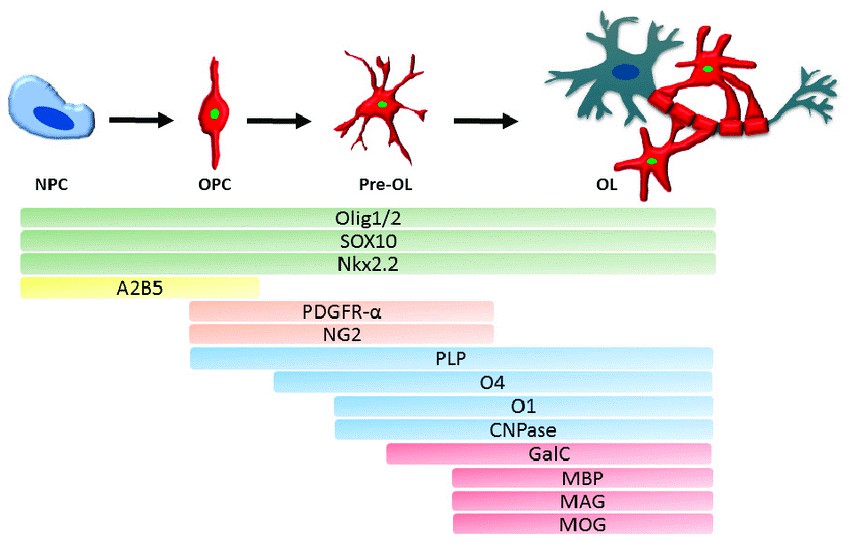 Fig. 1 Schematic depiction of oligodendroglial lineage markers specific for different developmental stages from neuronal progenitor cells (NPC) to myelinating oligodendrocytes. (Kuhn S, et al., 2019)
One important oligodendrocyte precursor cell marker is platelet-derived growth factor receptor alpha (PDGFRA), a cell surface tyrosine kinase receptor. PDGFRA is expressed by oligodendrocyte precursor cells and plays a crucial role in their development and differentiation.
NG2
NG2, also known as neural-glial antigen 2, is a chondroitin sulfate proteoglycan (CSPG) expressed in a subset of glial cells, including oligodendrocyte precursor cells, and in various tumor cells. NG2 is also an early marker of pericyte activation in pathological conditions. Therefore, NG2 may play a role in experimental autoimmune encephalomyelitis (EAE), which is a disease associated with inflammatory infiltration, increased blood-brain barrier (BBB) permeability, and CNS damage.
Olig1 and Olig2 are bHLH transcription factors that are considered essential for oligodendrocyte progenitor cells to determine oligodendrocyte fate. Olig1 is expressed only in oligodendrocytes late in embryonic development. Olig2 cooperates with OLIG1 to establish the pMN domain of the embryonic neural tube and works with ZNF488 to promote oligodendrocyte differentiation.
The Claudin family of proteins are integral membrane proteins that contribute to the formation of tight junction strands. These tight junction strands act as barriers, preventing the free movement of solutes and water through the space between epithelial or endothelial cell sheets. The protein (OSP) encoded by this gene is found on the surface of oligodendrocytes in the CNS and is vital for regulating the proliferation and migration of oligodendrocytes.
Myelin basic protein (MBP) is a structural component of myelin and is exclusively expressed by myelinating glia, including oligodendrocytes. It plays a critical role in the formation and stability of myelin sheaths. Due to the role of the blood-brain barrier (BBB), MBP is easily released into the cerebrospinal fluid and only a small amount is released into the blood. When the CNS is damaged, BBB function is destroyed, resulting in increased serum MBP levels. Measuring serum MBP content can reflect changes in MBP content in a timely manner. Therefore, MBP has been reported to be used as an indicator to judge the degree of CNS damage.
Myelin oligodendrocyte glycoprotein (MOG) is a membrane protein that is found at two specific locations: the surface of oligodendrocyte cells and the outermost surface of myelin sheaths. MOG has been reported to be involved in myelin stability, intercellular communication, and immune response in the CNS.
Oligodendrocyte markers play a crucial role in neuroscience research, enabling the identification, characterization, and study of oligodendrocytes and their precursor cells. Creative Diagnostics offers a comprehensive range of high-quality antibodies targeting key oligodendrocyte markers, such as PDGFR alpha, NG2, Olig1, Olig2, OSP, MBP, and MOG, providing researchers with reliable tools to advance their understanding of oligodendrocyte biology, myelination processes, and neurological disorders.
References
Loading ......
