
Inquiry Basket
 Loading ......
Noroviruses are highly contagious viruses that cause vomiting and diarrhea. Most nonbacterial gastroenteritis infections are caused by noroviruses. These viruses are transmitted by the fecal-oral route and the source of infection is often contaminated food or water; for example, eating fresh or frozen berries without heating them first has been identified as a typical way of catching the disease. The virus also spreads easily when one comes into contact with infected individuals and from surfaces that they have touched. This means that the virus easily spreads among groups of people, for example in schools, in hospitals or even at home.
Noroviruses belong to the Caliciviridae family and are non-enveloped, single-stranded, positive-sense ribonucleic acid (RNA) viruses. Human norovirus genomes are 7.4–7.7 kb in length and have three open reading frames (ORFs). The non-structural proteins, such as the RNA dependent polymerase (RdRp), are encoded by ORF1, while the structural proteins are encoded by ORF2 (VP1) and ORF3 (VP2). The major capsid protein VP1 forms dimers, which assemble into the viral capsid with T = 3 icosahedral symmetry of approximately 36–42 nm diameter. VP2 is considered as minor capsid protein and carries multiple functions, which are still not completely deciphered. VP1 can be divided into a shell (S) domain and a protruding (P) domain, which is further subdivided into P1 and P2. The lack of a robust cell culture system has limited research on human noroviruses. Nevertheless, the production of virus-like VP1 particles (VLPs) shows comparable characteristics to the native virion.
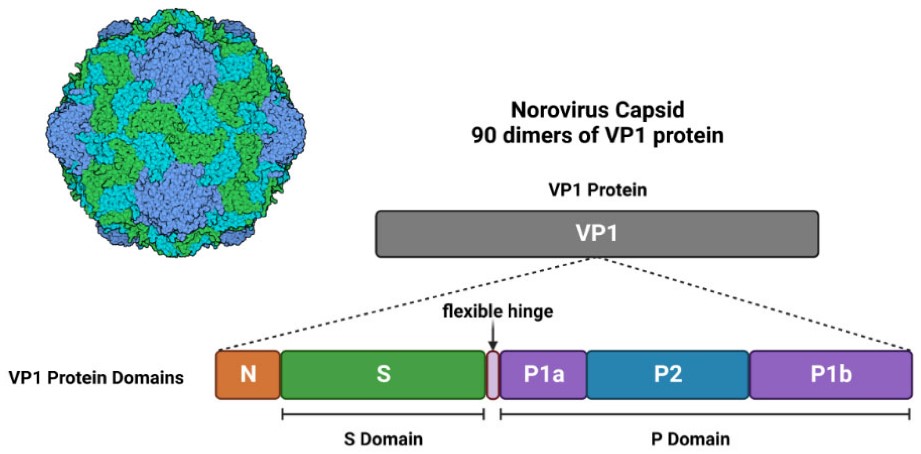 Fig. 1 NoV Viral Particle Structure
Noroviruses are classified into genogroups/polymerase groups (P-groups) and genotypes/P-types based on amino acid diversity in VP1 and ORF1 proteins. The data obtained from VP1 sequencing was used for assignment to genogroups and genotypes, while RdRp partial sequencing data was used for assignment to P-groups and P-types. According to the system, the Norovirus genus is divided into 10 genogroups (GI-GX) and 49 genotypes (9 GI, 27 GII, 3 GIII, 2 GIV, 2 GV, 2 GVI and 1 genotype each for GVII, GVIII, GIX [formerly GII.15] and GX), where genogroups known to infect humans include GI, GII, GVIII, and GIX. GII.4 is especially significant as it has caused a multitude of outbreaks globally over the years and is considered to be predominant in human infections.
Various methods have been used for the diagnosis of Norovirus infection, including electron microscopy (EM), IEM, radio immunoassays, ELISAs and viral RNA based nucleic acid amplification assays. Of the available detection methods, the most commonly used assays for Norovirus diagnosis include ELISAs and RT-PCR.
Creative Diagnostics offers a series of Norovirus antibodies which are manufactured to the highest quality standards and are performance guaranteed for the applications listed on the detailed datasheets.
References
 Fig. 1 Reactivity of Norovirus Mab sets
Loading ......
