
Inquiry Basket
 Loading ......
CAR T cell therapy is a type of cancer immunotherapy treatment that uses immune cells (T cells) that are genetically altered in a lab to enable them in locating in destroying cancer cells more effectively. CAR T treatment can be very effective against some types of cancer, even when other treatments are not working. Currently, CAR T therapy is FDA-approved to treat several types of hematological malignancies, including:Leukemia, Lymphoma, Multiple myeloma. Although treatment with CAR-T cells has produced remarkable clinical responses with certain subsets of B cell leukemia or lymphoma, many challenges limit the therapeutic efficacy of CAR-T cells in solid tumors and hematological malignancies.
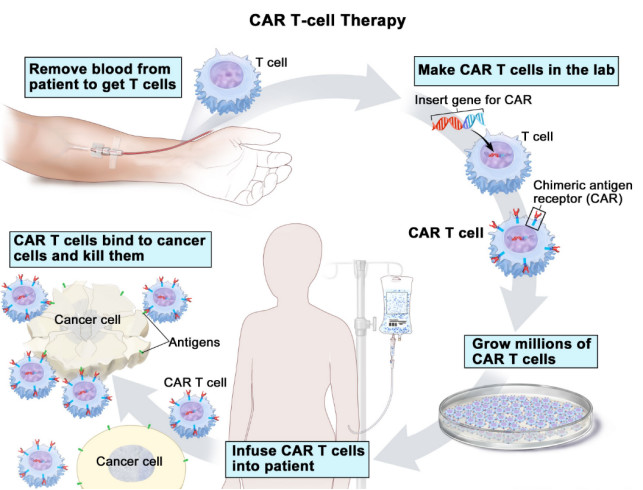 Fig. 1: CAR-T Therapy Process
In CAR T-cell therapies, T cells are taken from the patient's blood and are changed in the lab by adding a gene for a receptor (called a chimeric antigen receptor or CAR), which helps the T cells attach to a specific cancer cell antigen. To achieve prominent tumor clearance, CAR-T cells should target the vast majority of tumor cells.
Restricted trafficking and infiltration into the tumor site, hypoxic and immunosuppressive tumor microenvironment (TME), antigen escape and heterogeneity, CAR T-cell exhaustion, and severe life-threatening toxicities are a few of the major obstacles facing CAR T-cells.
1. Strategies for improving coverage and specificity
Due to the lack of ideal target, the potential of CAR-T therapy has not been fully realized in many cases. The most common strategy is to combine different targets.The first kind of relationship between different targets is that the transfected T cells will express two CARs specific for two different antigens. Full activation could be achieved when each antigen is engaged, the immune response can be further enhanced. Except for expressing two different CAR molecules, tandem expression of two scFv domains in one CAR molecule can also come up to a similar effect. According to several reports, the relative positional changes between the two scFv domains have an important effect on the function of the CAR molecule. Therefore, the design of such tandem CAR may require more detailed optimization.
The second kind of relationship between different targets is that the intracellular activating regions of a complete CAR molecule, the CD3ζ and co-stimulatory activation domains, are expressed separately within two half-baked CARs. The CAR-1 provides a CD3ζ-mediated activation signal upon recognition of antigen 1, and the co-stimulatory signal is provided by the CAR-2 when antigen 2 is engaged. It has been demonstrated that recognition of two targets was necessary for full activation in this design.
2. Target tumor microenvironment
Solid tumors establish a sophisticated composition to support tumor growth, including immunosuppressive microenvironment, unique vascular system, and nutritional environment suitable for tumor growth and so on. The cells involved in the establishment and maintenance of the microenvironment can also be the targets for CAR-T therapy. For example, the cancer-associated fibroblasts (CAF), which support tumor growth by secreting growth factors, chemokines, and extracellular matrix, could be destroyed by CAR-T cells targeting fibroblast activation protein (FAP), and potent antitumor effects by CAR-T-FAP have been also confirmed. In addition, destroying tumor vascular system and killing cancer stem cells by CAR-T cells have also been proved to be feasible and effective. The strategy that transforms the targets from cancer cells to other cells supporting the growth of tumors also provides a basis for combined application of other treatments.
3. Triggering endogenous immunity
Due to the extremely high abundance of TCR in vivo, compared to the CAR-T cells recognizing a specific target, the endogenous tumor-specific T cells (recognizing neoantigen and HLA complexes by TCR) are more likely to fully cover solid tumor cells and thus may eliminate the malignancies more clearly. In this scenario, CAR-T cells could be used as therapeutic tools to activate the antitumor activity of endogenous immune system. Many clinical cases have confirmed that lymphocyte infiltration in solid tumors would increase after CAR-T treatment. In addition to CAR-T cells themselves, the infiltration of endogenous dendritic cells (DCs), macrophages, and endogenous T cells could also be increased. In the activation loop (Fig. 2), the neoantigens released after CAR-T cells attacking could activate the more specific endogenous tumor-specific immune response if they are uptaken and presented by antigen-presenting cells. In addition, the CAR-T cells could be modified to release pro-inflammatory factors and form a favorable microenvironment for inflammatory response in the local area of tumors, which would further boost the endogenous tumor immune response.
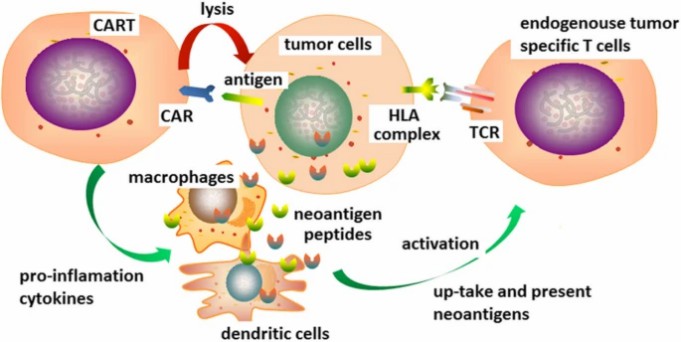 Fig. 2: CAR-T cells can be modified to initiate and boost the endogenous tumor-specific immune response
Loading ......
