
Inquiry Basket
 Loading ......
The immune system consists of multiple cell types which develop from hematopoietic stem cells (HSCs) found in the bone marrow. The cells start their development journey through sequential differentiation processes which result in the production of all innate and adaptive immune cells. The identification of specific cell surface markers becomes necessary for studying immune cell populations because these markers show minor variations between human and mouse populations.
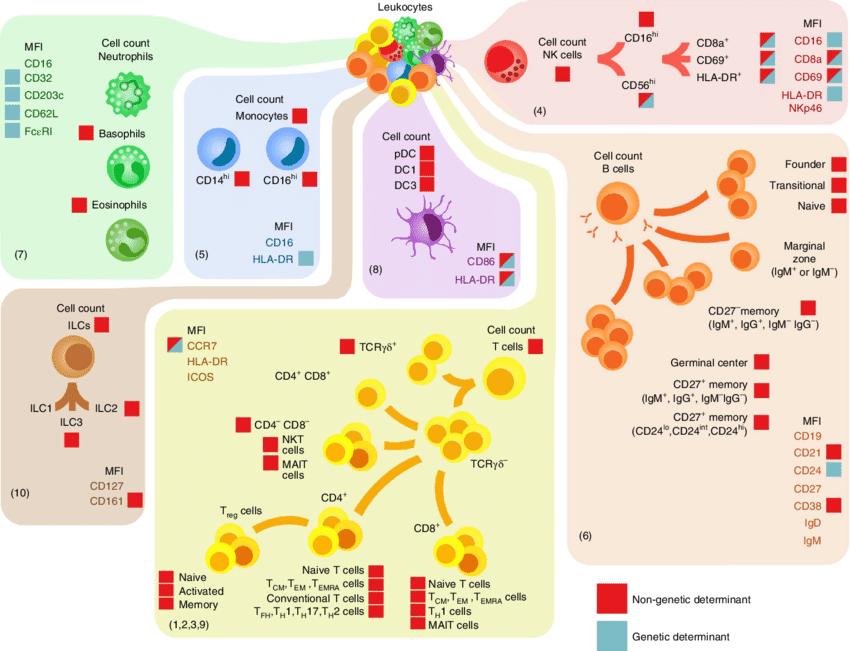 Figure 1. Quantification of immune cells and cell-surface markers measured in the Milieu Intérieur cohort.(Patin E, et al.; 2018)
The identification of these markers enables researchers to perform immunophenotyping and conduct functional studies and translate their findings to clinical applications. The following article presents a comprehensive description of immune cell development which includes human and mouse marker identification from stem cells to fully developed immune effectors.
The process of hematopoietic cell differentiation begins with hematopoietic stem cells (HSCs) which function as multipotent self-renewing cells which maintain blood production throughout life. Human HSCs exist as cells which display CD90 (Thy1) and CD49 markers yet lack CD45RA expression to maintain their undifferentiated state. The differentiation process from hematopoietic stem cells produces multipotent progenitors (MPPs) which maintain their ability to develop into multiple cell types but lose their ability to self-renew while showing minimal changes in CD90 expression. The differentiation of Common lymphoid progenitors (CLPs) from MPPs results in cells which express CD10 and CD45RA and develop into T cells and B cells and natural killer (NK) cells. The common myeloid progenitor (CMP) cell type develops from CMPs through expression of CD135 while losing CD7 and CD10 and CD90 markers to produce GMPs and MEPs. The GMP cell type expresses CD123 and CD45RA to produce neutrophils and eosinophils and basophils and monocytes while MEP cells negativly express markers for CD135 and IL3Rα to develop into erythrocytes and megakaryocytes.
The mouse hematopoietic stem and progenitor cell population contains Sca-1 and c-Kit expresses which serve as their defining characteristic. The CD34- CD48- CD135- CD150+ CD49b-low cell population functions as long-term hematopoietic stem cells (LT-HSCs) which sustain blood cell production throughout life. The hematopoietic cells known as short-term and intermediate HSCs display CD34, CD49 and CD48 expression patterns that differ from each other. The lymphoid-primed multipotent progenitor (LMPP) cell type in mice expresses CD34, CD127 and CD135 while it shows preference for lymphoid development yet still possesses some myeloid cell potential. The mouse progenitor cells CMP and GMP and MEP cells function identically to their human counterparts while their surface marker patterns include CD16/32 and CD34 and CD64 and Sca-1 which indicate their developmental path.
The lymphoid lineage from CLPs produces three immune cell types which include T cells and B cells and NK cells. The human immune system depends on T cells which express CD3 to perform their adaptive immune functions through helper cells and cytotoxic cells and regulatory cells. B cells function to produce antibodies and maintain memory cells through their CD19 surface marker. The innate immune system depends on NK cells which lack CD3 but express CD56 and CD94 and NKp46 to destroy infected or transformed cells.
The mouse lymphoid development process follows a comparable pattern to humans although it uses distinct genetic markers. The T cell population in mice maintains CD3 expression while B cells use B220 as their identification marker and NK cells display NK1.1 along with CD122 and FCD11b and NKG2D and NKp46 surface markers.
The myeloid progenitor cells produce multiple types of innate immune cells. The blood contains human monocytes which express CD14 and develop into macrophages and dendritic cells. The immune cells known as macrophages can be recognized through their CD11b and CD68 and CD163 surface markers while they execute phagocytosis and produce immunomodulatory cytokines. The antigen-presenting cells known as dendritic cells (CD11c+, HLA-DR+) activate naive T cells through their professional antigen presentation. The granulocyte family includes three cell types which neutrophils with CD11b, CD16, CD18 , CD32, CD44 and CD55 markers for fast infection response and eosinophils with CD45 and CD125 and CD193 and Siglec-8 markers for parasite combat and basophils and mast cells with CD22 and CD123 and CD32 and CD117 and FcεRI markers for allergy and inflammation.
The myeloid cell populations in mice maintain their functional capabilities through distinct markers which differ from human cells. The myeloid cells in mice display monocytes with CD11b, CD115, CX3CR1, Ly6C, macrophages with CD45, CD64, F4/80, MerTK, and dendritic cells with CD11c, CD24, MHC II. The mouse immune cells consist of Gr-1+/Ly6G+ neutrophils and CCR3+ IL-5Rα+ Siglec-F+ eosinophils and CD41+ CD49b+ basophils and CD117+ Integrin β7+ mast cells. The specific markers enable detailed functional analysis while showing minimal variations between species.
MEPs differentiate into erythrocytes and megakaryocytes. Human erythrocytes, marked by CD235a, transport oxygen; megakaryocytes (CD41b+, CD42a+, CD42b+, CD61+) generate platelets; and circulating platelets (CD41+, CD42a+, CD42b+, CD61+) mediate hemostasis and immune interactions.
In mice, erythrocytes express Ter119, megakaryocytes CD41, CD42b, CD117, CD150, CXCR4, and platelets CD41, CD9, GPIb/V/IX, GPVI, reflecting conserved functional roles across species.
Comparative Insight and Biological Implications
The hematopoietic structures between humans and mice display a shared organizational pattern but they exhibit different marker expression patterns including human HSCs expressing CD34 but mouse HSCs lacking this marker and mice showing NK1.1 expression as a strain-dependent NK cell marker. The different species requirements for immunological research become essential because they impact both fundamental immune cell identification and the analysis of disease models in translation.
The identification and functional analysis of hematopoietic lineages in humans and mice depends on complete knowledge of immune cell markers. The expression of particular markers on cells from HSCs to fully mature immune effectors reveals their developmental stage and activation level. The advancement of immunology research depends on understanding both common immune cell marker patterns and unique species-specific marker profiles which enables researchers to connect preclinical results to human biological processes.
| Cell Type | Human Markers | Mouse Markers |
| HSC / LT-HSC | CD34+ CD38- CD90+ CD45RA- CD49f+ | Lin- Sca-1+ c-Kit+ CD150+ CD48- |
| MPP | CD34+ CD38- CD90- CD45RA- | Lin- Sca-1+ c-Kit+ CD150- CD48+ |
| CLP | CD34+ CD10+ CD127+ CD45RA+ | Lin- Sca-1+ c-Kit+ Flt3+ CD34+ |
| CMP | CD34+ CD38+ CD123+ CD45RA- | Lin- Sca-1- c-Kit+ CD34+ CD16/32^low |
| GMP | CD34+ CD38+ CD123+ CD45RA+ | Lin- Sca-1- c-Kit+ CD34+ CD16/32^high |
| MEP | CD34+ CD38+ CD123- CD45RA- | Lin- Sca-1- c-Kit+ CD34- CD16/32^low |
| T cell | CD3+ (CD4+ / CD8+) | CD3+ (CD4+ / CD8+) |
| B cell | CD19+ CD20+ CD22+ | B220+ CD19+ IgM+ |
| NK cell | CD56+ CD16+ NKG2D+ | NK1.1+ CD3- |
| Monocyte | CD14+ CD16+/- HLA-DR+ | CD11b+ Ly6C^hi/lo F4/80+ |
| Macrophage | CD68+ CD163+ CD11b+ | F4/80+ CD11b+ CD68+ |
| Dendritic cell | CD11c+ CD1c+ / CD123+ | CD11c+ MHC II+ (CD8α+ / CD11b+) |
| Neutrophil | CD15+ CD16+ CD66b+ | CD11b+ Ly6G+ |
| Eosinophil | CD16- CD125+ Siglec-8+ | Siglec-F+ CCR3+ |
| Basophil | CD123+ FcεRI+ CD203c+ | FcεRI+ CD49b+ |
| Mast cell | CD117+ FcεRI+ | FcεRI+ c-Kit+ |
| Erythrocyte | CD235a+ | Ter119+ |
| Megakaryocyte | CD41+ CD42b+ | CD41+ CD61+ |
| Platelet | CD41+ CD61+ | CD41+ CD42b+ |
Reference
Loading ......
