Introduction of Identification of Immature Myeloerythroid Development
Since most effector cells have a limited life span, appropriate homeostasis in the blood system is contingent upon the constant production of new blood cell elements. This production is the result of multiple differentiation events, where the many different types of mature effector cells are ultimately derived from bone marrow-residing hematopoietic stem cells (HSCs); a cell type capable at the single-cell level to both self-renew and differentiate into separate hematopoietic lineages, thereby allowing for lifelong hematopoiesis.
The immediate progeny of HSCs are multipotential progenitor cells that retain full lineage potential but have lost extensive self-renewal ability. Such multipotent progenitors, in turn, give rise to a set of oligopotent progenitors with more restricted developmental potential. Upon further differentiation, these oligopotent progenitors mature into lineage-restricted progeny, from which all the mature blood cells eventually arise. As these subsets constitute only a minor fraction of all cells found in a measurement of a bulk population of unenriched cells, it is obvious that measurement of the bulk population in most cases is not sufficient to deduce information about a defined cellular stage or developmental pathway. The subset of interest would simply “drown” in the noise contributed by other cell types. Therefore, to detail hematopoietic lineage development, it is necessary to purify cells not only with appropriate lineage affiliation but ultimately also at defined developmental stages.
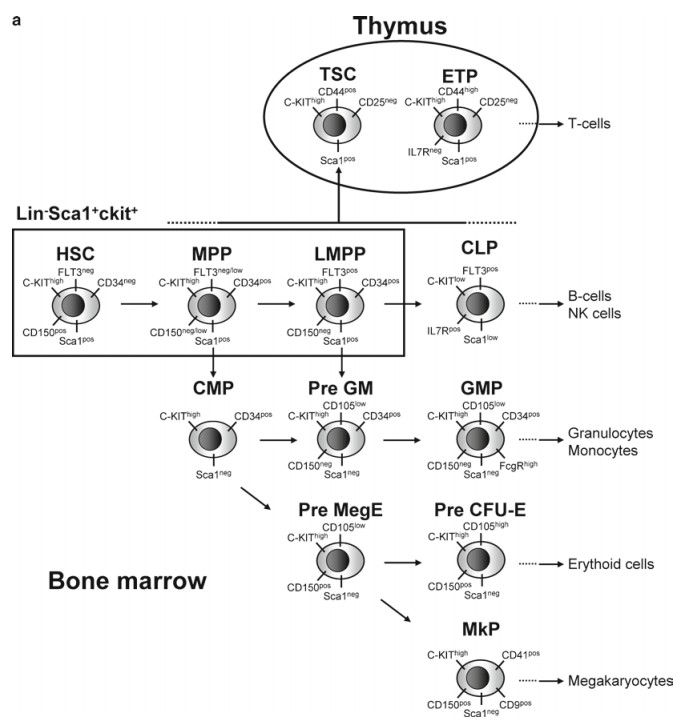 Figure 1. Schematic and flow cytometry-based overview of early hematopoiesis.
Due to technological advances in recent years, flow cytometry nowadays routinely allows for the simultaneous assessment of multiple proteins on cells. Thereby, it is possible to resolve complex combinatorial expression patterns that associate with functionally distinct cellular properties. Multiparameter analysis is the key here, since no single protein identified to date can be used alone to define HSCs and/or their downstream immature progeny phenotypically. Rather, a panel of markers has to be evaluated simultaneously.
Using five-parameter flow cytometry, the prospective identification of oligopotent common lymphoid progenitors (CLPs) and common myeloid progenitors (CMPs) proposed that a first step in hematopoietic lineage restriction is the mutual exclusion of myeloerythroid from lymphoid potential. However, as much of this fundamental concept was challenged in reports detecting myeloid output from CLPs and reports demonstrating loss of megakaryocyte/erythroid (Meg/E) potential prior to lymphoid and granulocytic/monocytic divergence, we screened the myeloid progenitor compartment for additional cell surface markers that could potentially reveal heterogeneity. This effort led to the identification of three markers; CD150, CD105, and CD41 that in combination with several previously described markers can be used to define a hierarchy of myeloid progenitors at high resolution.
This chapter provides protocols for flow cytometric detection and purification of immature myeloerythroid progenitor subsets from mouse bone marrow, including early bipotent progenitors for the erythroid/megakaryocyte lineages (preMegE), early monopotent erythroid (preCFU-E and CFU-E) and megakaryocyte progenitors (MkP), and primitive granulocyte/macrophage progenitors (preGM and GMP). We provide detailed protocols for cell isolation and cell surface staining, and describe approaches that can be used to manage instrument settings, data acquisition, and data analysis appropriately.
Methods of Identification of Immature Myeloerythroid Development
Isolation and Preparation of Mouse Bone Marrow Cells
In this section, we describe the dissection of mouse bones and subsequent recovery of bone marrow cells.
- Euthanize mice according to locally approved procedure.
- Disinfect the skin of the mouse with 70% ethanol using a spray bottle. Prepare 1 mL of cold buffer per mouse to collect the bones.
- Using clean instruments, make a transverse cut in the abdominal area and draw the skin laterally to open the abdominal lavage.
- Inspect liver and spleen for possible signs of disease, abdominal carcinomas, or organomegaly. Signs of disease should be a very rare event in young wild-type mice.
- Cut off both feet. Hold the knee joint with one forceps and the proximal part of the tibia with the other forceps, and bend the latter anteriorly to break off the tibia. Clear the tibia from tissues (muscles, tendons, etc.) using a scalpel and put bones in cold buffer.
- Grab distal femur with one pair of forceps and the knee joint with the other, and bend the latter anteriorly to break off the knee joint. Cut the femur loose as proximal as possible, clear from other tissues using a scalpel and transfer to cold buffer.
- To isolate the Iliac crest (see Note 6), hold with a forceps the site (bone fragment) from which the femur was cut, cut about 2 cm upwards medially from the forceps and pull out the crista. Remove other tissues and transfer to cold buffer.
- After isolation of all bone fragments, transfer to a mortar and gently crush the bones. Flush crushed bones with isolation buffer and pipette up and down with cold buffer, followed by filtering the suspension (80-mm cup filter) into an appropriately sized collection tube (see Note 7).
- Centrifuge the cell suspension at 400×g for 10 min and resuspend cell pellet in 1× lysis buffer if red blood cell lysis is performed (see Note 8); 200 mL/mouse. Incubate for 1 min at room temperature. Add isolation buffer (1 mL per mouse) and filter to rid clumps of cell debris. Centrifuge again at 400×g for 10 min and resuspend in an appropriate volume of isolation/staining buffer. This relatively fast method should yield a recovery of bone marrow cells in the range of 1–1.5×10⁸ cells per mouse (=one mouse BM equivalent).
Pre-enrichment of Mouse Bone Marrow Cells
In this section, we describe the enrichment for the target populations using negative selection of cells expressing mature “lineage markers,” so-called lineage depletion (see Note 9). These lineage-depleted cells are the cells of interest, since cells within the more immature bone marrow compartments lack expression of these markers. For several reasons, we find pre-enrichment of the sample advantageous (see Note 10). Enrichment for lineage-negative cells is performed using either an autoMACS according to instructions from the supplier, or using MACS separation columns and separator magnets as described below. For quantitative analysis of population frequencies in unfractionated bone marrow, the sample or an aliquot of the sample is not enriched (see Note 11) and bone marrow cells are directly targeted for cell surface staining.
- Centrifuge cell suspension (at 400×g for 10 min; this speed and time are used throughout) and resuspend one mouse BM equivalent in 200 mL of buffer containing anti-lineage antibodies at predetermined concentrations.
- Incubate on ice for 15 min, wash with 1 mL of buffer per mouse equivalent, and centrifuge.
- Resuspend in 100 mL of buffer per mouse equivalent. Vortex anti-biotin Microbeads stock, add 10 mL of Microbeads stock per mouse equivalent, mix, and incubate on ice for 20 min. Vortex once or twice during incubation.
- Wash with 1 mL of buffer per mouse equivalent, centrifuge, and resuspend in 250–500 mL of buffer per mouse equivalent (although a minimum of 1 mL).
- Place the column on the magnet (for up to three mice: use MS columns; for 4–7 mice: use LS columns) and rinse the columns (twice with 1 mL of buffer for MS and twice with 3 mL of buffer for LS columns).
- Place a 80-mm Filcon cup type filter on top of the column and apply the cells to the column. Apply three times washing volume (1 mL for MS and 3 mL for LS columns) to the filter/ column and collect the lineage-depleted fraction.
- If lineage-positive cells are needed (for instance, to evaluate enrichment efficiency), take the column from the magnet, add one volume of washing volume, and flush out the lineage-positive enriched fraction (see Note 12).
Cell Surface Staining of Mouse Bone Marrow Cells
Prior to the actual staining of cells, antibody cocktails (containing antibodies at predetermined concentrations in staining buffer) are prepared for the staining steps in which the cells are stained with two or more antibodies simultaneously. This includes antibody cocktails for both the actual samples and the FMO (see Note 4) controls (see Note 13). The staining volumes indicated herein can be adjusted depending on cell numbers.
- Following enrichment by lineage depletion, aliquot a small fraction of the enriched cells to separate Eppendorf tubes for FMO controls. Centrifuge cells and resuspend all FMOs and sample(s) in FcgRII/III-PE containing buffer; 50 mL per mouse equivalent (see Note 14).
- Incubate for 2 min and add an equal volume of antibody cocktail containing the remaining antibodies (at double the optimal concentrations to reach a final optimal concentration of antibodies).
- Incubate for 30 min on ice in the dark.
- Wash and resuspend at a cell density of 108 cells/mL of buffer containing PI at a 1:1,000 diluted concentration.
- Store in dark on ice until acquisition on the flow cytometer.
Compensation Procedures
As compensation in multi-color stainings becomes increasingly complicated for each additional parameter, we use automatic software compensation. Ideally, compensation is performed using identical material (cells) and antibodies as in the actual experiment. However, many of the cell surface proteins in the described stainings are expressed on very infrequent population and/or at dim levels, complicating compensation procedures. Capture beads provide a good alternative and are, therefore, recommended in these protocols (see Note 15).
- Prepare single-stained compensation controls by aliquoting 100 mL of buffer into an Eppendorf tube for each of the fluorochromes used herein and adding 25 mL (or a small drop) of CompBeads to each tube (vortex bead stock first). No compensation control is generated for PI.
- Add 1 mL of primary antibody to each tube and mix. In the case of markers that are detected with secondary reagents (i.e., biotinylated lineage antibodies), stain capture beads first with the primary antibody (for instance, B220-biotin), then wash and add the secondary reagents. In the case where primary fluorochrome antibodies are not recognized by capture beads (i.e., wrong isotype of species of primary antibody), use an appropriate fluorochrome-conjugated primary antibody recognized by the capture beads (see Note 15).
- Vortex and incubate for 10 min on ice in the dark. Resuspend each compensation control in 400 mL of buffer and put aside in dark on ice.
- Aliquot 500 mL to an Eppendorf tube and add two drops of negative control CompBeads.
- Take the unstained cells to the flow cytometer to set PMT values for all detectors, including the channel dedicated to the PI signal.
- Acquire all single-stained compensation controls and calculate compensation values across all included detectors according to software instructions.
Acquisition, Gating Strategies, and Sorting of Target Cells
Acquisition
We recommend to always filter samples directly prior to acquisition to minimize the risk of clogs.
- Filter an aliquot of the lineage-enriched cell fraction and run on the flow cytometer to set appropriate gains for forward and side scatter.
- Filter samples and run all FMO controls, followed by the actual sample(s).
- When sorting, acquire a sufficient amount of events to set sorting gates.
- For frequency determination, acquire sufficient amounts of events to obtain statistically sound data, as discussed in Notes 10 and 11.
In our experiments, we use the BD FACSAria with a 70-mm nozzle and run the machine at high pressure (70 psi). We follow the manufacturer’s recommendations on drop drive frequency at this pressure (typically 88–90 kHz).
Gate Setting Strategies
In this section, we provide a strategy on how to set gates that define the different immature myeloerythroid cellular subsets. Please note that most parameters are presented using a biexponential, or “logicle,” display that uses alternative scaling of the lower end of the axis. This allows for presentation also of negative values and avoids events from “sticking to the axes,” thereby maximizing visualization of data.
- Displaying FSC area against FSC height allows for exclusion of most cellular doublets.
- PI-positive cells (i.e., dead cells) are excluded.
- Plotting FSC area versus SSC area excludes smaller or larger particles such as unwanted cells and debris.
- Lineage-negative cells are defined by plotting cKit versus lineage. Most cKit high cells are lineage negative/low. This gate could be difficult to define on an enriched sample and is easier set in an unenriched sample.
- This gate is set based on other “reference cells” within the same plot. Sca-1 negativity is based on absent Sca-1 expression in the majority of cKit medium expressing cells. High cKit expression is compared to cKit expression in cKit+ Lin− Sca1+ (KLS) cells. A more generous gate for Sca-1 expression will include cells that are more immature, and a more generous gate for cKit expression will primarily include more immature erythroid-restricted progenitors.
- We see two alternatives to set these gates. When performing these staining for the first time, we strongly recommend including FMOs for gate setting controls. The gates in this plot are set based on FMO-APC and FMO-FITC. However, preparation of FMOs for each parameter could be time consuming and/or difficult. In addition, FMOs are of little use to separate cells that express medium versus high levels of a certain antigen. Therefore, we frequently use internal reference populations (IRP) and find these of great value. IRPs are cell populations within the tested sample that can serve as positive or negative references. A requirement for the use of IRPs is pre-existing knowledge of cell surface expression of the marker of interest within these IRP, obtained, for instance, through the use of FMO in earlier experiments and/or based on information from the literature.
- FcgRII/III high versus negative/ low-expressing cells are defined by FcgRII/III expression in the CD150-positive cells in this plot.
- The gates in these plots are defined by FMOs for Cy7PE and APC, or can alternatively be set based on an IRP.
Single-Cell and Bulk Sorting of Target Cells
- Set up the machine as describe above. Take the samples (including FMOs) and run enough events (about 20,000– 30,000 of lineage-depleted cells) to allow for proper gate setting.
- Optimize the FACS machine for cell sorting (set drop delay, position side stream, etc.) according to the manufacturer’s protocol. As the cellular subset in these protocols is relatively infrequent, it is important to sort in the highest purity mode.
- Adjust speed of sample acquisition depending on the purity of the sample. Too high speed increases the electronic abort rate, while viability can be affected if sorting procedure takes too long. For bulk sorting, we typically run at a higher speed (about 2,000–4,000 events/s) than for single-cell sorting (about 1,000 events/s).
- Prior to cell sorting, decide the number of desired target cells, and sort the exact number of desired cells directly into the appropriate media used in downstream applications (cell culture media, lysis buffer, etc.) (Note 17).
- When performing co-cultures with, for instance, stromal cells or transplantation with bone marrow support cells, sort the target cells in a medium that already contains the other cell type.
- When sorting cells into cell culture plates (96- and 48-well Terasaki plates or other formats), we sort our cells directly into plates containing appropriate media and thereafter transfer plates directly to the incubator (Note 18).
- When sorting into tubes, vortex the collection tube immediately prior to sorting (for preventing sorted cells from sticking to the sides) and then vortex immediately to mix cells in the media. We recommend using low-retention tubes to prevent the cells from adhering to the tube wall.
Analysis and Presentation of Data
Some principles for the analysis of these data were already discussed. We see some additional considerations that should be taken into account.
- For frequency determination of cellular subsets in total bone marrow cells, calculate frequencies as percentage of total live cells.
- In plots with many events, use contour plots. However, in cases of very low numbers of events, these plots may become misleading; then use dot plots instead.
- Of the different commercial analysis software we have tested to date, we find Mac-based FlowJo analysis software to be a good compromise in terms of options, stability, and speed. This latter point may become an issue in cases where multiple, very large data files are to be analyzed.

 Loading ......
