
Inquiry Basket
 Loading ......
The enteric nervous system (ENS) is a complex network of neurons and glial cells that regulates various gastrointestinal functions, including motility, secretion, and immune responses. Enteric glial cells (EGCs) form a crucial component of the ENS and play essential roles in maintaining gut homeostasis. The identification and characterization of specific molecular markers for EGCs have significantly contributed to our understanding of their function and interactions within the enteric microenvironment.
EGCs are a large number of non-myelinating peripheral glial cells derived from neural crest precursor cells. As an important component of the ENS, their morphology and function are similar to astrocytes in the central nervous system, and they can express the same markers as astrocytes. Previous studies have suggested that EGCs mainly support, nourish, and protect neurons and participate in the integration of neural activities in the intestine. In recent years, it has been found that EGC is also a key regulator of intestinal homeostasis, which can not only participate in the regulation of various intestinal physiological functions but also play an important role in the development of certain intestinal diseases, such as inflammatory bowel disease, infectious enterocolitis, intestinal tumors and so on.
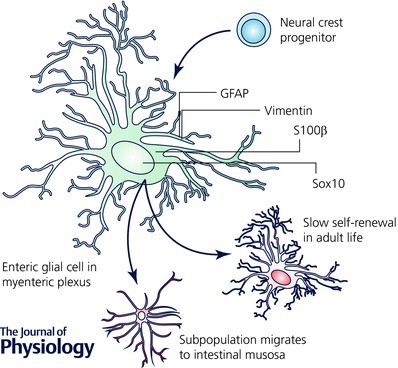 Fig. 1 Enteric glial cells derive from neural crest precursors and mature into neuroglia in the ENS. (Grubišić V, et al., 2017)
From a molecular perspective, mature EGCs can express molecular markers similar to astrocytes, such as intermediate filament glial fibrillary acidic protein (GFAP), S100β, SOX8, vimentin, and 43 hemichannel protein (connexin-43, Cx43), etc. However, there are differences between the two types of cells. Enteric glia lack expression of some key astrocytic proteins, such as aldehyde dehydrogenase 1 family member L1 (Aldh1L1), and express non-astrocyte molecules, such as Sox10, a more common transcription factor in oligodendrocytes.
Glial fibrillary acidic protein is a type III intermediate filamentous protein that exists in monomeric form. GFAP can be used as a classic marker of EGC and appears in the late embryonic stage of mice. Its expression is modulated by glial cell differentiation, inflammation, and injury. GFAP delays the differentiation of EGCs compared with the emergence of astrocytes during nervous system development. Notably, while GFAP is consistently present in the rodent ENS, this is completely different for the human gut. Only the injured human ENS showed large numbers of GFAP-positive glial cells.
S100B is a member of the S100 protein family, which consists of over 20 EF-hand Ca2+-Zn2+ binding proteins. In the human gut, S100B is specifically and physiologically expressed by EGCs, distinguishing it from other S100 proteins such as S100A8, S100A9, and S100A12, which are found in phagocytes and intestinal epithelial cells in patients with inflammatory bowel disease (IBD). Recent research has shown that abnormal expression and release of S100B are associated with gut inflammation.
As a leading provider of scientific solutions, Creative Diagnostics recognizes the importance of reliable and high-quality enteric glial cell markers. By offering a range of validated antibodies and assays targeting key markers such as GFAP and S100B, Creative Diagnostics empowers researchers to delve deeper into the intricate world of enteric glial cells.
References
Loading ......
