
Inquiry Basket
 Loading ......
Shigella is the causative agent of shigellosis, a severe acute gastrointestinal infection that frequently presents as bloody diarrhea, fever, and severe abdominal pain. The global epidemiology of Shigella is worsened by the emergence and spread of multi- and extensively drug resistant (MDR and XDR) variants, making infections increasingly difficult to treat. To date, there are no broadly available vaccines against shigellosis, but several candidates are being evaluated in preclinical and clinical studies, bringing to light very important data and information.
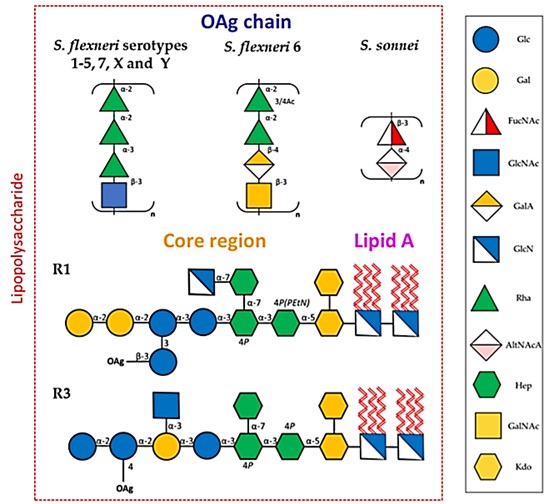
Fig.1 Structures of Shigella O-antigens and core regions.
(Raso MM.; et al. Int J Mol Sci. 2023)
Shigella are facultative anaerobic, non-motile, non-sporulating, rod-shaped, Gram-negative bacteria belonging to the family of Enterobacteriaceae. Shigellosis can be caused by any serotype belonging to four groups: group A (Shigella dysenteriae), group B (Shigella flexneri), group C (Shigella boydii), and group D (Shigella sonnei). These species are further distinguished into serotypes and subserotypes based on the specificity of the saccharide repeating units that form the O-Antigen (OAg) portion of lipopolysaccharides (LPSs). The species S. dysenteriae is known to comprise 14 serotypes, S. boydii comprises 19 serotypes, S. flexneri comprises 15 serotypes and sub-serotypes, and S. sonnei comprises only one serotype. S. dysenteriae serotype 1 (SD1), the first Shigella species isolated, emerges as one of particular concern, due to its expression of the Shiga toxin.
The bacterial effector proteins are encoded by a large 220 kb plasmid called virulence plasmid or invasion plasmid (pINV). The pINV is composed of a 30 kb pathogenicity island (PAI) that encodes the type III secretion system (T3SS) and other virulence factors involved in adhesion and actin-mediated motility.
Shigella has the distinction of being one of the first bacterial pathogens to be reported to be resistant to multiple antibiotics. Sulfonamides were the most effective drugs against the outbreaks of dysentery in postwar Japan. Unfortunately, the efficacy of these drugs lasted only a few years, and, by 1952, more than 80% of the Shigella isolates were resistant to sulfonamides. Isolates resistant to streptomycin, tetracycline, and chloramphenicol emerged in Japan soon after their introduction. While mutations to drug resistance are often accompanied by growth defects, these new mutants grew similarly to the drug-sensitive strains. At present, the WHO recommends ceftriaxone, azithromycin, and pivmecillinam for treatment of infection by fluoroquinolone-resistant Shigella spp. Unfortunately, ceftriaxone-resistant and azithromycin-resistant strains have already been isolated in some places.
The O-antigen of LPS as being the critical antigenic target for vaccine development. A vaccine consisting of Shigella flexneri 2a, 3a and 6, as well as Shigella sonnei O-antigens could provide direct coverage against 64% of global Shigella isolates. There is also a body of evidence implicating surface protein antigens common to multiple serotypes in protection against shigellosis. Most prominent among these are the Ipa proteins which form the needle and extracellular complexes of the Shigella type 3 secretion system (T3SS). T3SS forms a macromolecular needle-like structure across the membrane of the target eukaryotic cell and enables the bacteria to translocate at least a set of different effector proteins from their bactplasm directly into the eukaryotic host cells.
The earliest vaccines were based on the whole-cell formalin or heat killed approach, but these suffered from high levels of reactogenicity. The Walter Reed Army Institute for Research (WRAIR) developed formalin-inactivated S. sonnei (SsWc) and S. flexneri 2a (Sf2aWC) monovalent whole-cell vaccine candidates, which were well tolerated in a phase 1 trial, though immune responses were variable.
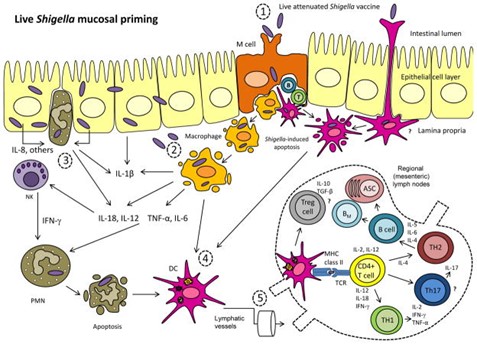
Fig. 2 Live Shigella mucosal priming.
(Barry EM.; et al. Nat Rev Gastroenterol Hepatol. 2013)
More recently, progresses in whole genome sequencing allowed the development of well-defined live attenuated vaccines with targeted genetic mutations, but balancing between acceptable levels of reactogenicity and sufficient immunogenicity remained a challenge. WRAIR have developed a series of live attenuated vaccine candidates containing a fundamental mutation in the virG (icsA) gene which is required for cell to cell spread of the bacteria. Additional mutations in some strains include genes encoding ShET1 and ShET2 as well as the msbB gene which is thought to detoxify lipid A of LPS and render the strain less reactogenic.
The Institute Pasteur has instead developed a well-defined synthetic glycoconjugate vaccine made of synthetically produced S. flexneri 2a oligosaccharides chemically linked to tetanus toxoid (TT) carrier protein, which was demonstrated to be safe and immunogenic in a phase 1 study even after a single dose. The traditional glycoconjugate approach has been used by Beijing Zhifei Lvzhu Biopharmaceuticals for the development of a bivalent vaccine, ZF0901, made of S. sonnei and S. flexneri 2a O-Ag conjugated to TT. After promising results in phase 1 and phase 2 trials, ZF0901 is currently being tested in a phase 3 study.
WRAIR has proposed an interesting alternative subunit vaccine, which combining Shigella LPS to Ipa proteins. The vaccine has gone through three iterations. The initial version of Invaplex (InvaplexNAT) consisted of IpaB, IpaC and IpaD and LPS extracted from wild-type S. flexneri 2a. The more defined version of Invaplex (InvaplexAR) was developed using recombinant IpaB and IpaC produced in E. coli and LPS. The new version (InvaplexAR-Detox) employs an LPS of low reactogenicity purified from S. flexneri 2a with deleted msbB genes. This form of LPS has good safety and immunogenicity results in a recent phase 1 study.
A novel protein vesicle technology, GMGA, composed of predicted Shigella outer membrane and periplasmic proteins without LPS was proposed by GSK. In preclinical mouse studies, immunization with GMMA provided 65–100% protection against lethal challenge.
In addition, with the development of genomics and proteomics, investigators have identified two conserved protein candidates: IcsP2 and SigA2. IcsP2 is an outer membrane protease which cleaves IcsA from the surface and present on all Shigella species and EIEC. SigA2 is a SPATE present on all S. flexneri 2a, S. boydii and S. sonnei.
References
| Cat. No | Product Name | Host | Applications | |
| DAGA-3027 | Native Shigella flexneri | - | LFIA | Inquiry |
| DAG-WT533 | Native Shigella boydii | - | LFIA | Inquiry |
| DAG-WT534 | Native Shigella dysenteriae | - | LFIA | Inquiry |
| DAG-WT535 | Native Shigella sonnei | - | LFIA | Inquiry |
Loading ......
