
Inquiry Basket
 Loading ......
The CRISPR/Cas9 system has revolutionized genome engineering by enabling precise, efficient, and programmable modification of DNA sequences in living cells. Derived from the adaptive immune system of prokaryotes, CRISPR/Cas9 is widely used in gene knockout, knock-in, base editing and epigenetic modulation. With such broad applications, robust tools for monitoring and validating CRISPR activity at the protein level have become increasingly important, especially for confirming expression, localization, and functional integrity of Cas9 and its variants.
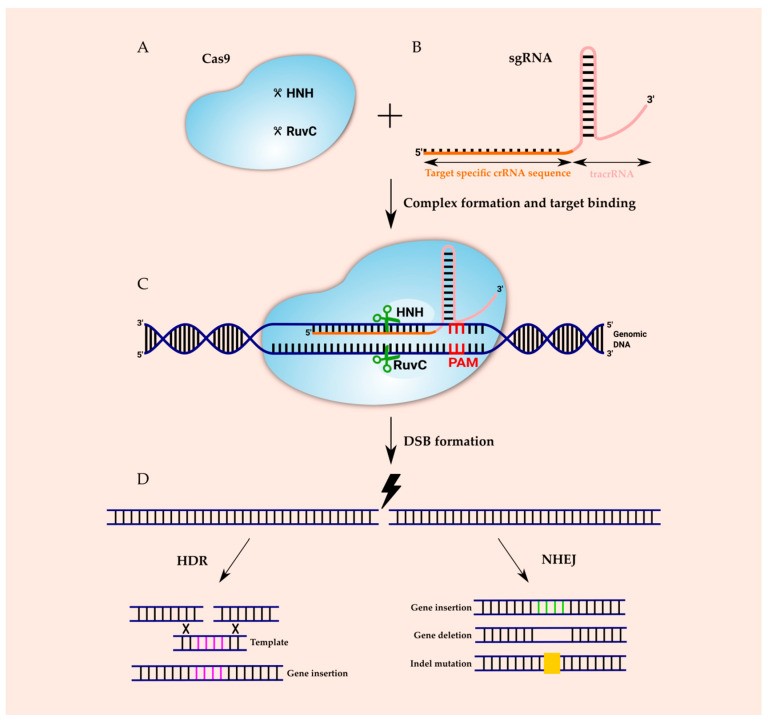 Fig. 1 Schematic diagram of the CRISPR–Cas 9 system molecular mechanism.
(Janik E.; et al. Int J Mol Sci. 2020)
CRISPR/Cas9 system employs a single-guide RNA (sgRNA) to direct the Cas9 endonuclease to a complementary DNA target. Upon binding, Cas9 introduces a double-strand break (DSB) at the specific locus, which is subsequently repaired by the cell's endogenous machinery through non-homologous end joining (NHEJ) or homology-directed repair (HDR). The system comprises two primary components:
Guide RNA (gRNA): Typically ~20 nucleotides in length, the gRNA directs Cas9 to the target genomic sequence through complementary base pairing.
Cas9 (CRISPR-associated protein 9): A 160 kDa endonuclease that functions as a molecular scissor, Cas9 introduces site-specific double-stranded breaks (DSBs) in DNA. Among the various Cas9 orthologs currently available, the most widely used are derived from Streptococcus pyogenes (SpCas9) and Staphylococcus aureus (SaCas9).
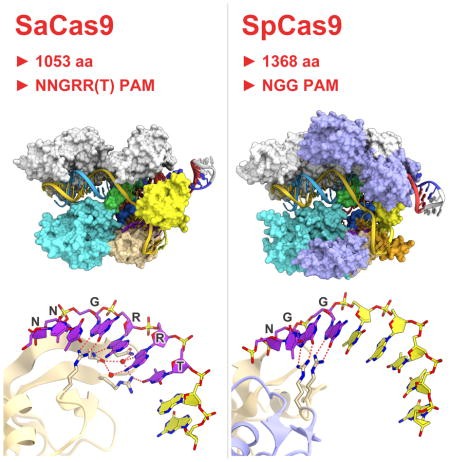 Fig. 2 Structure of the SaCas9 and SpCas9.
(Nishimasu H.; et al Cell. 2015)
Antibodies play a pivotal role in supporting CRISPR/Cas9 research via enabling the detection, tracking, and analysis of Cas9 proteins and their engineered derivatives across multiple stages of the gene editing workflow.
Detection of Cas9 protein expression: Antibodies specific to SpCas9 or SaCas9 are commonly used to assess expression levels by western blotting or flow cytometry.
Examining subcellular localization: Functional genome editing requires nuclear import of Cas9, and immunofluorescence assays using anti-Cas9 antibodies provide direct visualization of its intracellular distribution, particularly when fused with nuclear localization signals or other functional domains.
The validation of editing efficiency: Prolonged Cas9 expression is often correlated with increased off-target mutations. Antibody-based tracking helps define optimal time windows for transient expression.
Evaluating Cas9 binding specificity: When combined with ChIP and primers targeting both intended and non-target regions, ChIP-grade antibodies can help determine whether Cas9 is correctly localized to its target site guided by a specific sgRNA.
Creative Diagnostics now offers a specialized portfolio of high-quality antibodies for the detection and characterization of CRISPR/Cas9. Engineered to support advanced genome editing research, these antibodies are validated for key applications and provide reliable, high-performance tools for researchers working across genome engineering workflows.
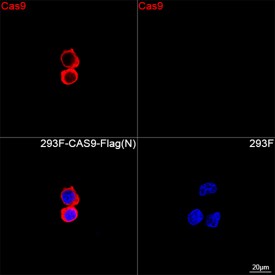 Fig. 3 Confocal imaging of 293T cells transfected with CAS9 cells using Cas9 Rabbit mAb (DMABC-JX135) at 1:200 dilution.
 Fig. 4 Western blot analysis of CRISPR-Cas9 SP on 293T transfected with Cas9 cell lysates with Rabbit anti-CRISPR-Cas9 SP mAb (CABT-L945) at 1:1000 dilution.
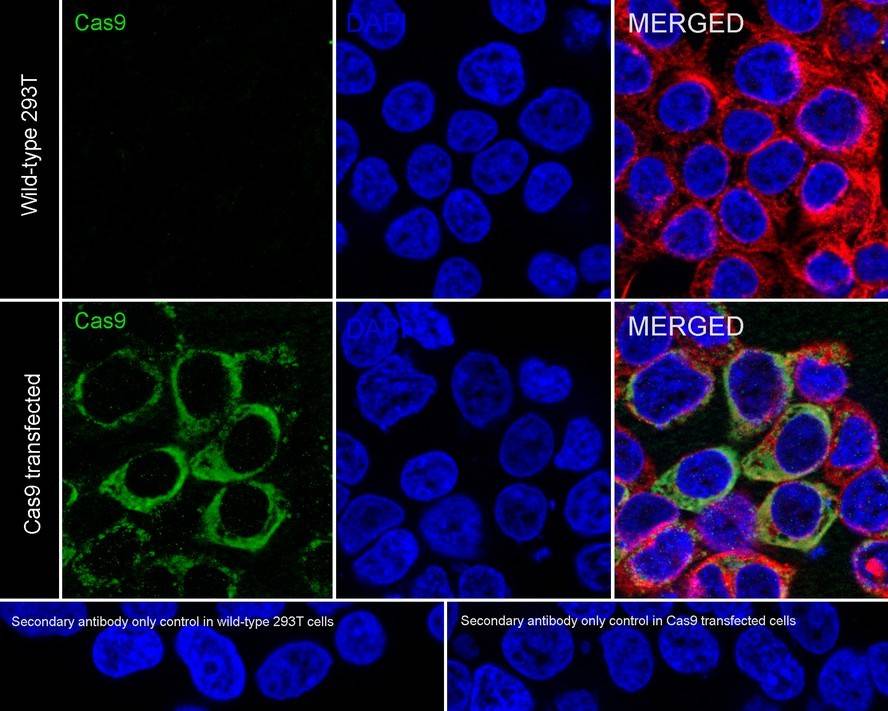 Fig. 5 Immunocytochemistry analysis of 293T cells transfected with or without px459 labeling CRISPR-Cas9 with Mouse anti-CRISPR-Cas9 mAb (DCAB-WB155) at 1:1000 dilution.
 Fig. 6 ChIP-qPCR using anti-Cas9 antibody (DPABC-JX108) on HEK293T cells expressing nuclease dead Cas9 and sgRNA targeting GAPDH intron 8 showed specific enrichment at the target site vs. MYOD1 control; IgG and antibody titration (1-10 µl) validated specificity.
References
| Anti-S. pyogenes CAS9 Antibodies | |||
| Cat. No. | Product Name | Application | |
| CABT-L945 | Rabbit Anti-S. pyogenes CAS9 monoclonal antibody, clone KN22-66 | WB, ICC/IF, IHC, FC | Inquiry |
| DMABC-JX135 | Rabbit Anti-S. pyogenes Cas9 monoclonal antibody, clone 83534 | WB, IF/ICC, ELISA | Inquiry |
| DCAB-WB151 | Mouse Anti-S. pyogenes Cas9 monoclonal antibody, clone 8B10-4B4 | WB, IHC | Inquiry |
| DMABC-JX136 | Mouse Anti-S. pyogenes Cas9 (N-Term) monoclonal antibody, clone 330 | ChIP, WB, IP, IF | Inquiry |
| DMABC-JX137 | Mouse Anti-S. pyogenes Cas9 (C-Term) monoclonal antibody, clone 342 | ChIP, WB, IF | Inquiry |
| DPABC-JX108 | Rabbit Anti-S. pyogenes Cas9 polyclonal antibody | ChIP, WB, IP, IF | Inquiry |
| DPAB-WB152 | Rabbit Anti-S. pyogenes Cas9 polyclonal antibody | WB, IP | Inquiry |
| Anti-S. aureus Cas9 Antibodies | |||
| Cat. No. | Product Name | Application | |
| DCAB-WB155 | Mouse Anti-S. aureus Cas9 monoclonal antibody, clone 9-B77 | WB, IF | Inquiry |
| DMABC-JX138 | Mouse Anti-S. aureus Cas9 (N-Term) monoclonal antibody, clone 341 | WB, IP, IF | Inquiry |
| DCAB-WB155 | Mouse Anti-S. aureus Cas9 monoclonal antibody, clone 9-B77 | WB, IF | Inquiry |
| DPABC-JX109 | Rabbit Anti-S. aureus Cas9 (C-Term) polyclonal antibody | WB, IP, IF | Inquiry |
| DPABC-JX110 | Rabbit Anti-S. aureus Cas9 (N-Term) polyclonal antibody | WB, IP, IF | Inquiry |
| DPABC-JX111 | Rabbit Anti-S. aureus Cas9 polyclonal antibody | WB, ELISA | Inquiry |
Loading ......
