
Inquiry Basket
 Loading ......
Cholera is an acute watery diarrhea disease caused by the bacterium Vibrio cholerae, which can lead to severe dehydration and death if left untreated. Depending on the severity, treatments include oral rehydration with saline, intravenous fluids, or antibiotics. Since 1817, there have been seven cholera pandemics, with the seventh beginning in 1961 and continuing to the present day. In 2015, the annual incidence of cholera was estimated to be between 1.3 and 4 million cases, resulting in between 21,000 and 143,000 deaths. However, cholera is actually a preventable and treatable disease, and in 2017, the Global Task Force for Cholera Control proposed an ambitious plan, by 2030 in 20 countries eliminate local cholera, cholera deaths decreased by 90%.
Vibrio cholerae lives in aquatic environments and is a curved, rod-shaped, motile gram-negative bacterium. The bacterium originates in the Ganges Delta and causes unpredictable cholera outbreaks that can occur in both cholera-endemic and non-endemic areas, depending largely on environmental conditions. Places with poor sanitation, such as open defecation, unhygienic food handling, and limited access to safe drinking water, are more prone to cholera outbreaks.
Vibrio cholerae can be classified into more than 200 serogroups based on the O-antigenic structure on the lipopolysaccharide, with a subset of strains from serogroups O1 and O139 producing cholera toxin (CTX), which can cause cholera and epidemics. Lack of CTX in non-O1 and O139 serogroups caused outbreaks of small gastroenteritis, disseminated bacteremia, and wound infections, but not cholera. More than 85% of non-O1 serogroups (including O139) have a capsule that is essential for virulence in extraintestinal infections.
In addition, based on the methylation status of perosamine at the end of the LPS, O1 strains were classified into three serotypes, Ogawa, Inaba, and Hikojima, where Ogawa was methylated, Inaba was unmethylated, and Hikojima expressed both methylated and unmethylated O antigens. Biotype is another key classification method for Vibrio cholerae O1 strains. The classical and El Tor biotypes can be distinguished on the basis of a set of phenotypic and genetic markers, with EI Tor strains being transmitted more efficiently from host to host, surviving better in the environment and human gut, and having a higher incidence of asymptomatic carriers than symptomatic carriers, as compared to the classical strains.
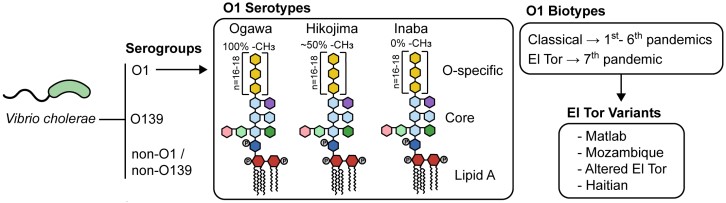 Figure 1. V. cholerae is classified into serogroups based on the composition of the O antigen of LPS
(Source: Montero DA, et al. 2023)
Cholera has become a major public health problem in resource-poor endemic areas, adding to the burden in those areas. Historically endemic on the Asian subcontinent, cholera is now endemic in Africa, Latin America and the Caribbean. Many countries do not report cholera cases or deaths because of weak or absent surveillance systems, and some countries are very cautious in publicizing cholera outbreaks to avoid economic losses to tourism and exports and to prevent generalized social panic, although early reporting of cholera outbreaks can shorten the duration of the outbreak. Cholera is usually seasonal in the delta region of Bangladesh, and in Africa, outbreaks occur in different regions during the rainy season. Haiti experienced a cholera outbreak between 2017 and 2018, with the WHO reporting 800,000 cholera cases and about 10,000 deaths from cholera since the outbreak. Mathematical modeling of cholera transmission suggests that outbreaks depend on changes in the environment and herd protection.
Vibrio cholerae is transmitted through fecal-oral transmission, directly from person to person by consuming food or water contaminated with the bacteria, or by drinking water from ponds, rivers, and other environmentally contaminated sources. Risk factors for cholera infection are poverty-related and include inadequate sanitation, contaminated drinking water and poor food hygiene. Hand washing with soap before and after meals reduces the risk of contracting cholera. O-blood group, retinol deficiency, hypochlorhydria, and concurrent infection of the intestines with other bacteria or parasites also increase the risk of contracting cholera. Malnutrition increases susceptibility, especially in young children. In cholera-endemic countries, the incidence of cholera is highest among children under 5 years of age because of their lower level of acquired immunity compared with adults. Secreted immunoglobulin A (SIgA) secreted in breast milk protects against severe cholera, so exclusive breastfeeding is recommended for the first six months of life for women living in cholera-endemic communities.
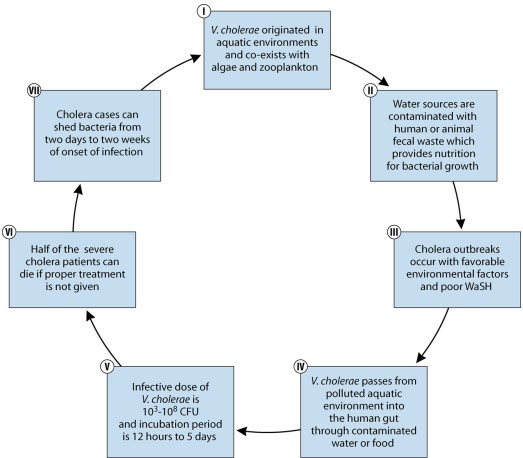 Figure 2. Life cycle of V. cholerae
(Source: Chowdhury F, et al. 2022)
Cholera infections can be classified as asymptomatic, mild, moderate or severe. Diarrhea occurs in cholera patients is usually painless and may contain bile or feces in the early stages of infection. "Rice-water stool" is a symptom unique to cholera patients; it looks like it contains uncooked rice or water that has been used to wash rice and has a fishy odor. Adult cholera patients may pass up to 1,000 milliliters of dilute, watery feces per hour, resulting in hypovolemia, shock, and death, known as severe cholera. The fecal excretion rate in children with severe cholera is usually between 10 and 20 ml/kg/hour. A large amount of watery diarrhea can cause symptoms of dehydration, including sunken eyes, dry mouth, rapid pulse, and cold skin. In addition, cholera-induced diarrhea loses large amounts of potassium, sodium, and bicarbonate. As a result of hyperventilation and acidosis, patients with severe cholera develop a characteristic deep and rapid breathing pattern. Symptomatic cholera patients excreted the bacteria in their feces for 2 days to 2 weeks from the start of the infection, whereas asymptomatic carriers excreted them for only a few days. In cholera-endemic settings, cholera cases are highly contagious within the first five days of infection and can spread the bacteria within a 200-meter radius of their homes. Household contacts have 100 times the risk of contracting cholera than contacts outside the radius.
A large number of watery stools and excessive vomiting can lead to severe dehydration, when a large amount of water is used up in the body, thus causing the patient to develop renal failure, shock, sepsis, and even death within a few hours if left untreated. Electrolyte imbalances are a common complication of cholera and include hyponatremia or hypernatremia, hypocalcemia, and hypokalemia. In patients with severe dehydration, inadequate hydration may lead to metabolic abnormalities. Reduced food intake during acute illness may lead to hypoglycemia, a fatal complication that is more common in children.
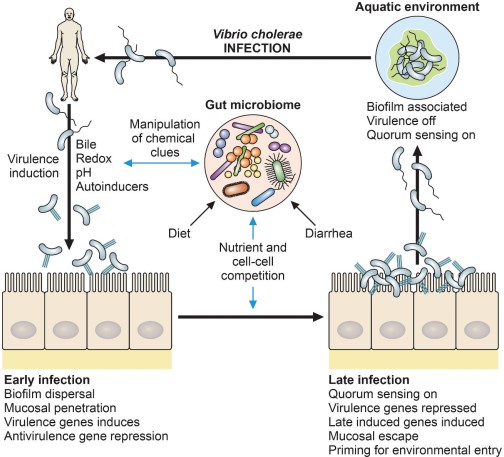 Figure 3. Interaction of the gut microbiome with environmental signaling during V. cholerae life cycle
(Source: Hsiao A, et al. 2020)
In cholera-endemic areas, the World Health Organization recommends that cholera vaccination be included in national cholera control plans. Early vaccination during an epidemic provides 79% protection against cholera, and even a single dose of cholera vaccine can significantly reduce the risk. There are four different types of cholera vaccines, (1) monovalent Vibrio cholerae whole-cell (WC) killed vaccines containing recombinant cholera toxin B subunit, (2) WC-modified bivalent Vibrio cholerae O1 and O139 killed vaccines without the B subunit, (3) attenuated oral cholera vaccine (OCV), and (4) parenteral cholera vaccine. Currently, there are only two OCVs available worldwide, the WC monovalent killed vaccine containing the recombinant cholera toxin B subunit and the WC (O1 and O139) killed and modified vaccine containing the B subunit.
The WC killed monovalent OCV, first produced in Sweden, licensed as early as the last century, and now available in more than 60 countries, is formulated with a mixture of recombinant cholera toxin B subunit and formalin or heat-killed WC Vibrio cholerae O1. The B unit of Vibrio cholerae toxin is compositionally and functionally similar to the heat-labile toxin (LT) of enterotoxigenic E. coli (ETEC) and induces a cross-protective effect against ETEC. The vaccine does not protect against Vibrio cholerae serogroup O139 or other types.
In the mid-1980s, Vietnamese scientists used technology transferred from Sweden to develop a modified inactivated WC vaccine (ORC-Vax) that included Vibrio cholerae O1 serogroups without CTB and included both Vibrio cholerae O1 and O139, which became known as a bivalent inactivated WC vaccine and was first licensed in 1997 in Vietnam. The vaccine was subsequently formulated and adjusted several times in accordance with World Health Organization standards, resulting in a modified vaccine with fewer adverse reactions and higher levels of antibody response.
OCV is effective in protecting individuals against cholera in endemic, epidemic, and outbreak settings, but the vaccine still faces a number of challenges. OCV provides limited protection in children under 5 years of age and is therefore not recommended for use in infants. In cholera epidemics, two to three boosters are required for long-lasting immunization protection, which also increases clinic visits and vaccination costs. In addition the thermal stability of vaccines is most important for mass vaccination campaigns in resource-limited environments and in unstable situations, where vaccine storage and cold chain maintenance often remain a challenge.
References
| Target | Cat. No. | Product Name | Expression System | Tag/Conjugate | Application | |
| Cholera Toxin | DAGB146 | V. cholerae Cholera Toxin (Azide free) | V. cholerae | N/A | HA | Inquiry |
| DAGZ012 | Cholera Toxin | V. cholerae | Unconjugated | N/A | Inquiry | |
| Cholera Toxin B Subunit | DAGB148 | V. cholerae Cholera Toxin B [FITC] | V. cholerae | FITC | ID, HA | Inquiry |
| DAGB149 | V. cholerae Cholera Toxin B [HRP] | V. cholerae | HRP | ELISA | Inquiry | |
| DAGB151 | V. cholerae Cholera Toxin B [Biotin] | V. cholerae | Biotin | ELISA | Inquiry | |
| DAG-WT235 | Recombinant V. cholerae Toxin B (aa 22-124) | E.coli | Unconjugated | N/A | Inquiry | |
| DAGC750 | Recombinant Cholera Toxin B subunit | E. coli | Unconjugated | N/A | Inquiry | |
| DAGC751 | Recombinant Cholera Toxin B subunit [FITC] | E. coli | FITC | N/A | Inquiry | |
| DAGC139 | Native Cholera Toxin B subunit | V. cholerae | Unconjugated | ELISA | Inquiry | |
| DAGC137 | Recombinant Cholera Toxin B subunit [His] | HEK293 cells | His | ELISA | Inquiry |
Loading ......
