
Inquiry Basket
 Loading ......
Apple stem pitting virus (ASPV) is one of the most widespread and economically important latent viruses affecting pome fruits, particularly apple (Malus domestica) and pear. First described in the mid-20th century, ASPV is a member of the family, and is known for its ability to cause chronic infections that often go unnoticed until trees are grafted or subjected to environmental stress. While many infected trees remain asymptomatic, the virus can induce severe stem pitting, graft union necrosis, reduced vigor, and significant yield losses—especially when present in mixed infections with other latent viruses such as Apple chlorotic leaf spot virus (ACLSV) or Apple stem grooving virus (ASGV). Due to its global distribution and the increasing reliance on certified virus-free planting material, ASPV has become a primary target for certification programs and molecular diagnostics. Understanding its molecular biology, pathological pathways, and detection strategies is essential for sustainable orchard management.
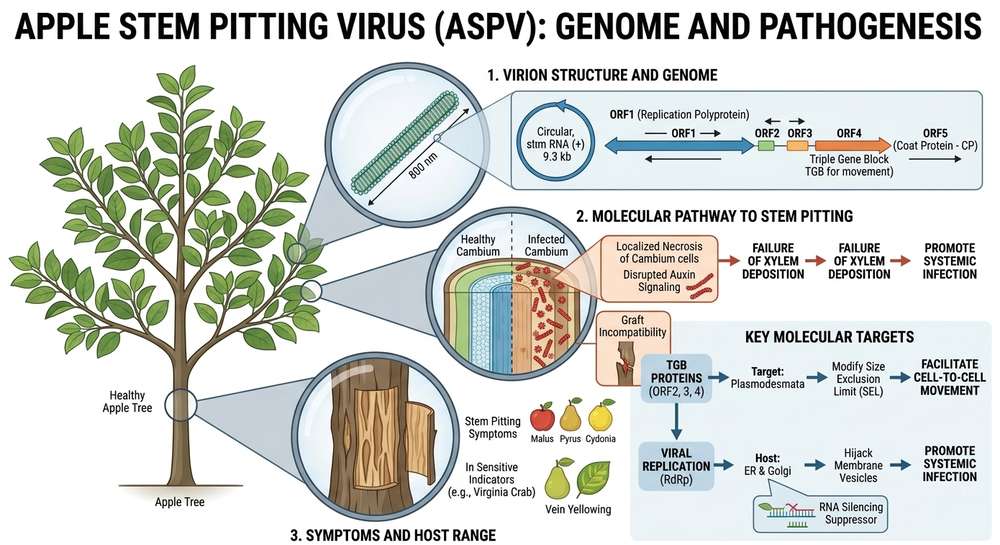 Figure 1. Apple Stem Acne Virus (ASPV): Genome and Pathogenesis.
ASPV is a non-enveloped, filamentous virus with a flexuous particle morphology, typically measuring 700–800 nm in length and 12–15 nm in diameter. Its genome consists of a single-stranded, positive-sense RNA of approximately 9.3–9.4 kb, organized into three major open reading frames (ORFs) that are expressed via subgenomic RNAs. The virus is classified within the genus Trichovirus, family Betaflexiviridae, which includes several other economically important fruit tree viruses. The genome organization is highly conserved among isolates, although significant sequence variability exists, particularly in the coat protein (CP) and movement protein regions. This genetic diversity poses challenges for reliable detection and has led to the classification of multiple strains and variants based on host range and symptomatology.
ASPV is distributed worldwide in all major apple- and pear-growing regions. Its primary means of dissemination is through vegetative propagation—grafting, budding, and the use of infected scion wood or rootstock. The virus is not known to be transmitted by any insect vector, and seed transmission is considered negligible. Consequently, the spread of ASPV is almost exclusively anthropogenic, driven by the global movement of infected plant material. Once introduced into an orchard, ASPV can persist for the life of the tree, with no natural eradication mechanism. Mixed infections with other latent viruses (ACLSV, ASGV) are extremely common and often result in more severe disease complexes known as apple topworking disease or apple decline.
Symptoms induced by ASPV vary greatly depending on the host genotype, virus strain, and presence of co-infecting viruses. In susceptible apple cultivars, characteristic symptoms include:
On pear, ASPV infection can cause similar pitting disorders, often referred to as "pear stem pitting" or "pear decline" in combination with other viruses.
Accurate and early detection of ASPV is critical for certification and disease management. Serological methods (ELISA) have been used historically but are limited by low virus titer and strain-specific antibody cross-reactivity. Currently, molecular techniques dominate:
Management relies almost exclusively on prophylactic measures: propagation from certified virus-free mother plants, strict sanitation during grafting, and the use of thermotherapy or meristem tip culture to generate clean planting material. No chemical control or resistant cultivars are commercially available for ASPV.
The replication, movement, and pathogenicity of ASPV are governed by a limited number of viral proteins that represent promising targets for diagnostics, resistance breeding, and potential antiviral strategies.
| Key Molecular Targets | Details |
| Triple Gene Block (TGB) Proteins – TGBp1, TGBp2, TGBp3 | ASPV, like other trichoviruses, encodes a triple gene block (TGB) movement module essential for cell-to-cell and systemic movement. TGBp1 possesses ATPase and RNA-binding activities, functions as a viral movement protein, and may suppress RNA silencing—a key host antiviral defense. TGBp2 and TGBp3 are membrane-associated proteins that facilitate the transport of viral ribonucleoprotein complexes through plasmodesmata. The TGB module is a potential target for resistance strategies aimed at blocking viral spread. |
| Coat Protein (CP) | The CP is the most abundant viral protein and is involved in virion assembly, stability, and vector-independent movement. It also participates in host-virus interactions that influence symptom expression. The CP gene is the primary target for serological detection and RT-PCR assays due to its relatively conserved regions. Genetic variation in CP often correlates with strain differentiation and may affect the efficiency of detection protocols. |
Apple stem pitting virus exemplifies the complex interplay between latent viral infections and perennial crop health. While often overlooked due to its asymptomatic nature in many cultivars, ASPV contributes significantly to graft failure, reduced orchard longevity, and economic losses in pome fruit production. A thorough understanding of its virology, molecular targets (CP, TGB proteins, RdRp), and pathological pathways is essential for improving detection, certification, and long-term management strategies. As the global demand for high-quality, virus-free planting material continues to rise, ASPV will remain a key focus for plant virologists, pathologists, and the fruit industry alike.
| Target | Cat. No. | Product Name | Host | |
| ASPV | DAGA-4045 | Recombinant Apple stem pitting virus ORF2, E.coli | E. coli | Inquiry |
| ASPV | DAGA-4046 | Recombinant Apple stem pitting virus ORF2, Mammalian cell | Mammalian cells | Inquiry |
| ASPV | DAGA-4047 | Recombinant Apple stem pitting virus ORF2, Baculovirus | Baculovirus | Inquiry |
Loading ......
