
Inquiry Basket
 Loading ......
Compared to monoclonal antibody (mAb) drugs, antibody-drug conjugates (ADCs) exhibit greater complexity. In addition to all the processes involved in mAb production, the manufacturing of ADCs also includes antibody conjugation and chemical modification steps. As a result, quality characterization of ADCs requires not only analysis of the antibody itself, but also additional dimensions of evaluation—such as drug-to-antibody ratio (DAR) determination, conjugation site analysis, and more.
A typical ADC manufacturing process includes monoclonal antibody production and buffer exchange, antibody reduction, conjugation of the linker-drug moiety to the antibody, purification, and final buffer exchange.
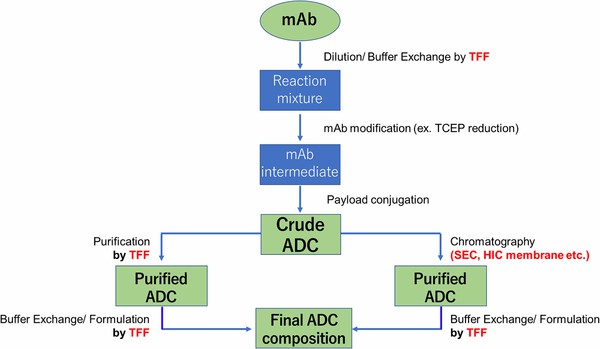 Fig. 1 ADC drug production process
Each step in the production process has a critical impact on the quality of the final product. Therefore, process development and validation for these steps are essential. The drug-to-antibody ratio (DAR) serves as a key indicator for evaluating the effectiveness and consistency of these process parameters.
The drug-to-antibody ratio (DAR) is a critical quality attribute (CQA) in the development and manufacturing of antibody-drug conjugates (ADCs). Several analytical techniques are currently available for DAR determination, including UV/Vis spectrophotometry, hydrophobic interaction chromatography (HIC-HPLC), reverse-phase chromatography (RP-HPLC), and liquid chromatography–mass spectrometry (LC-MS). The choice of method should be based on the specific type of ADC and its development or production stage, in order to ensure product quality and maximize development efficiency.
1. Lysine
For ADCs utilizing conjugation based on natural amino acids, lysine is a typical conjugation site. For example, Kadcyla is an ADC in which the cytotoxic payload DM1 is linked to lysine residues on the trastuzumab molecule via the SMCC linker. DM1 molecules are randomly conjugated to at least 20 lysine residues within the light and heavy chains of the antibody sequence, resulting in a heterogeneous mixture with an average DAR (drug-to-antibody ratio) of approximately 4. In general, the number of drug molecules per antibody in the sample ranges from 0 to 8.
 Fig. 2 The conjugation process of Kadcyla
2. Cysteine
A typical IgG1 monoclonal antibody contains 32 cysteine residues, which form 4 interchain disulfide bonds and 12 intrachain disulfide bonds. For cysteine-based ADCs, the production process involves selectively reducing some or all of the 4 interchain disulfide bonds. The resulting free thiol groups on the cysteines are then conjugated to payloads such as MMAE or DXd via a suitable linker. This process results in a drug-to-antibody ratio (DAR) distribution typically consisting of species with 0, 2, 4, 6, or 8 drug molecules per antibody.
3. Site-Specific Glycan Conjugation
Native IgG1 antibodies contain a conserved N-glycosylation site on each of the two heavy chains in the Fc region. Glycan site-specific conjugation involves enzymatically removing the N-glycans at these sites using endoglycosidase, followed by the addition of a linker using glycosyltransferase. The linker typically contains an azide group, which can then react with a cyclooctyne-modified payload via click chemistry to form a stable ADC.
Creative Diagnostics offers customized services to support your ADC development at all stages. During the initial proof-of-concept (PoC) phase, we can help evaluate various payloads, linkers, and conjugation strategies to design an ADC tailored to your specific needs. Whether you have a proprietary antibody, target, or payload, we can work with you to develop the right ADC solution. With experience across a wide range of targeting molecules, linkers, and toxins, we're well-equipped to address complex challenges and deliver high-quality, effective solutions to our clients.
| Service Name | Service Content | Criteria and Deliverables | Time Cycle |
| ADC Sample Preparation | The naked antibody will be conjugated using the selected linker-payload (LP) under at least three different sets of conditions to develop and optimize conjugation strategies. The optimized conditions will then be used to generate ADC samples with varying quantities for candidate selection, controls, and in vitro as well as preliminary in vivo efficacy evaluation.
| 1. Micro-scale Preparation: 1.1 ADC Samples: Meet specified criteria for DAR value and monomer percentage (by SEC). 1.2 Report: Includes conjugation method development and quality control (QC) data. 2. Small-/Medium-/Large-scale Preparation: 2.1 ADC Samples: Meet specified criteria for DAR value, monomer percentage (by SEC), and residual small molecules. 2.2 Report: Includes conjugation method development report and quality control results. | 2-6 weeks (Excluding the time for the anti- body and small molecules raw materials preparation) |
| Note: ADC Delivery Specifications: Purity by SEC-HPLC: >95%; DAR value by iCIEF: MMAE: 4 ± 0.3, Dxd: 8 ± 0.3, SN-38: 8 ± 0.3, Tesirine: 2 ± 0.3, DM1: 4 ± 0.3 (Values may be adjusted based on specific project requirements); Endotoxin level (LAL): < 1 EU/mg, Free drug content: < 0.1%; Binding affinity (by ELISA): Comparable to parental antibody. | |||
| Name | Target | Conjugation method | Stands for ADC/DAR Value | Specification |
| mc-vc-PAB-MMAE | Tubulin | Thiol coupling | Adcetris/4 | 10 mg |
| MC-GGFG-Dxd | Topoisomerase | Thiol coupling | Enhertu/8 | 10 mg |
| CL2A-SN-38 | Topoisomerase | Thiol coupling | Trodelvy/4 | 10 mg |
| Tesirine | DNA | Thiol/site-directed coupling | Zynlonta/2 | 1 mg |
| Ve-seco-DUBA | DNA | Thiol/site-directed coupling | MGC018/2 | 1 mg |
| SMCC-DMI | Tubulin | Amino coupling | Kadcyla/4 | 10 mg |
| Other optional LP | Other | Amino, Thiol, site-specific conjugation | NA | NA |
Loading ......
