• Home
  • Products
    • Functional Slides
      • Aldehyde
      • Alkene
      • Amine
      • Azide
      • Carboxyl
      • Epoxy
      • Maleimide
      • NHS
      • PDITC
      • Poly-L-lysine
      • Streptavidin
      • Thiol
    • Microfluidic Chips
      • Basic Flow Chips
      • Cell and Organism Culture Chips
      • Droplet Generator Chips
      • Droplet Sequencing Chips
      • Electrophoresis Microfluidic Chips
      • Gradient Chips
      • LNP & Nanoparticle Preparation Chips
      • Particle and Cell Sorting Chips
      • Permeation Array Chips
      • Porous Media Model Chips
      • Sample Preparation Chips
      • Vascular Simulation Chips
  • Services
    • Custom Protein Arrays
      • Custom Array Design
      • Functional Protein Arrays
      • Large-Scale Screening
      • Specific Protein Detection
    • Drug Screening and Toxicity Assessment
      • Cytokine Release Assay
      • Dose-Response Toxicity Evaluation
      • High-Throughput Drug Screening
      • Off-Target Effects Analysis
    • Immunoprofiling
      • Cytokine Profiling
      • Immune Checkpoint Molecule Detection
      • Immune Escape Mechanism Analysis
      • T-Cell and B-Cell Profiling
    • Oncology Drug Screening
      • Biomarker Discovery
      • Cell Signaling Pathway Mapping
      • Drug Resistance Mechanism Analysis
      • Target Identification
    • Signaling Pathway Analysis
      • Cross-Talk Between Pathways
      • Glycosylation Status Detection
      • Kinase Activity Assay
      • Pathway Activation/Inhibition Profiling
      • Phosphorylation Status Detection
    • Spatial Multi-Omics and Targeted Proteomics
      • Reverse Phase Protein Array (RPPA)
      • Digital Spatial Profiler (DSP)
      • Spatial Proteomics
    • Vaccine Development
      • Adjuvant Efficacy
      • Antigen Discovery
      • Antigen Mutation Analysis
      • Immunogenicity Assessment
      • Post-Vaccination Immune Response
    • Antibody Profiling
      • Antibody Subclass Profiling
      • Autoantibody Detection
      • Monoclonal and Polyclonal Antibody Analysis
      • Therapeutic Antibody Monitoring
    • Protein-Protein Interaction Studies
      • Co-Factor and Complex Formation Analysis
      • Interaction Network Mapping
      • Mutant vs Wild-Type Interaction Comparison
      • Protein Binding Assays
    • Allergen Screening
      • Common Allergen Detection
      • Cross-Reactivity Assessment
      • IgE Antibody Profiling
    • Protein-Nucleic Acid Interaction Analysis
      • Autoantibody-Nucleic Acid Complex Analysis
      • Chromatin Remodeling Complex Interactions
      • CRISPR-Cas System Recognition
      • Epigenetics (DNA Methylation)
      • Gene Splicing Factor - Pre-mRNA Interactions
      • Nucleic Acid Aptamer Screening
      • Pathogen-Associated Molecular Pattern (PAMP) Recognition
      • RNA-Binding Protein Regulation
      • Small Molecule Interference with Protein-Nucleic Acid Interactions
      • Structure-Dependent Interactions
      • Transcriptional Regulation
      • Viral Protein-Host Nucleic Acid Interactions
  • Resource
    • Biomolecular Interactions
    • Cellular Signaling
    • Drug Discovery
    • Immunology & Diagnostics
  • Technology
    • Protein Biochip Technology Platform (Multi Marker)
      • Silica-Based Membrane as Protein Chip
      • Near-Infrared Fluorescent Labeled Chip
      • Laser Confocal Chip Scanner
  • About Us
  • Contact Us
Get A Free Quote
  1. Home
  2. Services
  3. Vaccine Development
  4. Immunogenicity Assessment

Immunogenicity Assessment

What is Immunogenicity Assessment?

Immunogenicity refers to the ability of an antigen to induce an immune response, directly impacting the safety, efficacy, and protective immunity of a vaccine.

The primary goal of immunogenicity assessment is to ensure that a vaccine can activate a specific immune response, helping individuals establish immune memory against pathogens without triggering adverse reactions or hypersensitivity. This critical step in vaccine development allows researchers to evaluate antigen responses, as well as the strength, type, and role of antibodies, T cells, and other immune responses in immune defense.

We can say, effective immunogenicity assessment is an essential foundation for vaccine development and regulatory approval.
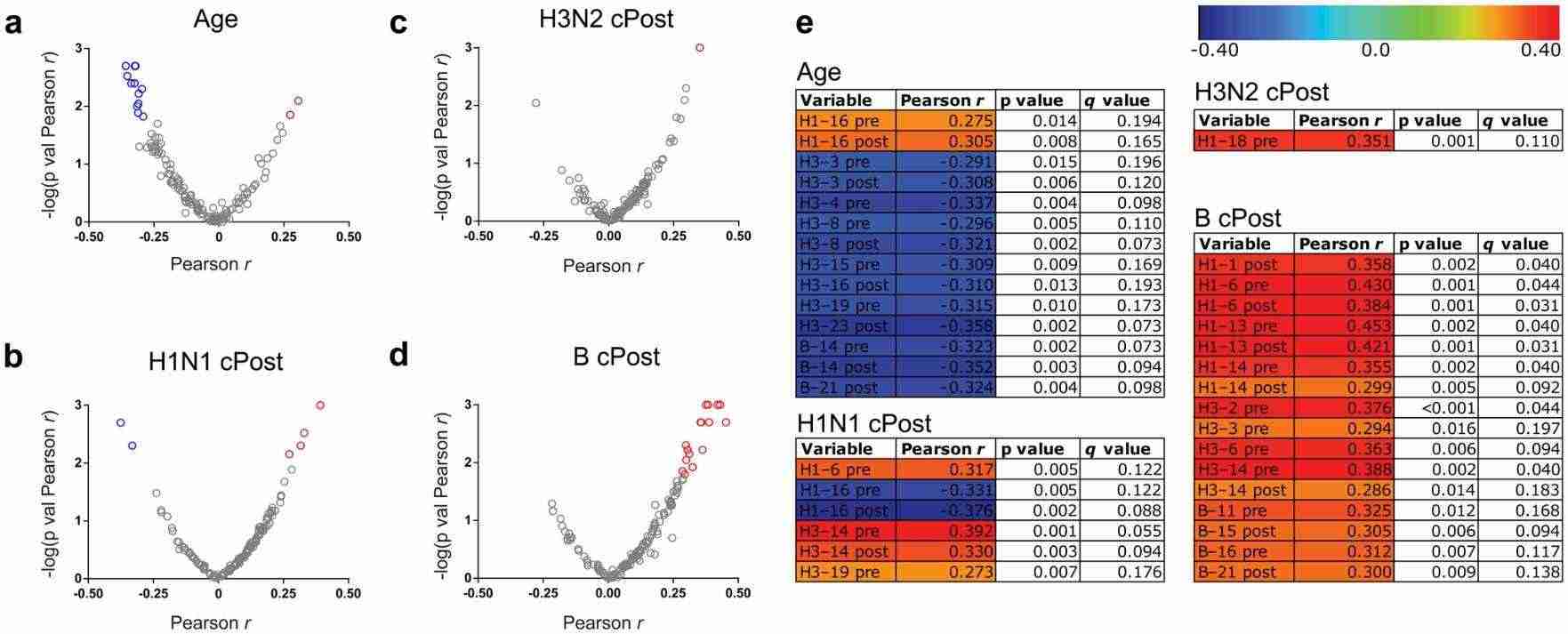
Figure 1. Influenza HA peptide array antibody reactivity correlates with age/post-vaccine neutralization titer. (Source: Price JV, et al. 2013)Figure 1. Influenza HA peptide array antibody reactivity correlates with age/post-vaccine neutralization titer. (Source: Price JV, et al. 2013)

Complete Every Stage of Immunogenicity Assessment with Our Protein Biochip Technology

At Creative Diagnostics, our advanced Protein Biochip platform offers efficient and precise solutions for immunogenicity assessment, covering all steps from antigen screening to dynamic immune response monitoring. Here's how our platform can support your research:

High-Throughput Screening and Immune Response Monitoring

With our platform, you can evaluate multiple immunogenicity indicators simultaneously in a single experiment, including antibody production, T cell responses, and cytokine secretion. This significantly boosts screening efficiency and shortens experimental timelines.

Accurate Quantitative Analysis of Immunogenicity

By integrating laser confocal imaging and near-infrared fluorescence labeling technologies, our Protein Biochip platform achieves precise detection of antibody affinity, subtype distribution, and neutralizing capacity. Its sensitivity at the picomolar level ensures accurate identification of low-abundance molecules.

Dynamic Tracking of Immune Responses

Beyond static immune detection, our platform supports real-time monitoring of dynamic immune responses. This allows you to capture critical molecular changes during immune reactions, providing insights into potential risks related to immune escape and tolerance.

Comprehensive Data Support for Immunogenicity Assessment

Our platform includes built-in intelligent data analysis tools to help you process high-dimensional data quickly. Generate intuitive analysis reports to streamline decision-making in vaccine development.

Array Example

PanelExample CombinationTarget ApplicationPossible Sample Preparation
Panel A
(Antibody Detection)
- Protein drug (wild-type + mutants)
- Vaccine antigen + common contaminants
- Detection of IgG subclasses (IgG1, IgG2), IgM, IgA, IgE
- Anti-drug antibody detection (ADA)
- Vaccine immunogenicity profiling
- Evaluate isotype distribution (possible allergic response via IgE)
- In vitro: Cell culture supernatants (B cell or hybridoma cultures)
- In vivo: Serum/plasma from immunized or treated animals/patients at multiple timepoints (day 7, 14, etc.)
Panel B
(Cytokine Release)
- Th1: IFN-γ, IL-2
- Th2: IL-4, IL-5, IL-13
- Pro-inflammatory: IL-1β, IL-6, TNF-α
- Regulatory: IL-10, TGF-β
- T-cell immunogenicity (skewing toward Th1, Th2, Th17, or Treg)
- Detect potential cytokine storm or excessive inflammation
- In vitro: Culture supernatants from PBMCs, T cells, DC co-cultures stimulated with the protein
- In vivo: Serum or ex vivo restimulation of splenocytes/lymph node cells
Panel C
(Epitope Mapping & Cross-Reactivity)
- Peptide arrays: Overlapping 15–20mer peptides covering the therapeutic/vaccine protein
- Self-antigens or proteins from closely related organisms (for cross-reactivity)
- Fine-map immunogenic epitopes
- Determine cross-reactivity with host or related pathogens
- Guide rational re-engineering of therapeutics to reduce immunogenicity
- In vitro: T-cell assays (proliferation/cytokine release) with each peptide variant
- In vivo: Serum tested for antibody binding to each peptide or cross-antigen; also ex vivo T-cell restimulation

Why Creative Diagnostics' Protein Biochip Stands Out?

  • Cutting-Edge Technology Platform
    Combines laser confocal imaging and near-infrared fluorescence labeling to detect immune molecules even at extremely low abundance levels.
  • Efficient Multi-Indicator Detection
    Suitable for multi-pathway analysis of complex immune responses.
  • Flexible Customization Services
    Tailored solutions for specific molecule detection, immune pathway analysis, and optimization of experimental conditions to meet your unique vaccine R&D needs.
  • International Standards and High Reproducibility
    All data comply with international standards and exhibit excellent reproducibility.
  • Resource-Saving with Low Sample Requirements
    Our Protein Biochip requires minimal sample volumes, conserving valuable resources—especially beneficial for early clinical research or rare sample immunogenicity assessments.

Accelerate Your Vaccine Development with Creative Diagnostics

Leverage the precision and efficiency of our Protein Biochip technology for immunogenicity assessment. Gain accurate, high-quality experimental data to accelerate vaccine development, improve research efficiency, and ensure the clinical safety and effectiveness of your vaccines.

Ready to get started? Have questions?

Contact us today and let's discuss how we can support your research goals!

Reference

  1. Price JV, Jarrell JA, Furman D, Kattah NH, Newell E, Davis MM. Characterization of influenza vaccine immunogenicity using influenza antigen microarrays. PLoS One. 2013;8(5):e64555.
Online Inquiry
✔ ✖ Verification code
Services
  • Custom Protein Arrays
    • Custom Array Design
    • Functional Protein Arrays
    • Large-Scale Screening
    • Specific Protein Detection
  • Drug Screening and Toxicity Assessment
    • Cytokine Release Assay
    • Dose-Response Toxicity Evaluation
    • High-Throughput Drug Screening
    • Off-Target Effects Analysis
  • Immunoprofiling
    • Cytokine Profiling
    • Immune Checkpoint Molecule Detection
    • Immune Escape Mechanism Analysis
    • T-Cell and B-Cell Profiling
  • Oncology Drug Screening
    • Biomarker Discovery
    • Cell Signaling Pathway Mapping
    • Drug Resistance Mechanism Analysis
    • Target Identification
  • Signaling Pathway Analysis
    • Cross-Talk Between Pathways
    • Glycosylation Status Detection
    • Kinase Activity Assay
    • Pathway Activation/Inhibition Profiling
    • Phosphorylation Status Detection
  • Spatial Multi-Omics and Targeted Proteomics
    • Reverse Phase Protein Array (RPPA)
    • Digital Spatial Profiler (DSP)
    • Spatial Proteomics
  • Vaccine Development
    • Adjuvant Efficacy
    • Antigen Discovery
    • Antigen Mutation Analysis
    • Immunogenicity Assessment
    • Post-Vaccination Immune Response
  • Antibody Profiling
    • Antibody Subclass Profiling
    • Autoantibody Detection
    • Monoclonal and Polyclonal Antibody Analysis
    • Therapeutic Antibody Monitoring
  • Protein-Protein Interaction Studies
    • Co-Factor and Complex Formation Analysis
    • Interaction Network Mapping
    • Mutant vs Wild-Type Interaction Comparison
    • Protein Binding Assays
  • Allergen Screening
    • Common Allergen Detection
    • Cross-Reactivity Assessment
    • IgE Antibody Profiling
  • Protein-Nucleic Acid Interaction Analysis
    • Autoantibody-Nucleic Acid Complex Analysis
    • Chromatin Remodeling Complex Interactions
    • CRISPR-Cas System Recognition
    • Epigenetics (DNA Methylation)
    • Gene Splicing Factor - Pre-mRNA Interactions
    • Nucleic Acid Aptamer Screening
    • Pathogen-Associated Molecular Pattern (PAMP) Recognition
    • RNA-Binding Protein Regulation
    • Small Molecule Interference with Protein-Nucleic Acid Interactions
    • Structure-Dependent Interactions
    • Transcriptional Regulation
    • Viral Protein-Host Nucleic Acid Interactions
Services
Immunoprofiling Signaling Pathway Analysis Vaccine Development Antibody Profiling Custom Protein Arrays Oncology Drug Screening Protein-Protein Interaction Studies Allergen Screening Drug Screening and Toxicity Assessment Spatial Multi-Omics and Targeted Proteomics
Technology
  • Protein Biochip Technology Platform (Multi Marker)
Contact Us
  • Tel: (USA)
  • (Europe)
  • Fax:
  • Email:
Privacy Policy | Cookie Policy | © Copyright Creative Diagnostics 2026. All Rights Reserved.
Follow Us On