• Home
  • Products
    • Functional Slides
      • Aldehyde
      • Alkene
      • Amine
      • Azide
      • Carboxyl
      • Epoxy
      • Maleimide
      • NHS
      • PDITC
      • Poly-L-lysine
      • Streptavidin
      • Thiol
    • Microfluidic Chips
      • Basic Flow Chips
      • Cell and Organism Culture Chips
      • Droplet Generator Chips
      • Droplet Sequencing Chips
      • Electrophoresis Microfluidic Chips
      • Gradient Chips
      • LNP & Nanoparticle Preparation Chips
      • Particle and Cell Sorting Chips
      • Permeation Array Chips
      • Porous Media Model Chips
      • Sample Preparation Chips
      • Vascular Simulation Chips
  • Services
    • Custom Protein Arrays
      • Custom Array Design
      • Functional Protein Arrays
      • Large-Scale Screening
      • Specific Protein Detection
    • Drug Screening and Toxicity Assessment
      • Cytokine Release Assay
      • Dose-Response Toxicity Evaluation
      • High-Throughput Drug Screening
      • Off-Target Effects Analysis
    • Immunoprofiling
      • Cytokine Profiling
      • Immune Checkpoint Molecule Detection
      • Immune Escape Mechanism Analysis
      • T-Cell and B-Cell Profiling
    • Oncology Drug Screening
      • Biomarker Discovery
      • Cell Signaling Pathway Mapping
      • Drug Resistance Mechanism Analysis
      • Target Identification
    • Signaling Pathway Analysis
      • Cross-Talk Between Pathways
      • Glycosylation Status Detection
      • Kinase Activity Assay
      • Pathway Activation/Inhibition Profiling
      • Phosphorylation Status Detection
    • Spatial Multi-Omics and Targeted Proteomics
      • Reverse Phase Protein Array (RPPA)
      • Digital Spatial Profiler (DSP)
      • Spatial Proteomics
    • Vaccine Development
      • Adjuvant Efficacy
      • Antigen Discovery
      • Antigen Mutation Analysis
      • Immunogenicity Assessment
      • Post-Vaccination Immune Response
    • Antibody Profiling
      • Antibody Subclass Profiling
      • Autoantibody Detection
      • Monoclonal and Polyclonal Antibody Analysis
      • Therapeutic Antibody Monitoring
    • Protein-Protein Interaction Studies
      • Co-Factor and Complex Formation Analysis
      • Interaction Network Mapping
      • Mutant vs Wild-Type Interaction Comparison
      • Protein Binding Assays
    • Allergen Screening
      • Common Allergen Detection
      • Cross-Reactivity Assessment
      • IgE Antibody Profiling
    • Protein-Nucleic Acid Interaction Analysis
      • Autoantibody-Nucleic Acid Complex Analysis
      • Chromatin Remodeling Complex Interactions
      • CRISPR-Cas System Recognition
      • Epigenetics (DNA Methylation)
      • Gene Splicing Factor - Pre-mRNA Interactions
      • Nucleic Acid Aptamer Screening
      • Pathogen-Associated Molecular Pattern (PAMP) Recognition
      • RNA-Binding Protein Regulation
      • Small Molecule Interference with Protein-Nucleic Acid Interactions
      • Structure-Dependent Interactions
      • Transcriptional Regulation
      • Viral Protein-Host Nucleic Acid Interactions
  • Resource
    • Biomolecular Interactions
    • Cellular Signaling
    • Drug Discovery
    • Immunology & Diagnostics
  • Technology
    • Protein Biochip Technology Platform (Multi Marker)
      • Silica-Based Membrane as Protein Chip
      • Near-Infrared Fluorescent Labeled Chip
      • Laser Confocal Chip Scanner
  • About Us
  • Contact Us
Get A Free Quote
  1. Home
  2. Services
  3. Protein-Nucleic Acid Interaction Analysis
  4. Viral Protein-Host Nucleic Acid Interactions

Viral Protein-Host Nucleic Acid Interactions

Viral Protein-Host Nucleic Acid Interactions Research Directions

The study of viral protein-host nucleic acid interactions focus on how viral proteins bind, recognize, and regulate host DNA or RNA within cells. Key research areas include:

  • Viral Replication and Genome Stability: Research viral proteins' attachment mechanisms to host nucleic acids which facilitate replication and evade immune detection.
  • Viral Modulation of Host Gene Expression: Explore the changes viral interactions induce in host cell gene expression patterns and analyze the subsequent impact on immune response activities and the cellular controls over apoptosis and cell cycle regulation.
  • Viral Pathogenesis: Research the mechanisms by which particular viral proteins interacting with nucleic acids induce cellular harm and lead to cancerous transformations in host cells.
  • Antiviral Drug Development: The task involves finding specific interaction sites and testing them with inhibitors including small molecules or antibodies to prevent viral processes.

Analysis Using Protein Microarrays

Here are some common methods we offer:

  • Fixing viral proteins on a protein microarray, then detecting the binding with fluorescent-labeled or biotin-labeled DNA/RNA probes.
  • Alternatively, nucleic acid arrays can be designed to detect specific interactions between viral proteins and nucleic acid sequences.
  • The specific experimental design depends on the research objectives and the type of viral protein/nucleic acid being tested.

Service Example: Classic Protein Microarray Operation Steps

StepDescription
Protein Microarray Preparation
  • Purify the viral proteins (it is recommended to use tagged proteins, such as His-tag or GST-tag), and spot them onto a specially designed protein microarray slide at an appropriate concentration (typically 50-500 µg/mL).
  • Incubate at room temperature or 4°C for fixation, wash off unbound proteins, and block (e.g., using a BSA solution).
Nucleic Acid Probe Preparation
  • Synthesize DNA/RNA probes labeled with fluorescence (e.g., Cy3 or Cy5) or biotin, based on the viral-host nucleic acid interaction.
  • The probe length is typically around 20-100 bases, and it can be a specific host DNA/RNA sequence or a random sequence library to identify the viral protein-binding sequence specificity.
Probe Hybridization and Binding
  • Dissolve the labeled nucleic acid probes in an appropriate buffer and apply them to the surface of the protein microarray.
  • Typical reaction conditions: incubate at 4°C to room temperature for 1-2 hours.
  • Wash to remove unbound probes (using PBS, low-salt buffer, or a buffer with a small amount of detergent).
Signal Detection and Analysis
  • Detect the fluorescence signal using a fluorescence scanner or detect the biotin-avidin colorimetric signal using a microplate reader.
  • The fluorescence signal intensity represents the binding affinity or specificity between the viral protein and the nucleic acid probe.
  • Perform quantitative analysis of signal intensity differences (e.g., using ImageJ software).

Considerations and Technical Challenges

  • Protein Activity and Structure: Maintain viral protein conformational activity during chip immobilization, possibly requiring specific buffers or temperature conditions.
  • Non-specific Binding: Optimize experimental conditions (buffer, temperature, washing) to minimize non-specific viral protein-nucleic acid adsorption.
  • Control Groups: Include negative controls (irrelevant/denatured proteins) and positive controls (known strong-binding sequences) on the chip.

Application Cases

  • Viral Transcription Factors: Study how proteins like influenza NS1 or HIV Tat specifically recognize host mRNA/microRNA sequences.
  • Viral Nucleocapsid Proteins: Analyze the binding specificity of proteins such as coronavirus N protein to host RNA.
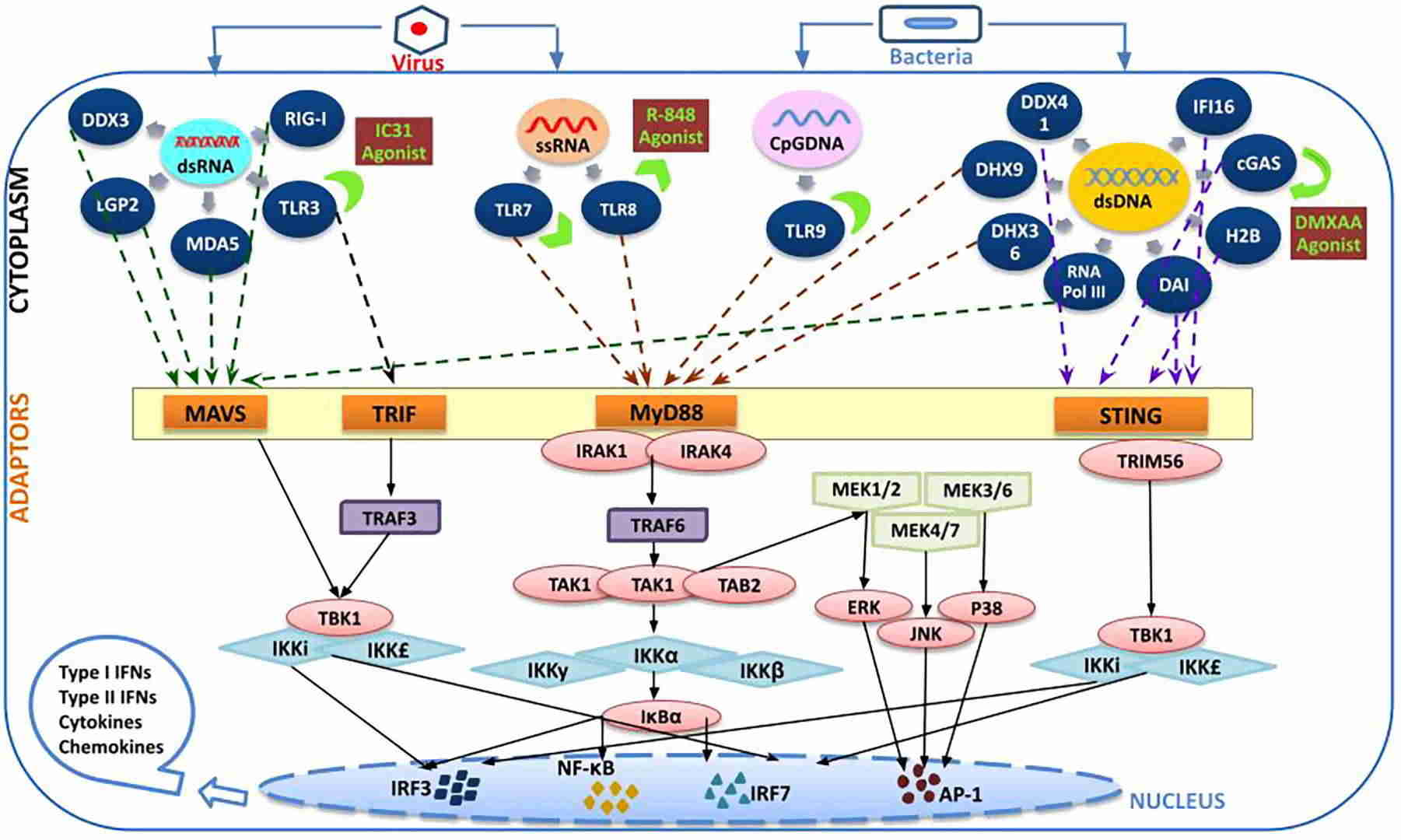
Summary of Major Adapters Involved in PRR and Their Downstream Signaling EventsFigure 1. Summary of Major Adapters Involved in PRR and Their Downstream Signaling Events (Source: Jain A, et al. 2022)

Equipped with cutting - edge technology platforms, we offer professional analysis services for viral protein - host nucleic acid interactions. Our experienced team is committed to delivering high - quality solutions for your research.

Reference

  1. Jain A, Mittal S, Tripathi LP, Nussinov R, Ahmad S. Host-pathogen protein-nucleic acid interactions: A comprehensive review. Comput Struct Biotechnol J. 2022;20:4415-4436.
Online Inquiry
✔ ✖ Verification code
Services
  • Custom Protein Arrays
    • Custom Array Design
    • Functional Protein Arrays
    • Large-Scale Screening
    • Specific Protein Detection
  • Drug Screening and Toxicity Assessment
    • Cytokine Release Assay
    • Dose-Response Toxicity Evaluation
    • High-Throughput Drug Screening
    • Off-Target Effects Analysis
  • Immunoprofiling
    • Cytokine Profiling
    • Immune Checkpoint Molecule Detection
    • Immune Escape Mechanism Analysis
    • T-Cell and B-Cell Profiling
  • Oncology Drug Screening
    • Biomarker Discovery
    • Cell Signaling Pathway Mapping
    • Drug Resistance Mechanism Analysis
    • Target Identification
  • Signaling Pathway Analysis
    • Cross-Talk Between Pathways
    • Glycosylation Status Detection
    • Kinase Activity Assay
    • Pathway Activation/Inhibition Profiling
    • Phosphorylation Status Detection
  • Spatial Multi-Omics and Targeted Proteomics
    • Reverse Phase Protein Array (RPPA)
    • Digital Spatial Profiler (DSP)
    • Spatial Proteomics
  • Vaccine Development
    • Adjuvant Efficacy
    • Antigen Discovery
    • Antigen Mutation Analysis
    • Immunogenicity Assessment
    • Post-Vaccination Immune Response
  • Antibody Profiling
    • Antibody Subclass Profiling
    • Autoantibody Detection
    • Monoclonal and Polyclonal Antibody Analysis
    • Therapeutic Antibody Monitoring
  • Protein-Protein Interaction Studies
    • Co-Factor and Complex Formation Analysis
    • Interaction Network Mapping
    • Mutant vs Wild-Type Interaction Comparison
    • Protein Binding Assays
  • Allergen Screening
    • Common Allergen Detection
    • Cross-Reactivity Assessment
    • IgE Antibody Profiling
  • Protein-Nucleic Acid Interaction Analysis
    • Autoantibody-Nucleic Acid Complex Analysis
    • Chromatin Remodeling Complex Interactions
    • CRISPR-Cas System Recognition
    • Epigenetics (DNA Methylation)
    • Gene Splicing Factor - Pre-mRNA Interactions
    • Nucleic Acid Aptamer Screening
    • Pathogen-Associated Molecular Pattern (PAMP) Recognition
    • RNA-Binding Protein Regulation
    • Small Molecule Interference with Protein-Nucleic Acid Interactions
    • Structure-Dependent Interactions
    • Transcriptional Regulation
    • Viral Protein-Host Nucleic Acid Interactions
Services
Immunoprofiling Signaling Pathway Analysis Vaccine Development Antibody Profiling Custom Protein Arrays Oncology Drug Screening Protein-Protein Interaction Studies Allergen Screening Drug Screening and Toxicity Assessment Spatial Multi-Omics and Targeted Proteomics
Technology
  • Protein Biochip Technology Platform (Multi Marker)
Contact Us
  • Tel: (USA)
  • (Europe)
  • Fax:
  • Email:
Privacy Policy | Cookie Policy | © Copyright Creative Diagnostics 2026. All Rights Reserved.
Follow Us On