Gene Splicing Factor - Pre-mRNA Interactions
Mechanism of Splicing Factor - Pre-mRNA Interactions
Pre-messenger RNA (pre-mRNA) splicing operates as a common mechanism for gene expression regulation in eukaryotes by eliminating introns and connecting exons into mature mRNA. Multiple conserved sequence elements and proteins work together in this complex process which includes splicing factors, RNA helicases and small nuclear ribonucleoproteins (SNRNPs).
The pre-mRNA forms connections with splicing factors via protein-nucleic acid interactions that encompass spliceosome assembly and catalytic reactions followed by product release. Regulatory elements that control these interactions consist of RNA and protein modifications together with RNA binding protein associations.
Gene Splicing Factors
Gene splicing factors function as proteins that perform the task of splicing RNA precursors. They regulate gene splicing by binding to pre-mRNA structures and sequences which they identify with precision. The selection of exons to be retained or removed during maturation determines the mRNA diversity resulting in different protein products. Functional roles allow for classification of splicing factors into two main groups which consist of snRNP protein factors and non - snRNP protein factors. The spliceosome assembly begins when U1 SNRNP binds to the 5' splice site and proceeds with U2 SNRNP attaching to the branch point sequence forming a protein - RNA network. Successful spliceosome assembly requires the activity of splicing factors which consist of serine - arginine proteins together with heterogeneous nuclear ribonucleoproteins. Specific RNA sequence binding by proteins enables both splice site selection regulation and splicing efficiency control.
Factors Involved in the Splicing Process
The splicing process involves multiple elements including several key factors.
- U1 snRNP: As an RNA splicing initiator U1 snRNP targets the 5' splice site and recruits downstream snRNPs together with splicing factors to construct the spliceosome.
- SF1 (Splicing Factor 1): The SF1 protein recognizes the branch point sequence within introns at the 3' splice site and binds to the large subunit of U2AF which is crucial during the initial formation of the spliceosome.
- RBM22: The protein RBM22 takes part in building the spliceosome complex while it controls transcription through chromatin binding.
- RBM39: RBM39 controls pre-mRNA splicing by modulating other proteins' functions and its absence results in widespread pre-mRNA splicing abnormalities.
- SF3B1, CWC22, and XAB2: The reduction of these splicing factors has a domino effect on the alternative splicing of numerous additional splicing factors which underscores their integral role in the splicing network.
The collaboration of these factors maintains pre-mRNA splicing accuracy and diversity which serves as a fundamental mechanism for gene expression regulation.
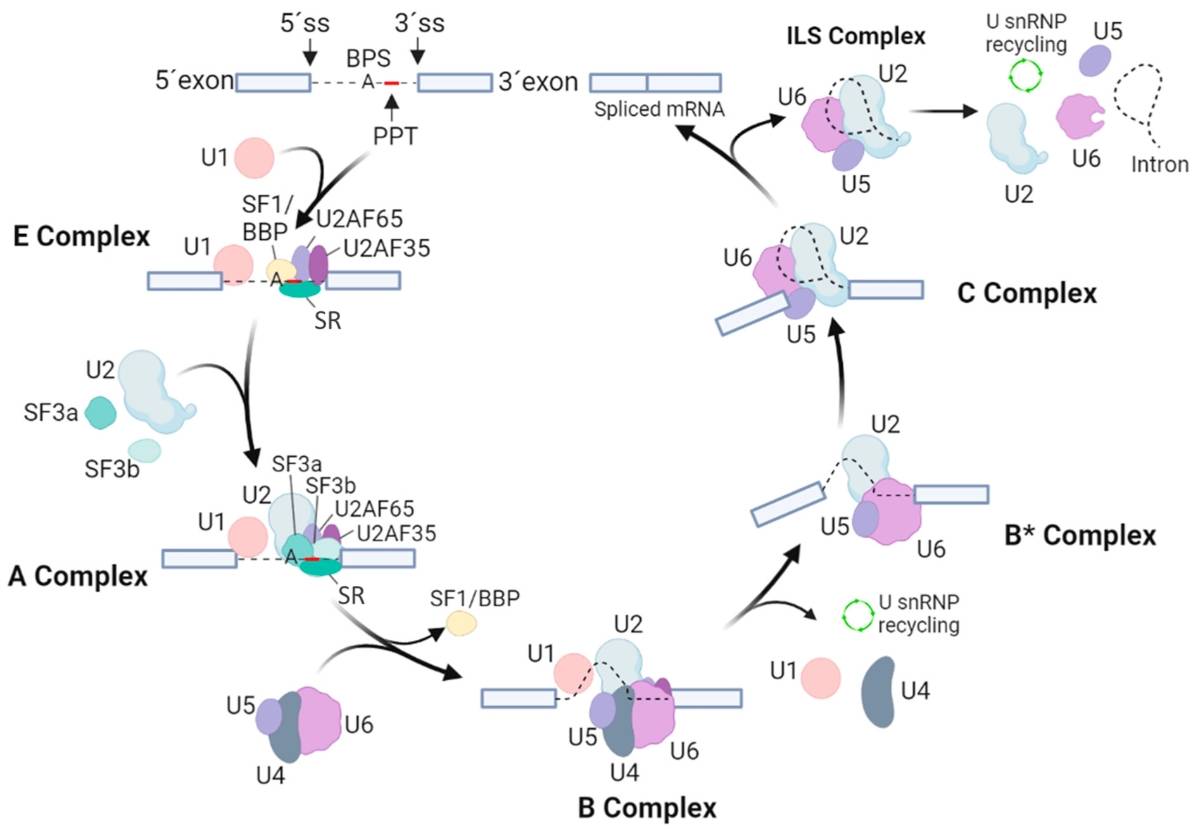 Figure 1. Overview of spliceosomal assembly, rearrangements and catalytic cycle. (Source: Kretova M, et al. 2023)
The Edge of Our Protein Array Technology
The technology of protein arrays serves as a powerful analytical instrument that allows researchers to conduct high-throughput, high-sensitivity detection of protein-nucleic acid interactions. The technology stands out as the ideal choice for analyzing gene-splicing factors' binding properties and kinetics with pre-mRNA and delivers essential technical support for interaction research.
This technology offers substantial benefits over traditional methods:
- High throughput: Detect multiple interactions simultaneously.
- High sensitivity: Detect minor bindings.
- Precision: It integrates near-infrared fluorescent labeling chips to ensure precise identification of targets as well as quantitative analysis.
- Realistic samples: This technology functions optimally with complex biological samples while accurately replicating physiological conditions.
Our platform utilizes near-infrared fluorescent labeling chips together with laser confocal chip scanners and silicone-based protein chips to achieve precise detection and measurement of interactions in complex biological samples. Researchers can use our platform to investigate how genes are spliced and identify possible treatments for genetic disorders such as hereditary fibrosis.
Service Content Examples
Array Design
| Panel Name | Marker Combination | Target Application | Possible Sample Preparation |
| Splicing Factor Interaction | SF3B1, SF3B3, U2AF1, U2AF2, SRSF1, SRSF2, hnRNP A1, hnRNP C | Study splicing factor-pre-mRNA binding and assess impacts on splice site selection and splicing efficiency | - In vitro: Purified splicing factors and synthetic pre-mRNA - In vivo: Cell lysates |
| Spliceosome Assembly Analysis | U1, U2, U4, U5, U6 snRNP components, PRP8, SF3A1, PHF5A | Analyze spliceosome assembly and interactions among components | - In vitro: Reconstituted spliceosome components - In vivo: Transfected cell lysates |
| Disease-related Splicing Variants | Disease-related mutant splicing factors, aberrant mRNA splice variants | Identify and evaluate disease-associated splicing variants | - Clinical samples: Patient-derived cells or tissues - Disease models: Transgenic animals or cell lines |
| Splicing Factor Interaction - for inhibitor investigation | SF3B1, SF3B3, U2AF1, U2AF2, SRSF1, SRSF2, hnRNP A1, hnRNP C | Develop specific RNA binding inhibitors (such as antisense oligonucleotides ASO, small molecules) to interfere with abnormal splicing events for the treatment of diseases. | Purified splicing factors and synthetic pre-mRNA |
Example Mutant/Variant Combinations
| Array Design | Example Mutant/Variant Combinations | Target Application | Possible Sample Preparation |
| Splicing Factor Mutant Array | - SR protein phosphorylation site mutants - hnRNP RNA-binding domain mutants - Functionally deficient spliceosome component mutants | 1. Study impacts of post-translational modifications on splicing factor function 2. Identify critical functional domains of splicing factors | - In vitro: Transcribed/translated mutant proteins - In vivo: Cell lines stably expressing mutant splicing factors |
| Pre-mRNA Variant Array | - Pre-mRNA fragments with different splice sites - Pre-mRNA variants processed by different splicing patterns | 1. Analyze splice site recognition mechanisms 2. Evaluate protein products from different splicing patterns | - In vitro: In vitro transcribed pre-mRNA - In vivo: Cellular mRNA extracts |
Our protein array services provide comprehensive solutions for studying gene splicing factor - pre-mRNA interactions. Our advanced technology integrated with Sample Preparation, Microarray Hybridization, Microarray Scanning, and Bioinformatics Analysis enables detailed exploration of splicing mechanisms which supports both research and genetic disease treatment. The technology platform provides robust assistance for accurate management and analysis of splicing while facilitating the creation of novel genetic disease treatments.
Reference
- Kretova M, Selicky T, Cipakova I, Cipak L. Regulation of pre-mRNA splicing: Indispensable role of post-translational modifications of splicing factors. Life (Basel). 2023;13(3):604.
- Custom Protein Arrays
- Drug Screening and Toxicity Assessment
- Immunoprofiling
- Oncology Drug Screening
- Signaling Pathway Analysis
- Spatial Multi-Omics and Targeted Proteomics
- Vaccine Development
- Antibody Profiling
- Protein-Protein Interaction Studies
- Allergen Screening
- Protein-Nucleic Acid Interaction Analysis