• Home
  • Products
    • Functional Slides
      • Aldehyde
      • Alkene
      • Amine
      • Azide
      • Carboxyl
      • Epoxy
      • Maleimide
      • NHS
      • PDITC
      • Poly-L-lysine
      • Streptavidin
      • Thiol
    • Microfluidic Chips
      • Basic Flow Chips
      • Cell and Organism Culture Chips
      • Droplet Generator Chips
      • Droplet Sequencing Chips
      • Electrophoresis Microfluidic Chips
      • Gradient Chips
      • LNP & Nanoparticle Preparation Chips
      • Particle and Cell Sorting Chips
      • Permeation Array Chips
      • Porous Media Model Chips
      • Sample Preparation Chips
      • Vascular Simulation Chips
  • Services
    • Custom Protein Arrays
      • Custom Array Design
      • Functional Protein Arrays
      • Large-Scale Screening
      • Specific Protein Detection
    • Drug Screening and Toxicity Assessment
      • Cytokine Release Assay
      • Dose-Response Toxicity Evaluation
      • High-Throughput Drug Screening
      • Off-Target Effects Analysis
    • Immunoprofiling
      • Cytokine Profiling
      • Immune Checkpoint Molecule Detection
      • Immune Escape Mechanism Analysis
      • T-Cell and B-Cell Profiling
    • Oncology Drug Screening
      • Biomarker Discovery
      • Cell Signaling Pathway Mapping
      • Drug Resistance Mechanism Analysis
      • Target Identification
    • Signaling Pathway Analysis
      • Cross-Talk Between Pathways
      • Glycosylation Status Detection
      • Kinase Activity Assay
      • Pathway Activation/Inhibition Profiling
      • Phosphorylation Status Detection
    • Spatial Multi-Omics and Targeted Proteomics
      • Reverse Phase Protein Array (RPPA)
      • Digital Spatial Profiler (DSP)
      • Spatial Proteomics
    • Vaccine Development
      • Adjuvant Efficacy
      • Antigen Discovery
      • Antigen Mutation Analysis
      • Immunogenicity Assessment
      • Post-Vaccination Immune Response
    • Antibody Profiling
      • Antibody Subclass Profiling
      • Autoantibody Detection
      • Monoclonal and Polyclonal Antibody Analysis
      • Therapeutic Antibody Monitoring
    • Protein-Protein Interaction Studies
      • Co-Factor and Complex Formation Analysis
      • Interaction Network Mapping
      • Mutant vs Wild-Type Interaction Comparison
      • Protein Binding Assays
    • Allergen Screening
      • Common Allergen Detection
      • Cross-Reactivity Assessment
      • IgE Antibody Profiling
    • Protein-Nucleic Acid Interaction Analysis
      • Autoantibody-Nucleic Acid Complex Analysis
      • Chromatin Remodeling Complex Interactions
      • CRISPR-Cas System Recognition
      • Epigenetics (DNA Methylation)
      • Gene Splicing Factor - Pre-mRNA Interactions
      • Nucleic Acid Aptamer Screening
      • Pathogen-Associated Molecular Pattern (PAMP) Recognition
      • RNA-Binding Protein Regulation
      • Small Molecule Interference with Protein-Nucleic Acid Interactions
      • Structure-Dependent Interactions
      • Transcriptional Regulation
      • Viral Protein-Host Nucleic Acid Interactions
  • Resource
    • Biomolecular Interactions
    • Cellular Signaling
    • Drug Discovery
    • Immunology & Diagnostics
  • Technology
    • Protein Biochip Technology Platform (Multi Marker)
      • Silica-Based Membrane as Protein Chip
      • Near-Infrared Fluorescent Labeled Chip
      • Laser Confocal Chip Scanner
  • About Us
  • Contact Us
Get A Free Quote
  1. Home
  2. Services
  3. Protein-Nucleic Acid Interaction Analysis

Protein-Nucleic Acid Interaction Analysis

Unlocking the Secrets of Life at the Molecular Level

Key biological processes such as gene expression regulation and DNA replication depend on protein-nucleic acid interactions alongside pathogen recognition. Precise analysis of protein-nucleic acid interactions provides essential insights into disease mechanisms which supports the development of targeted drugs and advances gene therapy technologies. The study of interactions between proteins and nucleic acids enables us to understand gene expression networks through the way transcription factors identify specific DNA sequences which results in the control of gene transcription. Disease mechanisms depend on these interactions which lead to abnormal gene expression in cancer and accumulation of RNA-binding proteins in neurodegenerative diseases. Early disease diagnosis requires deep knowledge of these interactions which helps identify therapeutic targets and develop new drugs.
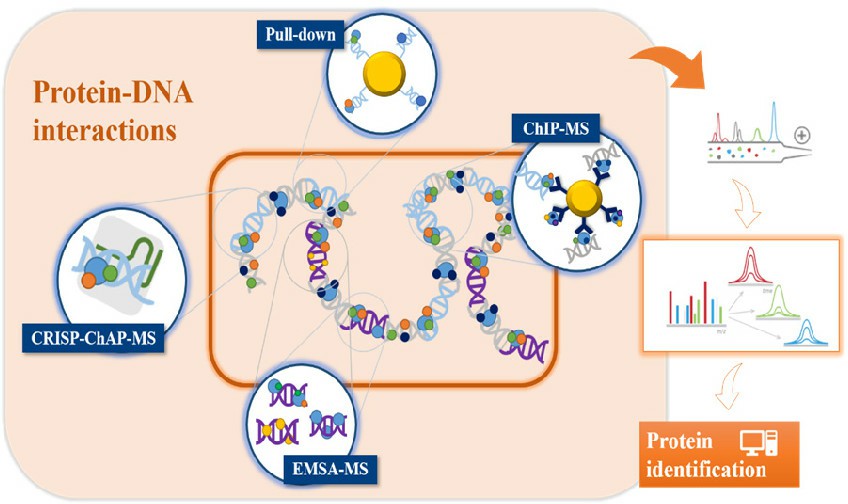
The most frequently used methods for identifying nucleic acid binding proteins in proteomics applicationsFigure 1. An overview of the approaches most commonly employed in proteomics applications for the identification of nucleic acid-binding proteins
(Source: Cozzolino F, et al. 2021)

Which Protein-Nucleic Acid Interaction Service Is Best for You?

We offer six professional analysis services:

Service DirectionSub-Divisional Service Directions
Cancer Research
  • Transcriptional Regulation
  • Epigenetics (DNA Methylation)
  • Structure-Dependent Interactions
Neurodegenerative Diseases
  • RNA-Binding Protein Regulation
  • Chromatin Remodeling Complex Interactions
Autoimmune Diseases
  • Pathogen-Associated Molecular Pattern (PAMP) Recognition
  • Autoantibody-Nucleic Acid Complex Analysis
Infectious Diseases
  • Viral Protein - Host Nucleic Acid Interactions
  • CRISPR-Cas System Recognition
Genetic Diseases
  • Gene Splicing Factor - Pre-mRNA Interactions
Drug Development & Screening
  • Small-Molecule Disruption of Protein-Nucleic Acid Interactions
  • Nucleic Acid Aptamer Screening

Revolutionary Technology: Core Platform

Our near-infrared microarray protein chip system combines laser confocal technology, near-infrared fluorescence labeling, and special functional silicon membrane to establish a highly efficient and sensitive platform for detecting protein-nucleic acid interactions. This platform has significant advantages in high-throughput, multi-index detection, and cost-effectiveness, allowing it to meet different research needs with flexibility and scalability.

  • High Sensitivity Detection: Laser confocal technology achieves fg-level detection limits with a dynamic range of five orders of magnitude.
  • High-Throughput Compatibility: Special silicon membrane supports parallel detection of thousands of samples per chip, with batch-to-batch differences<5%.
  • Fully Automated Process: Near-infrared labeling combined with robotic operation completes sample-to-data analysis within 48 hours.

Typical Application Scenarios

  • Basic Research: Utilizing protein-nucleic acid interaction analysis to deeply understand complex biological processes like chromatin spatial structure and non-coding RNA function mechanisms.
  • Cancer Research: The analysis of transcriptional regulation and epigenetic studies helps to identify distinct epigenetic markers in cancer cells which leads to the creation of targeted therapeutic approaches.
  • Neurodegenerative Diseases: Research into the abnormal accumulation of RNA-binding proteins such as TDP-43 with RNA provides insights into ALS pathogenesis and potential treatment development.
  • Autoimmune Diseases: Through analysis of how autoantibodies bind to nucleic acid complexes researchers can develop diagnostic and therapeutic methods for autoimmune disorders including systemic lupus erythematosus.
  • Infectious Diseases: Analyzing viral protein and host nucleic acid interactions enables researchers to identify potential antiviral drug targets and create RNA-targeting treatment methods.
  • Drug Development & Screening: High-throughput screening methods enable us to quickly identify small molecule inhibitors that interfere with protein-nucleic acid interactions while developing RNA-binding nucleic acid aptamers.

Your Trusted Partner

Our expertise and advanced technology enable us to offer protein-nucleic acid interaction analysis with superior sensitivity and throughput detection capabilities. Our team features seasoned professionals who tailor experimental designs to meet clients' precise requirements while offering complete analysis and interpretation of data. Our technology platform supports diverse sample types and detection requirements, ensuring clients receive high-quality research data.

Service Process

  • Need Consultation: Submit sample type and target molecule information.
  • Scheme Design: Provide chip probe layout and experimental scheme.
  • Experiment Execution: Complete interaction detection and quality control reports.
  • Data Analysis: Provide binding affinity (Kd), specificity heat maps, and other key parameters.

Understanding how proteins bind with nucleic acids stands as a vital process toward solving the fundamental secrets of life. Creative Diagnostics offers top-tier technological support and expert services to enable your research breakthroughs across multiple fields. You can reach out to us for additional details about our services. We're excited about working together to advance life sciences!

Reference

  1. Cozzolino F, et al. Protein-DNA/RNA Interactions: An Overview of Investigation Methods in the -Omics Era. J Proteome Res. 2021 Jun 4;20(6):3018-3030.
Online Inquiry
✔ ✖ Verification code
Services
  • Custom Protein Arrays
    • Custom Array Design
    • Functional Protein Arrays
    • Large-Scale Screening
    • Specific Protein Detection
  • Drug Screening and Toxicity Assessment
    • Cytokine Release Assay
    • Dose-Response Toxicity Evaluation
    • High-Throughput Drug Screening
    • Off-Target Effects Analysis
  • Immunoprofiling
    • Cytokine Profiling
    • Immune Checkpoint Molecule Detection
    • Immune Escape Mechanism Analysis
    • T-Cell and B-Cell Profiling
  • Oncology Drug Screening
    • Biomarker Discovery
    • Cell Signaling Pathway Mapping
    • Drug Resistance Mechanism Analysis
    • Target Identification
  • Signaling Pathway Analysis
    • Cross-Talk Between Pathways
    • Glycosylation Status Detection
    • Kinase Activity Assay
    • Pathway Activation/Inhibition Profiling
    • Phosphorylation Status Detection
  • Spatial Multi-Omics and Targeted Proteomics
    • Reverse Phase Protein Array (RPPA)
    • Digital Spatial Profiler (DSP)
    • Spatial Proteomics
  • Vaccine Development
    • Adjuvant Efficacy
    • Antigen Discovery
    • Antigen Mutation Analysis
    • Immunogenicity Assessment
    • Post-Vaccination Immune Response
  • Antibody Profiling
    • Antibody Subclass Profiling
    • Autoantibody Detection
    • Monoclonal and Polyclonal Antibody Analysis
    • Therapeutic Antibody Monitoring
  • Protein-Protein Interaction Studies
    • Co-Factor and Complex Formation Analysis
    • Interaction Network Mapping
    • Mutant vs Wild-Type Interaction Comparison
    • Protein Binding Assays
  • Allergen Screening
    • Common Allergen Detection
    • Cross-Reactivity Assessment
    • IgE Antibody Profiling
  • Protein-Nucleic Acid Interaction Analysis
    • Autoantibody-Nucleic Acid Complex Analysis
    • Chromatin Remodeling Complex Interactions
    • CRISPR-Cas System Recognition
    • Epigenetics (DNA Methylation)
    • Gene Splicing Factor - Pre-mRNA Interactions
    • Nucleic Acid Aptamer Screening
    • Pathogen-Associated Molecular Pattern (PAMP) Recognition
    • RNA-Binding Protein Regulation
    • Small Molecule Interference with Protein-Nucleic Acid Interactions
    • Structure-Dependent Interactions
    • Transcriptional Regulation
    • Viral Protein-Host Nucleic Acid Interactions
Services
Immunoprofiling Signaling Pathway Analysis Vaccine Development Antibody Profiling Custom Protein Arrays Oncology Drug Screening Protein-Protein Interaction Studies Allergen Screening Drug Screening and Toxicity Assessment Spatial Multi-Omics and Targeted Proteomics
Technology
  • Protein Biochip Technology Platform (Multi Marker)
Contact Us
  • Tel: (USA)
  • (Europe)
  • Fax:
  • Email:
Privacy Policy | Cookie Policy | © Copyright Creative Diagnostics 2026. All Rights Reserved.
Follow Us On