
Environmental pollution is often described in terms of concentration: how much lead is present in water, how much pesticide remains in soil, or how many contaminants are detected in the air. These measurements are essential for determining environmental exposure, but they do not always answer a more important biological question: What is the pollutant actually doing to a living organism? This is where biomarkers become particularly valuable. Rather than measuring the pollutant alone, biomarker analysis examines measurable biological changes associated with exposure. When antibodies are used to detect these biomarkers, researchers can monitor specific proteins, metabolites, cellular responses, and molecular changes that provide insight into how an organism is responding to environmental stress. Biomarker antibodies therefore do more than identify a molecular target. They can help connect environmental exposure with biological response, providing evidence that a contaminant has been absorbed, distributed within the organism, interacted with biological targets, or triggered cellular and physiological changes.
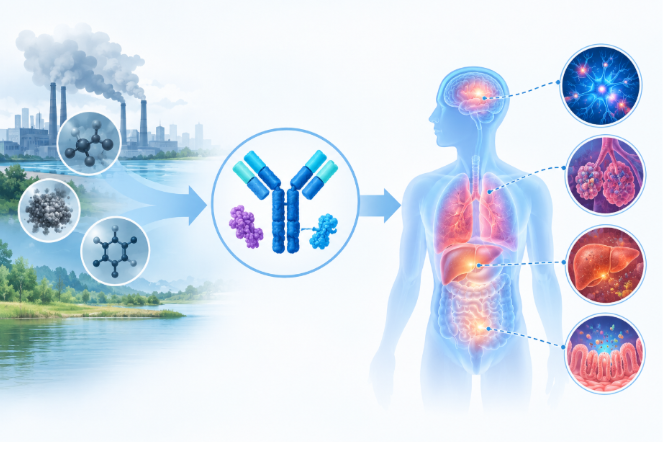
From Environmental Contamination to Biological Response
A chemical measurement provides information about what is present in the environment. A biomarker measurement addresses a different question: Has the biological system responded to that exposure? Once a pollutant enters an organism, it can interact with cells, proteins, enzymes, receptors, or other molecular targets. These interactions may interfere with normal cellular signaling, alter protein expression, disturb metabolic processes, or activate defense mechanisms. Depending on the pollutant and exposure conditions, the response may involve oxidative stress, inflammation, DNA damage, altered enzyme activity, membrane disruption, or other forms of cellular injury. These changes can produce measurable biological signals. This distinction is important because the same environmental concentration does not necessarily produce the same biological outcome in every organism. Absorption, metabolism, tissue distribution, exposure duration, species-specific susceptibility, and other biological factors can influence how a contaminant affects the body. Biomarkers help account for some of this complexity by measuring the response of the biological system itself.
Exposure Biomarkers and Effect Biomarkers Tell Different Stories
Environmental biomarkers are commonly considered in terms of whether they indicate exposure or biological effect. Exposure biomarkers provide evidence that a contaminant has entered or interacted with an organism. Measurements associated with metals such as lead or mercury, for example, can provide information about internal exposure rather than simply describing contamination in the surrounding environment. Effect biomarkers address what happens after exposure. Changes in stress-related proteins, enzymes, inflammatory markers, DNA damage-associated molecules, or other biological indicators may suggest that exposure has produced a measurable cellular or physiological response. The distinction is critical when interpreting environmental toxicology data. Detecting a contaminant does not automatically demonstrate that it has caused biological damage. Likewise, observing a biological response does not necessarily identify the responsible pollutant without appropriate exposure information. For this reason, combining exposure biomarkers with effect biomarkers can provide a much stronger basis for understanding the relationship between environmental contaminants and biological effects.
Why Antibodies Are Powerful Biomarker Detection Tools
Antibodies are particularly useful for biomarker research because they recognize specific molecular structures. Monoclonal antibodies are designed to recognize a defined epitope and can provide highly consistent molecular recognition. Polyclonal antibodies recognize multiple epitopes on a target and can sometimes provide strong detection across different forms of the same molecule. Both formats have applications in environmental toxicology and biomonitoring, depending on the target and assay requirements. The antibody-antigen interaction can be incorporated into several analytical platforms, including enzyme-linked immunosorbent assays (ELISA), immunoblotting, immunohistochemistry, immunosensors, and rapid lateral-flow formats. This molecular recognition is particularly useful when biological or environmental samples contain numerous potentially interfering compounds. Instead of relying solely on a physical or chemical property, antibody-based assays can provide an additional level of target selectivity.
ELISA Brings Antibody-Based Detection into Environmental Monitoring
ELISA remains one of the most practical antibody-based approaches for environmental analysis. Its relatively straightforward workflow, scalability, and compatibility with different sample types make it useful for screening environmental contaminants as well as biological response markers. Depending on the assay design, antibodies can be used to recognize pesticides, metabolites, proteins, toxins, or other targets relevant to environmental exposure. For example, monoclonal antibody-based ELISA methods have been developed for class-selective detection of organophosphate pesticides in water samples. Immunoassays have also been investigated for newer insecticides such as cyantraniliprole, demonstrating how antibody recognition can be adapted to emerging environmental contaminants. The broader significance is that antibody-based assays can help move environmental monitoring beyond simply measuring contamination in water or soil. When applied to biological samples, they can provide information about whether contaminants or their metabolites have entered an organism and whether exposure is associated with measurable biological changes.
Nanobodies Are Expanding Immunodetection Strategies
Traditional antibodies are not the only recognition molecules being explored for environmental biomarker analysis. Nanobodies, which are small antigen-binding domains derived from camelid heavy-chain antibodies, have attracted attention because of their compact size, structural stability, and potential for molecular engineering. These characteristics can be useful when developing portable immunoassays, biosensors, and other analytical systems. Nanobody-based immunoassays have been investigated for environmental exposure markers such as 3-phenoxybenzoic acid, a metabolite associated with pyrethroid exposure. In some assay formats, nanobody-based approaches have demonstrated substantially improved analytical sensitivity compared with corresponding conventional antibody systems. This illustrates a broader trend in environmental immunoassay development. Antibody engineering is creating recognition molecules that can potentially improve assay sensitivity, stability, portability, and suitability for field-based monitoring.
Biomarkers Capture the Biological Footprint of Pollution
The real value of biomarker antibodies becomes more apparent when pollutants trigger multiple biological responses. Environmental contaminants rarely affect only one molecular component. Depending on their mechanism of action, they may interfere with metabolic pathways, alter signaling networks, generate reactive oxygen species, activate inflammatory responses, or damage cellular structures. Once a pollutant enters an organism, it can interact with cells, proteins, enzymes, receptors, or other molecular targets. These interactions may disrupt normal cellular signaling and alter the abundance or activity of specific proteins. As the response develops, oxidative stress, inflammation, DNA damage, or other forms of cellular injury may emerge. Persistent or severe disturbances can ultimately affect tissue function and produce measurable physiological changes. Biomarker antibodies allow researchers to examine specific points within this biological response. For example, an antibody may be used to measure a stress-response protein whose expression increases following pollutant exposure. Another antibody may detect a protein associated with inflammation or cellular injury. When several markers are evaluated together, researchers can obtain a more informative picture of how exposure is affecting the biological system.
Protein Expression Can Reveal What Chemical Analysis Misses
One important consequence of environmental exposure is a change in protein expression. Cells constantly adjust their protein production in response to environmental conditions. When exposed to toxic chemicals, organisms may increase the expression of proteins involved in detoxification, antioxidant defense, stress responses, inflammation, or repair. Other proteins may decrease because of impaired synthesis, altered degradation, or cellular dysfunction.These changes provide a molecular record of how cells respond to environmental stress. Antibody-based methods can detect such changes using techniques including ELISA, Western blotting, immunohistochemistry, and related immunodetection approaches. Depending on the experimental design, researchers can determine not only whether a protein is altered but also where it is expressed within tissues or cells. This makes biomarker antibodies particularly valuable in mechanistic toxicology. Instead of simply showing that an organism has been exposed to a pollutant, researchers can investigate which biological pathways appear to be responding to that exposure.
A Single Biomarker Rarely Tells the Whole Story
Environmental toxicology is inherently complex, and a single biomarker rarely provides a complete explanation.Many biological responses are not specific to one contaminant. Oxidative stress, inflammation, and changes in cellular metabolism can be caused by numerous chemical and physiological stressors. Environmental organisms may also encounter multiple pollutants simultaneously. This is why biomarker panels can provide greater insight than isolated measurements.A carefully selected panel may combine indicators of internal exposure with markers of oxidative stress, inflammation, DNA damage, metabolic disruption, and cellular injury. Each marker contributes different information, allowing researchers to evaluate the overall biological pattern rather than relying on one potentially nonspecific signal. The objective is not simply to measure as many biomarkers as possible. The most useful panel is one in which the selected markers provide complementary information and can be interpreted within a well-defined toxicological framework.
Connecting Molecular Responses to Ecological Health
One of the most valuable aspects of environmental biomarker research is its ability to connect different levels of biological organization. At the molecular level, pollutants can alter proteins, enzymes, receptors, or signaling pathways. At the cellular level, these disturbances may lead to oxidative stress, impaired metabolism, inflammation, apoptosis, or other forms of dysfunction. At the organism level, persistent molecular and cellular changes may affect growth, reproduction, development, behavior, or physiological performance. When similar effects occur across many organisms, they may eventually influence population dynamics and ecological communities. Biomarker antibodies are particularly useful at the earlier stages of this chain because they allow researchers to detect molecular and cellular responses that may occur before obvious organism-level effects become apparent. This makes biomarker analysis valuable not only for laboratory toxicology but also for ecological risk assessment and environmental health monitoring.
Biomarker Monitoring Can Provide an Early Warning
Traditional environmental monitoring generally focuses on measuring pollutant concentrations in water, air, sediment, or soil. These measurements remain fundamental, but they do not necessarily indicate how strongly a biological system has responded.Biomarkers provide another layer of information. An organism may absorb, metabolize, and accumulate a contaminant differently from what would be expected based solely on its environmental concentration. Similarly, the presence of a chemical does not automatically mean that significant biological damage has occurred. Biomarkers can therefore provide an additional early-warning signal between environmental contamination and observable toxicity. In studies involving heavy metals, pesticides, industrial chemicals, and air-pollution-associated stressors, biomarker measurements can help identify biological responses at the individual or population level. When combined with exposure measurements and appropriate controls, these responses can contribute to a more comprehensive assessment of environmental health.
Antibody Quality Determines the Reliability of Biomarker Data
The performance of an antibody-based biomarker assay depends heavily on the quality and validation of the antibody.Specificity is one of the most important considerations. Cross-reactivity with structurally related molecules can produce false-positive or difficult-to-interpret results, particularly when environmental or biological samples contain complex mixtures. Sensitivity is also important when the target biomarker occurs at low abundance. However, high sensitivity alone is not enough. Researchers must also consider dynamic range, matrix effects, reproducibility, background signal, assay precision, and appropriate positive and negative controls. For environmental toxicology applications, antibody validation should therefore be integrated into the overall experimental design. The biological relevance of the target should also be considered. A statistically significant change in a protein does not automatically mean that the pollutant caused clinically or ecologically meaningful toxicity. Biomarker results are strongest when the selected targets have a plausible relationship with the exposure and when alternative explanations for the observed changes have been considered.
Combining Chemical and Biological Evidence
Biomarker analysis should complement rather than replace conventional chemical analysis. Chemical methods are essential for identifying contaminants and determining their concentrations. Biomarkers provide information about how biological systems respond to those contaminants. When both types of evidence are considered together, researchers can build a more complete exposure-to-effect picture. For example, environmental measurements may establish that a pesticide is present in water or sediment. An exposure biomarker can then provide evidence that the contaminant or its metabolite has entered an organism. Effect biomarkers can add another layer of information by indicating oxidative stress, altered protein expression, inflammation, or cellular injury. This integrated approach helps distinguish environmental presence from biological exposure and, ultimately, from biological effect.
Where Biomarker Antibodies Are Being Applied
Biomarker antibodies have applications across environmental monitoring, ecological toxicology, food safety research, occupational exposure assessment, and experimental toxicology. In environmental quality monitoring, antibody-based assays can support rapid screening of contaminants and biological response indicators. In ecological studies, biomarker panels can be used to investigate organisms exposed to polluted water, sediments, pesticides, heavy metals, or industrial chemicals. In laboratory toxicology, antibody-based detection is particularly useful for studying mechanisms of toxicity. Researchers can examine how exposure changes specific proteins or signaling pathways and determine whether these molecular changes are consistent with known toxicological mechanisms. This makes biomarker antibodies useful when the research question moves beyond “Is the pollutant present?” and toward “How is the biological system responding to the exposure?”
What Makes Biomarker Antibodies Different?
The key advantage of biomarker antibodies is not simply their ability to detect small amounts of a target. Their value comes from the biological context that can be obtained from molecular recognition. A conventional environmental measurement tells researchers how much of a chemical is present in a particular sample. An exposure biomarker can provide evidence that the contaminant has entered a biological system. An effect biomarker can indicate that the organism has undergone a measurable biological response. Antibodies provide a practical way to detect many of these molecular indicators with target-specific recognition. When multiple biomarkers are analyzed together, the resulting profile can help researchers determine whether an organism has experienced exposure, activated protective responses, developed cellular stress, or progressed toward tissue-level injury. This is what makes biomarker antibodies increasingly important in environmental toxicology. They help transform environmental monitoring from a measurement of contaminant concentration into a broader assessment of biological consequence.
The Future of Environmental Biomarker Research
Environmental exposure is becoming increasingly difficult to characterize using single-chemical measurements alone. Organisms may encounter mixtures of pesticides, heavy metals, industrial chemicals, emerging contaminants, and other environmental stressors over extended periods. This complexity is driving greater interest in biomarker strategies that can capture biological responses across multiple molecular pathways. Future approaches are likely to combine improved monoclonal antibodies, engineered nanobodies, multiplex immunoassays, antibody-based biosensors, and quantitative molecular profiling. Such technologies could make it increasingly practical to monitor multiple exposure and effect biomarkers simultaneously and potentially move more testing closer to the field. The most informative environmental assessment will increasingly depend on integrating several types of evidence. Researchers need to know not only what contaminants are present, but also whether they enter biological systems, which molecular pathways respond, and whether those responses indicate meaningful toxicity. Biomarker antibodies provide an important tool for making these connections. By translating molecular changes into measurable signals, they help bridge environmental chemistry, molecular toxicology, and ecological health. Ultimately, the question is no longer simply how much pollution is present. The more meaningful question is what biological footprint that pollution leaves behind—and biomarker antibodies offer a powerful way to begin revealing it.
References
1.Zhang C, et al.; Development of nanobody-based flow-through dot ELISA and lateral-flow immunoassay for rapid detection of 3-phenoxybenzoic acid. Anal Methods. 2021, 13(14):1757-1765.
2.Wang D, et al.; Dark under the Lamp: Neglected Biological Pollutants in the Environment Are Closely Linked to Lung Cancer. Int J Mol Sci. 2024, 25(6):3081.
Related Products
CYP1A Antibodies
| Cat. No. | Product Name | Species Reactivity | Application | |
| CABT-L1857W | Mouse anti-fish CYP1A peptide Monoclonal antibody, clone D21-8 | Rainbow trout, Atlantic salmon, carp, turbot, Atlantic cod | ELISA, WB, IHC | Inquiry |
| CABT-L1858W | Mouse anti-cod CYP1A Monoclonal antibody, clone OQ-8 | Atlantic cod, rainbow trout, Atlantic salmon, carp, turbot | ELISA, WB | Inquiry |
| CABT-L1873W | Rabbit anti-fish CYP1A peptide Polyclonal antibody | Rainbow trout, Atlantic salmon, Atlantic cod, common carp, flounder, sheephead minnow, gilthead bream | ELISA, WB, IHC | Inquiry |
Vitellogenin (Vtg) Antibodies
| Cat. No. | Product Name | Species Reactivity | Application | |
| CABT-L1859W | Mouse anti-salmon vitellogenin Monoclonal antibody, clone CO-6 | Atlantic salmon, Brown trout, rainbow trout, Arctic char, wrasse | ELISA, WB | Inquiry |
| CABT-L1860W | Mouse anti-salmon vitellogenin Monoclonal antibody, clone LC-2 | Atlantic salmon, Salmo spp., Brown trout | ELISA, WB | Inquiry |
| CABT-L1861W | Mouse anti-carp vitellogenin Monoclonal antibody, clone OE-3E4 | common carp, fathead minnow, zebrafish, goldfish, mullet, pinfish, sucker | ELISA, WB | Inquiry |
| CABT-L1862W | Mouse anti-striped bass vitellogenin Monoclonal antibody, clone OE-2D9 | striped bass, rainbow trout, largemouth bass, Atlantic cod, tilapia, killifish, sheepshead minnow. | ELISA, WB | Inquiry |
| CABT-L1863W | Mouse anti-striped bass vitellogenin Monoclonal antibody, clone OE-4H3 | striped bass, largemouth bass, rainbow trout, flounder, turbot, wrasse | ELISA, WB | Inquiry |
| CABT-L1864W | Mouse anti-killifish vitellogenin Monoclonal antibody, clone OE-6G9 | killifish, white perch, common carp, wrasse, tilapia, halibut, sheepshead minnow | ELISA, WB | Inquiry |
| CABT-L1865W | Mouse anti-medaka vitellogenin Monoclonal antibody, clone DL-5C4 | Japanese medaka, sheephead minnow, killifish | ELISA, WB | Inquiry |
| CABT-L1866W | Mouse anti-medaka vitellogenin Monoclonal antibody, clone DL-2I22 | Japanese medaka, Atlantic cod, rainbow trout, carp, tilapia | ELISA, WB | Inquiry |
| CABT-L1867W | Mouse anti-Gulf sturgeon vitellogenin Monoclonal antibody, clone OE-2I3 | Gulf sturgeon, lake sturgeon | ELISA, WB | Inquiry |
| CABT-L1868W | Mouse anti-sheepshead minnow vitellogenin Monoclonal antibody, clone OE-6D10 | Sheephead minnow, halibut, flounder | ELISA, WB | Inquiry |
| CABT-L1869W | Mouse anti-brown bullhead vitellogenin Monoclonal antibody, clone OE-2E23 | Brown bullhead | ELISA, WB | Inquiry |
| CABT-L1875W | Rabbit anti-salmon vitellogenin Polyclonal antibody | Atlantic salmon, Salmonids, flatfish, Atlantic cod | ELISA, WB | Inquiry |
| CABT-L1876W | Rabbit anti-cod vitellogenin Polyclonal antibody | Atlantic cod, turbot, rainbow trout, common carp, tilapia | ELISA, WB | Inquiry |
| CABT-L1877W | Rabbit anti-Arctic char vitellogenin Polyclonal antibody | Arctic char, Atlantic salmon, brown trout, Atlantic cod, turbot, flounder, wrasse, tilapia, zebrafish | ELISA, WB | Inquiry |
| CABT-L1878W | Rabbit anti-turbot vitellogenin Polyclonal antibody | Turbot, flounder, halibut, wrasse, carp, tilapia | ELISA, WB | Inquiry |
| CABT-L1879W | Rabbit anti-wolffish vitellogenin Polyclonal antibody | Wolffish, spotted wolffish, wrasse, common carp, tilapia | ELISA, WB | Inquiry |
| CABT-L1880W | Rabbit anti-stickleback vitellogenin Polyclonal antibody | Three-spined stickleback, rainbow trout, tilapia, sheephead minnow, cod, turbot, ballan wrasse | ELISA, WB | Inquiry |
| DMABT-Z60211 | Mouse anti-alligator vitellogenin Monoclonal antibody, clone OE-2F9 | American alligator | ELISA, WB, IHC | Inquiry |
| DMABT-Z60323 | Mouse anti-zebrafish vitellogenin Monoclonal antibody, clone KF-21E5 | Zebrafish, Carp, fathead minnow, roach | ELISA, WB, IHC | Inquiry |
| DMABT-Z60324 | Mouse anti-zebrafish vitellogenin Monoclonal antibody, clone KF-3B7 | Zebrafish | ELISA, WB, IHC | Inquiry |
| DMABT-Z60338 | Mouse anti-bird vitellogenin Monoclonal antibody, clone OE-4D4 | Japanese quail, common tern, barn swallow, American kestrel, zebra finch, domestic chicken | ELISA, WB | Inquiry |
| DMABT-Z60339 | Mouse anti-bird vitellogenin Monoclonal antibody, clone OE-4H7 | Japanese quail, common tern, barn swallow, American kestrel, zebra finch, domestic chicken | ELISA, WB | Inquiry |
| DPATB-H82356 | Rabbit anti-sea bream vitellogenin Polyclonal antibody | Sea bream, Atlantic salmon, brown trout, rainbow trout, turbot, flounder, Atlantic cod, wrasse, tilapia, carp | ELISA, WB | Inquiry |
Metallothionein (MT) Antibodies
| Cat. No. | Product Name | Species Reactivity | Application | |
| CABT-L1874W | Rabbit anti-cod MT Polyclonal antibody | Atlantic cod, whiting, yellow gurnard, flounder, cypriniform, siluriform, salmoniform, perciform, rajiform species | ELISA, WB | Inquiry |
Zona Radiata Protein (Zrp) Antibodies
| Cat. No. | Product Name | Species Reactivity | Application | |
| CABT-L1870W | Mouse anti-salmon Zrp Monoclonal antibody, clone NO-3C5 | Atlantic salmon, rainbow trout, Arctic charr | ELISA, WB | Inquiry |
| CABT-L1871W | Mouse anti-salmon Zrp Monoclonal antibody, clone NO-8G3 | Atlantic salmon, rainbow trout | ELISA, WB | Inquiry |
| CABT-L1872W | Mouse anti-salmon Zrp Monoclonal antibody, clone NO-9D5 | Atlantic salmon, rainbow trout, Arctic charr, turbot, cod | ELISA, WB | Inquiry |
| CABT-L1881W | Rabbit anti-salmon Zrp Polyclonal antibody | Atlantic salmon, rainbow trout, Arctic char, Atlantic cod, turbot, flounder, halibut | ELISA, WB | Inquiry |