
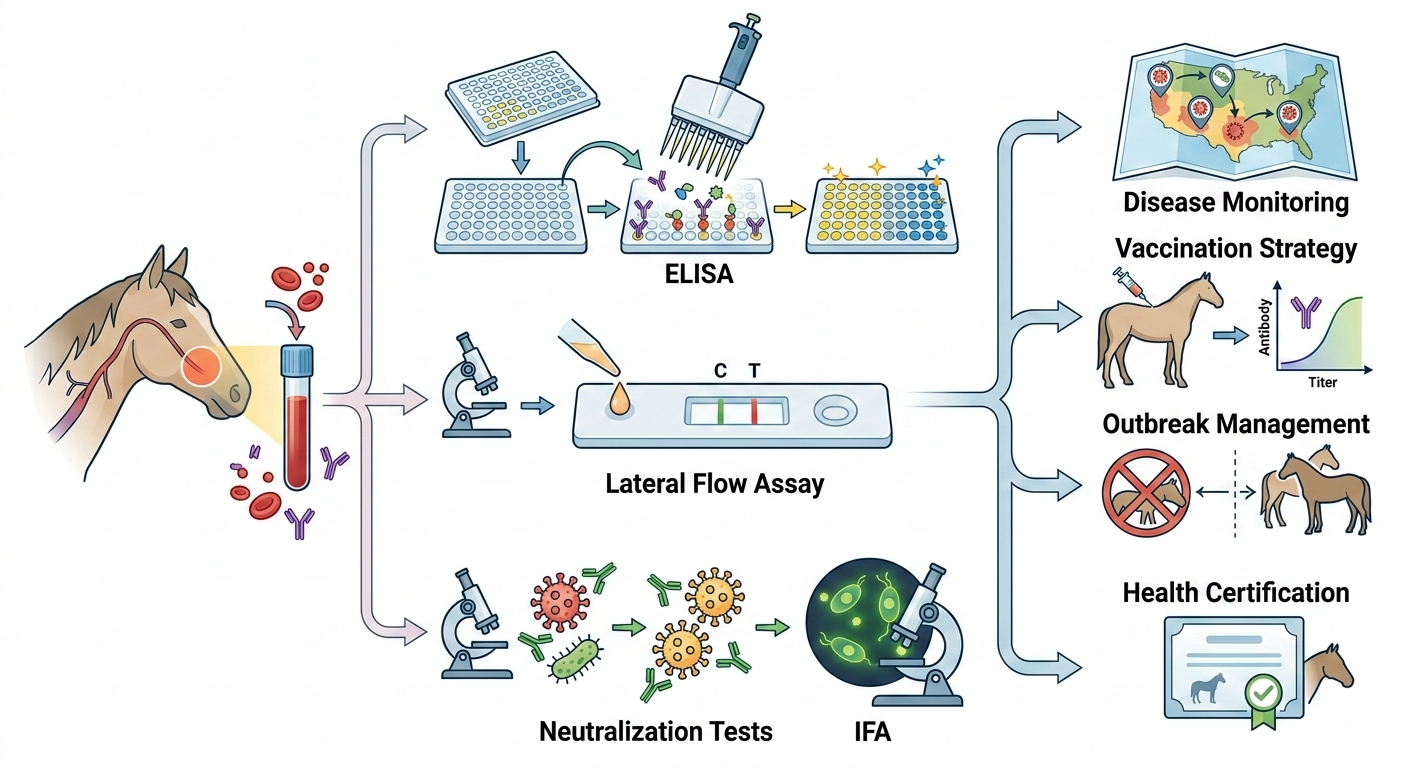
Understanding the immune response of horses to infectious agents is central to equine health research. Serological tools, which detect antibodies and antigens in the blood, have become indispensable for studying disease exposure, immune dynamics, and pathogen circulation in equine populations. These methods not only inform diagnostics but also provide critical data for vaccine development, epidemiological studies, and experimental research.
The Role of Antibodies and Antigens in Equine Research
Serology revolves around the detection of two primary targets: antibodies, which indicate the host’s immune response to past or current infections, and antigens, which reflect the presence of pathogen components in the bloodstream. In research, analyzing antibody-antigen interactions allows scientists to:
- Trace infection histories across domestic and wild horse populations.
- Evaluate vaccine-induced immunity and cross-protection against viral strains.
- Identify potential reservoir hosts contributing to disease spread.
- Develop high-throughput assays for studying multiple pathogens simultaneously.
By leveraging these insights, researchers can generate data that supports both disease control and fundamental understanding of equine immunology.
Case Study: Monitoring Equine Influenza Virus (EIV)
A 2024 study in Ukraine (Serological monitoring of Influenza A among wild and domestic ungulates) highlights the value of serological approaches in equine research. Serum samples from both domestic and wild horses were analyzed using ELISA kits (IDEXX, INGEZIM, IDVet) to detect antibodies against Influenza A virus.
Key findings included:
High antibody positivity (10–100%) in unvaccinated domestic horses, demonstrating active viral circulation.
Detection of antibodies in wild horses, suggesting they may serve as natural reservoirs for the virus.
For researchers, these results provide essential information on virus-host dynamics, population-level immunity, and interspecies transmission, guiding both experimental design and field studies.
Serology in Multi-Pathogen Surveillance
Equine herds are susceptible to several viral infections, including West Nile fever, Equine Infectious Anemia (EIA), and Surra. A 2021 study in northern Argentina applied standardized serological assays recommended by the World Organisation for Animal Health (OIE) to investigate these pathogens in a single herd.
The study successfully identified antibodies against multiple viruses, confirming that horses may harbor subclinical or concurrent infections. For research purposes, this demonstrates how antibody detection provides an efficient way to monitor exposure to multiple pathogens simultaneously, informing both epidemiological modeling and experimental hypotheses.
Innovations in Microsphere-Based Serological Assays
Traditional serological assays, while effective, often face limitations in sensitivity, specificity, and throughput. Recent advances, such as microsphere-based immunoassays, offer solutions for these challenges.
For instance, a 2022 study developed a microsphere-based immunoassay for equine trypanosomosis (Surra). Using xMAP® technology, researchers could detect multiple antibodies in a single reaction, allowing for high-throughput analysis without compromising sensitivity. Similarly, a 2020 study applied microsphere arrays to detect glanders, enabling rapid and specific detection of antibodies against Burkholderia mallei in equids.
These innovations allow researchers to quantitatively assess antibody responses, compare immune profiles across populations, and investigate pathogen-specific immunodynamics in unprecedented detail.
Practical Research Applications
For scientists and veterinarians engaged in equine studies, serological tools provide:
- Quantitative measurement of immune responses, enabling statistical analysis of vaccine or infection efficacy.
- Longitudinal monitoring of antibody titers, supporting studies on immune memory and pathogen persistence.
- Multiplex detection capabilities, facilitating comprehensive studies of co-infections or pathogen interactions.
- Validation of novel diagnostic reagents, advancing both academic research and translational applications in veterinary medicine.
By integrating antibody and antigen detection into experimental workflows, researchers can generate robust, reproducible data, improving both the quality and scope of equine disease research.
Conclusion
Serological tools have transformed equine disease research by enabling precise detection and quantification of antibodies and antigens. From monitoring equine influenza virus in Ukraine to multi-pathogen surveillance in Argentina, and from microsphere-based assays for Surra to glanders detection, these technologies empower scientists to study host-pathogen interactions at both population and individual levels.
By focusing on antibody and antigen detection, researchers can uncover hidden patterns of infection, assess immune responses, and develop better diagnostics and vaccines, ultimately advancing both scientific knowledge and equine health management.
References
- Hébert L., et al.; Serological monitoring of Influenza A among wild and domestic ungulates in Ukraine. Acta Tropica. 2024, 207, 105463.
- Verney M., et al.; Development of a microsphere-based immunoassay for the serological diagnosis of equine trypanosomosis. Scientific Reports. 2022, 12, 1308.
- Laroucau K., et al.; Development of a microsphere-based immunoassay for the serological detection of glanders in equids. Acta Tropica. 2020, 207, 105463.
Related Products
Antibodies
Antigens