
Introduction
Alzheimer’s disease (AD) is a progressive neurodegenerative disorder characterized by the accumulation of amyloid-β (Aβ) plaques and abnormal tau protein aggregates in the brain. These pathological changes can begin years before noticeable cognitive symptoms develop, making early detection and disease monitoring major priorities in Alzheimer’s research. Traditionally, diagnosis has relied on cognitive assessments, cerebrospinal fluid (CSF) analysis, and positron emission tomography (PET) imaging. However, advances in molecular biomarker research, particularly blood-based testing, are creating new opportunities for more accessible and sensitive disease assessment. Among the most important biomarkers, Aβ peptides and phosphorylated tau proteins provide complementary information about Alzheimer’s-related pathology and disease progression.
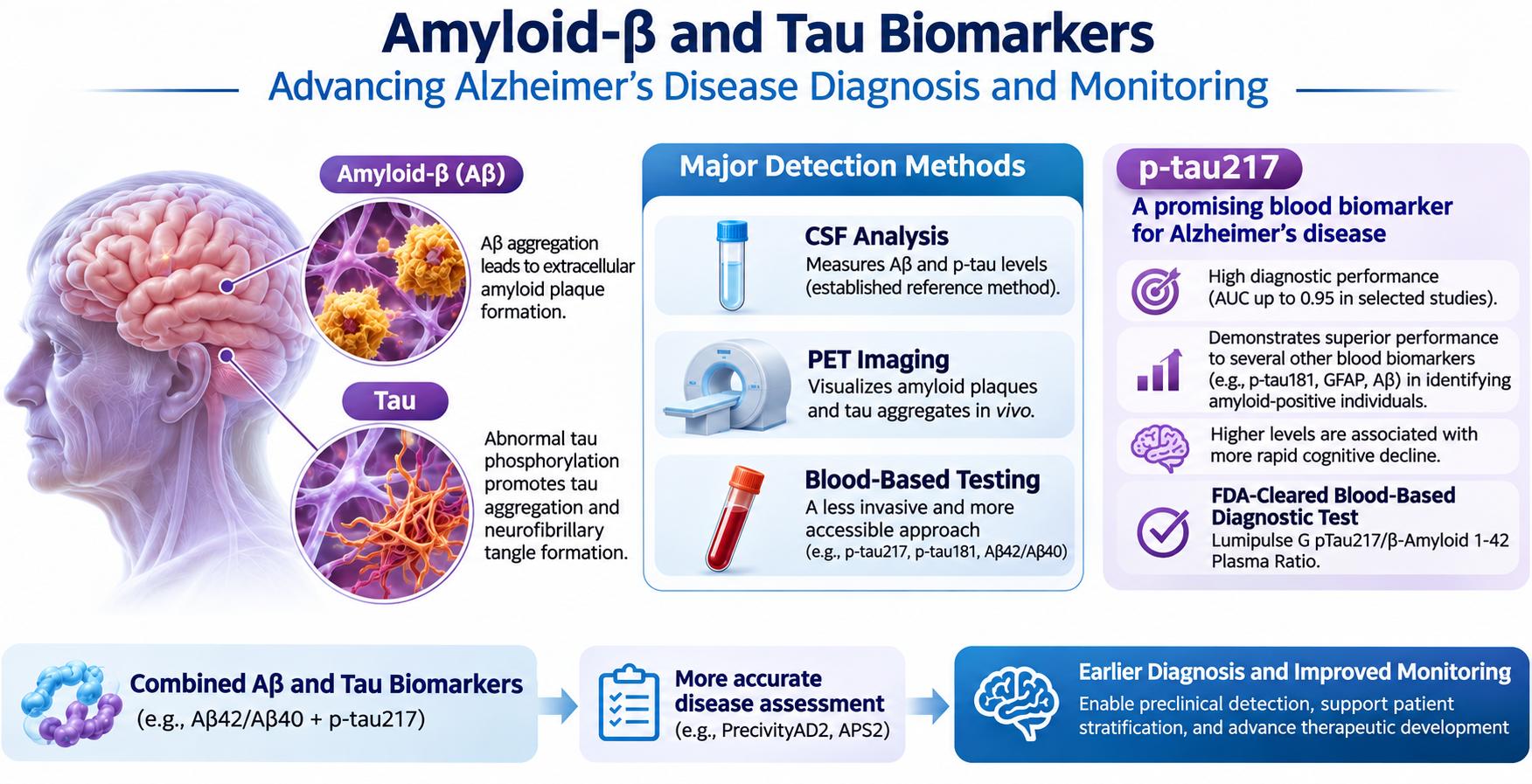
Amyloid-β and Tau: Key Biomarkers of Alzheimer’s Disease
Amyloid-β and tau reflect two closely related but distinct pathological processes in Alzheimer’s disease. Aβ peptides, particularly Aβ40 and Aβ42, are generated through the cleavage of amyloid precursor protein (APP). An imbalance between Aβ production and clearance can promote peptide aggregation and extracellular plaque formation. The Aβ42/Aβ40 ratio is therefore widely used to investigate amyloid pathology. Tau, meanwhile, is a microtubule-associated protein involved in maintaining neuronal structure and intracellular transport. Abnormal phosphorylation causes tau to detach from microtubules and aggregate into neurofibrillary tangles. Phosphorylated tau biomarkers, especially p-tau181 and p-tau217, are valuable indicators of Alzheimer’s-related pathological changes. Evaluating Aβ and tau together provides a more comprehensive understanding of disease biology than either biomarker alone.
Major Detection Methods for Aβ and Tau Biomarkers
Three major approaches are currently used to evaluate Alzheimer’s disease biomarkers. CSF analysis measures Aβ42/Aβ40 ratios and phosphorylated tau concentrations, providing established biochemical evidence of amyloid and tau pathology, although sample collection requires lumbar puncture. PET imaging enables the visualization of amyloid plaques and tau accumulation in the living brain, making it valuable for evaluating pathological distribution, but its cost and limited accessibility can restrict routine application. Blood-based testing has emerged as a less invasive alternative, allowing researchers to measure plasma Aβ42/Aβ40, p-tau181, and p-tau217 through advanced immunoassays and mass spectrometry-based technologies. These methods offer opportunities for preliminary assessment, large-scale research, and repeated biomarker monitoring.
Plasma p-tau217: A Promising Biomarker for Early Diagnosis
Among emerging blood-based biomarkers, plasma p-tau217 has demonstrated particularly strong potential for identifying Alzheimer’s-related pathology. Its concentration is associated with amyloid pathology and tau-related disease processes, allowing researchers to distinguish individuals with amyloid-positive and amyloid-negative status. Studies have reported AUC values approaching or exceeding 0.95 in certain cohorts, demonstrating its strong diagnostic performance. Higher p-tau217 levels have also been associated with greater pathological burden and more pronounced cognitive decline. These characteristics make p-tau217 an important candidate for early disease assessment, patient stratification, and longitudinal research. Nevertheless, its performance can vary depending on the assay platform, study population, and clinical context, so results should be interpreted alongside other diagnostic information.
FDA Clearance and Clinical Applications
A major milestone occurred in May 2025, when the U.S. Food and Drug Administration (FDA) cleared the Lumipulse G pTau217/β-Amyloid 1-42 Plasma Ratio as the first blood-based in vitro diagnostic device to aid in Alzheimer’s disease diagnosis. The test measures plasma p-tau217 and Aβ1-42 to help assess the likelihood of amyloid plaque accumulation. Its clinical evaluation demonstrated strong agreement with confirmatory PET or CSF results. The test is intended for adults aged 55 years and older presenting with signs and symptoms of cognitive decline in specialized care settings. It is not intended for population-wide screening or as a standalone diagnostic tool. This development highlights the growing clinical importance of blood-based Alzheimer’s biomarkers.
Comparison of p-tau217 Detection Platforms
Several analytical platforms are being investigated for plasma p-tau217 measurement, including Single Molecule Array (Simoa), Ella, and Lumipulse. Comparative studies have reported approximately 89%–95% accuracy in distinguishing amyloid-positive from amyloid-negative individuals in specific study populations. However, their analytical characteristics differ. Simoa offers high analytical sensitivity, Ella can provide a narrower indeterminate range under certain testing strategies, and Lumipulse has demonstrated a strong relationship with tau PET measurements. Selecting an appropriate platform therefore requires consideration of sensitivity, reproducibility, sample requirements, and the intended research or clinical application.
Combined Aβ and Tau Biomarkers Improve Diagnostic Assessment
Although individual biomarkers provide useful information, Alzheimer’s disease involves multiple interconnected pathological processes. Combining Aβ and tau measurements can improve diagnostic classification and reduce the limitations of relying on a single biomarker. For example, the PrecivityAD2 blood test integrates the Aβ42/Aβ40 ratio with the percentage of phosphorylated tau217 (%p-tau217) using a mass spectrometry-based approach. Its combined biomarker algorithm generates an Amyloid Probability Score 2 (APS2) to estimate the likelihood of brain amyloidosis. Clinical studies have demonstrated strong agreement with amyloid PET findings, supporting the value of multi-biomarker strategies. Other composite approaches, including normalized Aβ and p-tau measurements, are also being investigated to improve the interpretation of individual biomarker concentrations.
Detecting Alzheimer’s Pathology Before Cognitive Symptoms
One important advancement in Alzheimer’s research is the ability to identify One important advancement in Alzheimer’s research is the ability to identify pathological changes before measurable cognitive impairment develops. Amyloid accumulation and abnormal tau-related processes can begin many years before memory loss becomes apparent. Plasma p-tau217 has shown considerable potential for detecting these early biological changes. A large international study involving 2,916 cognitively unimpaired participants across 12 cohorts reported that plasma p-tau217 achieved approximately 81% accuracy in identifying amyloid status when used alone. A two-step strategy combining blood testing with confirmatory PET or CSF assessment increased the accuracy to approximately 91%. These findings support the potential application of blood-based biomarkers in early Alzheimer’s disease research and preventive clinical trial participant selection. However, the presence of amyloid pathology does not necessarily indicate that an asymptomatic individual will develop clinical Alzheimer’s dementia within a predictable timeframe.
The Role of p-tau181 in Alzheimer’s Disease Research
Despite the growing attention given to p-tau217, p-tau181 remains an established biomarker for Alzheimer’s disease investigation. It is associated with abnormal tau phosphorylation and can be measured in both CSF and plasma. Studies have demonstrated associations between p-tau181 levels and amyloid PET and tau-related pathological changes, supporting its use in evaluating different stages of the Alzheimer’s disease continuum. Although p-tau181 generally demonstrates lower diagnostic performance than p-tau217 in direct comparisons, its extensive research history, established analytical methods, and broad availability make it a valuable option for biomarker studies. Evaluating both p-tau181 and p-tau217 may help researchers better understand their complementary diagnostic and monitoring applications.
Challenges and Future Directions in Biomarker Development
Despite significant progress, several challenges remain in the development of reliable Alzheimer’s disease biomarker assays. Differences in antibody specificity, calibration materials, analytical sensitivity, and sample handling can affect measured concentrations across testing platforms. Biological factors, including age, kidney function, and other health conditions, may also influence circulating biomarker levels. Future research is therefore focusing on improving assay standardization, analytical reproducibility, and clinical validation. In addition, combining Aβ and tau biomarkers with neurodegeneration and neuroinflammation indicators, such as neurofilament light chain (NfL) and glial fibrillary acidic protein (GFAP), may provide a more comprehensive picture of disease-related changes. Advanced immunoassays and mass spectrometry-based technologies will remain important tools for developing sensitive and reliable multi-biomarker panels.
Conclusion
Amyloid-β and tau biomarkers are transforming Alzheimer’s disease research by enabling the detection and investigation of pathological changes before clinical symptoms become apparent. While CSF analysis and PET imaging remain important diagnostic approaches, blood-based testing is making biomarker assessment increasingly accessible. Plasma p-tau217 has emerged as a particularly promising candidate for early identification of Alzheimer’s-related pathology, while p-tau181 and Aβ42/Aβ40 measurements provide valuable complementary information. Continued improvements in analytical technologies, biomarker combinations, and assay standardization are expected to strengthen their applications in early diagnosis, disease monitoring, and therapeutic development.
References
1.Hampel H, et al.; Blood-based biomarkers for Alzheimer disease: mapping the road to the clinic. Nat Rev Neurol. 2018, 14(11):639-652.
2.Sharma A, et al.; Electrochemical Immunosensors Developed for Amyloid-Beta and Tau Proteins, Leading Biomarkers of Alzheimer’s Disease. Biosensors (Basel). 2023, 13(7):742.
Related Products