
When Ebola is mentioned, most people think of the devastating outbreaks caused by the Zaire species. Yet Ebola is not a single virus but a group of related viruses capable of causing severe disease. Among them, Bundibugyo virus (BDBV) remains one of the least recognized despite its ability to trigger deadly outbreaks. The resurgence of BDBV in 2026 has renewed concern over this overlooked pathogen, highlighting the need for better surveillance, diagnostics, vaccines, and therapeutics. Although generally less lethal than the Zaire species, Bundibugyo virus still poses a significant public health threat because no approved vaccine or targeted treatment is currently available.
What Is Bundibugyo Virus?
Bundibugyo virus belongs to the Filoviridae family and the Orthobolavirus genus. It is one of the Ebola virus species known to cause Ebola virus disease (EVD) in humans. First identified during an outbreak in western Uganda in 2007, it was named after the Bundibugyo District where the disease was initially detected.
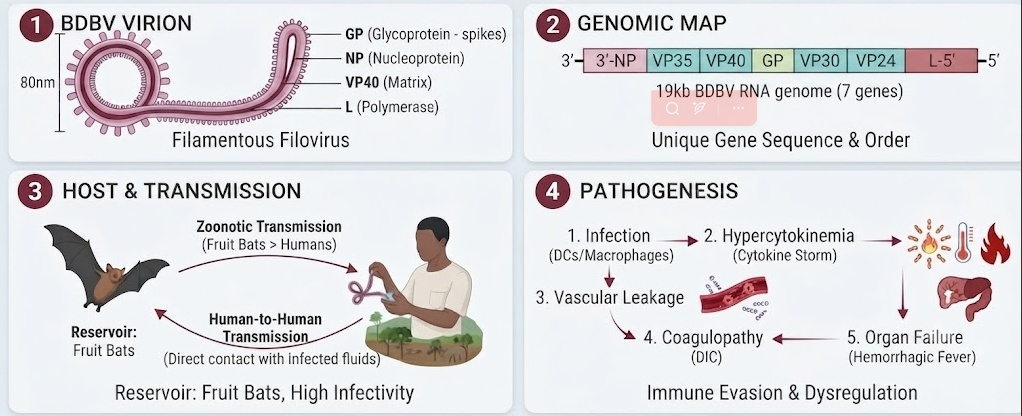
Like other Ebola viruses, BDBV is an enveloped, negative-sense, single-stranded RNA virus with a characteristic filamentous shape. Its genome is approximately 19 kb long and encodes seven structural proteins that enable viral entry, replication, immune evasion, and particle assembly.
The viral surface is covered with glycoprotein (GP), which attaches to host cells and initiates infection while helping the virus escape antibody recognition through a heavily glycosylated mucin-like domain. Beneath the envelope, VP40 directs viral assembly and budding, whereas the nucleoprotein (NP), VP30, VP35, and the L polymerase form the replication machinery. Two proteins, VP35 and VP24, also suppress interferon signaling, allowing the virus to replicate before the host develops an effective antiviral response.
From Discovery to a Renewed Public Health Threat
The first Bundibugyo virus outbreak occurred between 2007 and 2008 in Uganda, causing approximately 148 confirmed or probable infections and 37 deaths. Genetic analysis confirmed that the pathogen represented a previously unknown Ebola virus species rather than a variant of existing strains.
A second outbreak was reported in eastern Democratic Republic of the Congo (DRC) in 2012, demonstrating that the virus had established a broader geographic presence.
In 2026, Bundibugyo virus re-emerged in northeastern DRC, particularly in Ituri Province, with imported cases reported in Uganda. Hundreds of suspected infections and more than one hundred deaths prompted international concern, emphasizing that this relatively rare Ebola species continues to circulate and remains capable of causing large outbreaks.
How Bundibugyo Virus Causes Disease
Infection begins when viral GP binds to attachment factors on susceptible cells, particularly macrophages, monocytes, dendritic cells, endothelial cells, and hepatocytes. The virus enters cells through macropinocytosis, after which host enzymes activate GP inside acidic endosomes. The processed GP binds to the intracellular receptor NPC1, triggering membrane fusion and releasing the viral genome into the cytoplasm.
Once inside the cell, the viral polymerase rapidly produces new viral RNA and proteins. Newly assembled virions bud from the cell surface under the direction of VP40, allowing infection to spread efficiently throughout the body.
At the same time, VP35 and VP24 inhibit interferon-mediated antiviral responses, enabling uncontrolled viral replication. Infection of macrophages and dendritic cells also triggers excessive production of inflammatory cytokines, leading to immune dysregulation, vascular leakage, coagulation abnormalities, and progressive organ damage.
The incubation period ranges from 2 to 21 days, with symptoms typically appearing after about one week. Early illness resembles influenza, including fever, fatigue, headache, and muscle pain. As the disease progresses, patients often develop severe weakness, vomiting, diarrhea, abdominal pain, and dehydration. In advanced cases, multi-organ failure, shock, and occasionally hemorrhagic manifestations can occur, resulting in fatal outcomes.
How the Virus Spreads
Bundibugyo virus spreads primarily through direct contact with the blood or body fluids of symptomatic patients. Infection can also occur through contaminated medical equipment, clothing, bedding, or environmental surfaces. Healthcare workers face increased risk without appropriate personal protective equipment.
Animal-to-human transmission is believed to occur through contact with infected wildlife, including non-human primates and fruit bats, or during hunting and handling of bushmeat. Unlike respiratory viruses, Bundibugyo virus is not considered airborne, and infected individuals generally do not transmit the virus before symptoms develop.
Why It Remains Difficult to Control
Although Bundibugyo virus generally has a lower case fatality rate than the Zaire Ebola species, reported mortality still ranges from 25% to 50%, making it one of the world’s most dangerous infectious diseases.
Control efforts are further complicated by the absence of approved BDBV-specific vaccines or therapeutics. The licensed Ebola vaccine, Ervebo, was developed against the Zaire species and does not provide proven protection against Bundibugyo virus. Likewise, currently approved monoclonal antibody therapies are designed for Zaire Ebola and are not indicated for BDBV infection. Consequently, treatment relies on intensive supportive care, including fluid replacement, electrolyte management, oxygen therapy, and treatment of secondary complications.
The 2026 outbreak also highlighted additional obstacles, including delayed case detection, population movement across borders, mining-related migration, refugee populations, and security challenges that complicated surveillance and contact tracing.
Looking Ahead
Bundibugyo virus demonstrates that Ebola remains a diverse and evolving public health challenge. Continued investment in broad-spectrum Ebola vaccines, antiviral therapies, rapid diagnostics, and ecological surveillance will be essential for improving preparedness against future outbreaks.
Although it receives far less attention than the Zaire species, Bundibugyo virus should not be underestimated. Its ability to evade immune defenses, spread rapidly through direct contact, and cause severe multi-organ disease underscores the need for sustained research and international collaboration. As the 2026 outbreak has shown, understanding this “other” Ebola virus is critical to strengthening global readiness for emerging infectious diseases.
Related Products
Antibody:
| Target | Cat. No | Product Name | Host | Application |
| EBOV Nucleoprotein | CABT-CS861 | Anti-EBOV NP Mab, clone F150 | Mouse | ELISA (Cap), LFIA |
| EBOV Nucleoprotein | CABT-CS862 | Anti-EBOV NP Mab, clone F161 | Mouse | ELISA (Det), LFIA |
| EBOV Nucleoprotein | DMAB-A005 | Anti-EBOV NP Mab, clone C4263N | Mouse | ELISA (Cap), LFIA, WB |
| EBOV Nucleoprotein | DMAB-A006 | Anti-EBOV NP Mab, clone C4264N | Mouse | ELISA (Det), LFIA, WB |
| EBOV Nucleoprotein | CABT-L2655 | Anti-EBOV NP Mab, clone LA62 | Mouse | IP, WB, ELISA, IF |
| EBOV Nucleoprotein | CABT-L2656 | Anti-EBOV NP Mab, clone LA62 | Rabbit | IP, WB, ELISA, IF |
| EBOV Nucleoprotein | CABT-L2654 | Anti-EBOV NP Mab, clone LA62 | Human | IP, WB, ELISA, IF |
| EBOV Nucleoprotein | CABT-B1096 | Anti-EBOV NP Pab | Rabbit | ELISA, WB |
| EBOV VP40 | CABT-CS144 | Anti-EBOV VP40 Mab, clone N93067 | Mouse | ELISA (Cap), LFIA, WB |
| EBOV VP40 | CABT-CS145 | Anti-EBOV VP40 Mab, clone N93068 | Mouse | ELISA (Det), LFIA, WB |
| EBOV VP40 | DMAB-CS23038 | Anti-EBOV VP40 Mab, clone 4C0 | Rabbit | ELISA, IF, LFIA |
| EBOV VP40 | DMAB-CS23039 | Anti-EBOV VP40 Mab, clone 4G7 | Rabbit | ELISA, IF, LFIA |
| EBOV VP40 | CABT-RM281 | Anti-EBOV VP40 Mab, clone C4267N | Mouse | ELISA, WB |
| EBOV VP40 | CABT-B1100 | Anti-EBOV VP40 Pab | Rabbit | ELISA, WB |
| EBOV Glycoprotein | CABT-L2658 | Anti-EBOV GP Mab, clone LA63 | Mouse | crystallization, IP, Neut, IF |
| EBOV Glycoprotein | CABT-L2659 | Anti-EBOV GP Mab, clone LA63 | Rabbit | crystallization, IP, Neut, IF |
| EBOV Glycoprotein | CABT-L2657 | Anti-EBOV GP Mab, clone LA63 | Human | crystallization, IP, Neut, IF |
| EBOV Glycoprotein | CABT-B8488 | Anti-EBOV GP Mab, clone 5G4 | Mouse | ELISA |
| EBOV Glycoprotein | DMAB-CS23143 | Anti-EBOV GP I Mab, clone 58G0 | Mouse | WB |
| EBOV Glycoprotein | DMAB-CS23144 | Anti-EBOV GP II Mab, clone 5D89 | Mouse | WB |
| EBOV Glycoprotein | CABT-B1093 | Anti-EBOV GP Pab | Rabbit | ELISA, WB |
| EBOV Glycoprotein | CABT-L2769 | Anti-EBOV GP Pab | Rabbit | ELISA, WB, IF |
| EBOV Glycoprotein | CABT-B1097 | Anti-EBOV Soluble GP Pab | Rabbit | ELISA, WB |
| EBOV Glycoprotein | CABT-B1094 | Anti-EBOV GP Pab [Biotin] | Rabbit | ELISA, WB |
| EBOV Glycoprotein | CABT-CSV777 | NeutraAb™ Anti-Pan-EBOV GP Mab, clone ADI-15878 | Human | Neut, ELISA, IB |
| EBOV Glycoprotein | CABT-CSV778 | NeutraAb™ Anti-Pan-EBOV GP Mab, clone ADI-15878 | Mouse | Neut, ELISA, IB |
| EBOV Glycoprotein | CABT-CSV779 | NeutraAb™ Anti-Pan-EBOV GP Mab, clone ADI-15878 | Rabbit | Neut, ELISA, IB |
| EBOV Glycoprotein | CABT-JXC195 | NeutraAb™ Anti-Pan-EBOV Mab, clone EBOV-442 | Human | Neut, ELISA |
| EBOV Glycoprotein | CABT-JXC314 | NeutraAb™ Anti-Pan-EBOV Mab, clone EBOV-442 | Mouse | Neut, ELISA |
| EBOV Glycoprotein | CABT-JXC434 | NeutraAb™ Anti-Pan-EBOV Mab, clone EBOV-442 | Rabbit | Neut, ELISA |
| EBOV Glycoprotein | CABT-CSV735 | NeutraAb™ Anti-Pan-EBOV GP Mab, clone rEBOV-515 | Human | Neut, ELISA |
| EBOV Glycoprotein | CABT-CSV736 | NeutraAb™ Anti-Pan-EBOV GP Mab, clone rEBOV-515 | Mouse | Neut, ELISA |
| EBOV Glycoprotein | CABT-CSV737 | NeutraAb™ Anti-Pan-EBOV GP Mab, clone rEBOV-515 | Rabbit | Neut, ELISA |
| EBOV Glycoprotein | CABT-YN1235 | NeutraAb™ Anti-Pan-EBOV Mab, clone 6D6 | Human | Neut, ELISA |
| EBOV Glycoprotein | CABT-YN1312 | NeutraAb™ Anti-Pan-EBOV Mab, clone 6D6 | Mouse | Neut, ELISA |
| EBOV Glycoprotein | CABT-NS1079 | NeutraAb™ Anti-EBOV GP Mab, clone ADI-15946 | Human | Neut, Inhib |
| EBOV Glycoprotein | CABT-NS1080 | NeutraAb™ Anti-EBOV GP Mab, clone ADI-15946 | Mouse | Neut, Inhib |
| EBOV Glycoprotein | CABT-JXC206 | NeutraAb™ Anti-EBOV GP Mab, clone EBOV-293 | Human | Neut, ELISA |
| EBOV Glycoprotein | CABT-JXC325 | NeutraAb™ Anti-EBOV GP Mab, clone EBOV-293 | Mouse | Neut, ELISA |
| EBOV Glycoprotein | CABT-JXC445 | NeutraAb™ Anti-EBOV GP Mab, clone EBOV-293 | Rabbit | Neut, ELISA |
| EBOV Glycoprotein | CABT-JXC196 | NeutraAb™ Anti-EBOV GP Mab, clone EBOV-296 | Human | Neut, ELISA |
| EBOV Glycoprotein | CABT-JXC315 | NeutraAb™ Anti-EBOV GP Mab, clone EBOV-296 | Mouse | Neut, ELISA |
| EBOV Glycoprotein | CABT-JXC435 | NeutraAb™ Anti-EBOV GP Mab, clone EBOV-296 | Rabbit | Neut, ELISA |
| EBOV Glycoprotein | CABT-JXC181 | NeutraAb™ Anti-EBOV GP Mab, clone EBOV-437 | Human | Neut, ELISA |
| EBOV Glycoprotein | CABT-JXC300 | NeutraAb™ Anti-EBOV GP Mab, clone EBOV-437 | Mouse | Neut, ELISA |
| EBOV Glycoprotein | CABT-JXC420 | NeutraAb™ Anti-EBOV GP Mab, clone EBOV-437 | Rabbit | Neut, ELISA |
| EBOV Glycoprotein | CABT-CSV281 | NeutraAb™ Anti-EBOV GP Mab, clone EBOV-520 | Human | Neut, ELISA |
| EBOV Glycoprotein | CABT-CSV282 | NeutraAb™ Anti-EBOV GP Mab, clone EBOV-520 | Mouse | Neut, ELISA |
| EBOV Glycoprotein | CABT-CSV283 | NeutraAb™ Anti-EBOV GP Mab, clone EBOV-520 | Rabbit | Neut, ELISA |
| EBOV Glycoprotein | CABT-NS1074 | NeutraAb™ Anti-EBOV GP Mab, clone 13F6-1-2 | Human | FuncS, Neut, WB, ELISA |
| EBOV Glycoprotein | CABT-NS1073 | NeutraAb™ Anti-EBOV GP Mab, clone 13F6-1-2 | Mouse | FuncS, Neut, WB, ELISA |
| EBOV Glycoprotein | CABT-NS1072 | NeutraAb™ Anti-EBOV GP Mab, clone 13F6-1-2 | Rabbit | FuncS, Neut, WB, ELISA |
| EBOV Glycoprotein | CABT-NS1077 | NeutraAb™ Anti-EBOV GP Mab, clone CA54 | Human | Neut, ELISA |
| EBOV Glycoprotein | CABT-NS1078 | NeutraAb™ Anti-EBOV GP Mab, clone CA54 | Mouse | Neut, ELISA |
| EBOV Glycoprotein | CABT-JXC092 | NeutraAb™ Anti-EBOV GP Mab, clone KZ52 | Human | IP, Neut, IF |
| EBOV Glycoprotein | CABT-CSV552 | NeutraAb™ Anti-EBOV GP Mab, clone KZ52 | Mouse | IP, Neut, IF |
| EBOV Glycoprotein | CABT-CSV553 | NeutraAb™ Anti-EBOV GP Mab, clone KZ52 | Rabbit | IP, Neut, IF |
| EBOV Glycoprotein | CABT-JXC225 | NeutraAb™ Anti-EBOV GP Mab, clone 9.20.1A2 | Human | Neut, ELISA |
| EBOV Glycoprotein | CABT-JXC344 | NeutraAb™ Anti-EBOV GP Mab, clone 9.20.1A2 | Mouse | Neut, ELISA |
| EBOV Glycoprotein | CABT-JXC464 | NeutraAb™ Anti-EBOV GP Mab, clone 9.20.1A2 | Rabbit | Neut, ELISA |
| EBOV Glycoprotein | CABT-JXC238 | NeutraAb™ Anti-EBOV GP Mab, clone 114 | Human | Neut, ELISA |
| EBOV Glycoprotein | CABT-JXC357 | NeutraAb™ Anti-EBOV GP Mab, clone 114 | Mouse | Neut, ELISA |
| EBOV Glycoprotein | CABT-JXC477 | NeutraAb™ Anti-EBOV GP Mab, clone 114 | Rabbit | Neut, ELISA |
| EBOV | CABT-NS1075 | NeutraAb™ Anti-EBOV Mab, clone EBOV-548 | Human | Neut, ELISA |
| EBOV | CABT-NS1076 | NeutraAb™ Anti-EBOV Mab, clone EBOV-548 | Mouse | Neut, ELISA |
| EBOV | DMAB8624 | Anti-EBOV Mab, Clone GF19 | Mouse | ELISA, WB |
| EBOV | DMAB8625 | Anti-EBOV Mab, Clone GF38 | Mouse | ELISA, WB |
| EBOV | DPAB-CS23039 | Anti-EBOV Pab | Sheep | ELISA |
| EBOV VP24 | DPAB-CS23009 | Anti-EBOV VP24 (C-terminal) Pab | Rabbit | ELISA, WB |
| EBOV VP30 | DPAB-CS23010 | Anti-EBOV VP30 (N-terminal) Pab | Rabbit | ELISA, WB |
| EBOV VP35 | CABT-B1099 | Anti-EBOV VP35 Pab | Rabbit | ELISA, WB |
| EBOV L-Polymerase | CABT-B1095 | Anti-EBOV L-Polymerase Pab | Rabbit | ELISA, WB |
| EBOV VLP | CABT-B1098 | Anti-EBOV VLP Pab | Rabbit | ELISA, WB |
Antigen:
| Virus specie | Cat. No | Product Name | Target | Expression System |
| Zaire Ebola virus (EBOV) | DAGA-3013 | Ebola NP antigen [His] | Nucleoprotein (NP) | E. coli |
| Zaire Ebola virus (EBOV) | DAGZ016 | Ebola-Z glycoprotein (180 aa, mucin like domain) | Glycoprotein (GP) | E. coli |
| Zaire Ebola virus (EBOV) | DAGB180 | Ebola virus Glycoprotein (minus the Transmembrane Region) [His] | Glycoprotein (GP) | Insect cells |
| Zaire Ebola virus (EBOV) | DAGB181 | Ebola virus Glycoprotein (minus the Transmembrane Region) [HA] | Glycoprotein (GP) | Mammalian cells |
| Zaire Ebola virus (EBOV) | DAGB182 | Ebolavirus Soluble Glycoprotein [His] (DAGB182) | Glycoprotein (GP) | Mammalian cells |
| Zaire Ebola virus (EBOV) | DAGA-3111 | Recombinant Ebola GP (Zaire) | Glycoprotein (GP) | HEK293 cells |
| Zaire Ebola virus (EBOV) | DAGC672 | Recombinant EBOV Nucleoprotein [His] | Nucleoprotein (NP) | HEK293 cells |
| Zaire Ebola virus (EBOV) | DAGB179 | Ebola virus-like particles | Glycoprotein (GP), Nucleoprotein (NP), Matrix protein (VP40) | Insect cells |
| Zaire Ebola virus (EBOV) | DAGB183 | Ebola virus VP40 matrix protein | Matrix protein (VP40) | E. coli |
| Zaire Ebola virus (EBOV) | DAGA-970 | Recombinant ebola zaire nucleoprotein (>95%) [His] | Nucleoprotein (NP) | E. coli |
| Zaire Ebola virus (EBOV) | DAG-WT132 | Recombinant Ebola Zaire Nucleoprotein [His] | Nucleoprotein (NP) | HEK293 cells |
| Zaire Ebola virus (EBOV) | DAG-WT267 | Recombinant Zaire Ebola Virus glycoprotein 1 (GP1) [His] | Glycoprotein (GP) | HEK293 cells |
| Zaire Ebola virus (EBOV) | DAG-WT268 | Biotinylated Zaire Ebola Virus glycoprotein 1,2 (GP1,2) [His,Avi] | Glycoprotein (GP) | HEK293 cells |
| Zaire Ebola virus (EBOV) | DAG-WT269 | Recombinant Zaire Ebola Virus glycoprotein 1,2 (GP1,2) [His] | Glycoprotein (GP) | HEK293 cells |
| Zaire Ebola virus (EBOV) | DAG-CS144P | Recombinant Ebola Virus VP40 protein [His, GST] | Matrix protein (VP40) | E. coli |
| Taï Forest virus (TAFV) | DAG-WT7785 | Recombinant Tai Forest ebolavirus (TAFV) Glycoprotein 1 (GP1) [His] | Glycoprotein (GP) | Mammalian cells |
| Taï Forest virus (TAFV) | DAG-WT7786 | Recombinant Tai Forest ebolavirus (TAFV) Glycoprotein 1 (GP1) [Fc] | Glycoprotein (GP) | Mammalian cells |
| Taï Forest virus (TAFV) | DAG-WT7787 | Recombinant Tai Forest ebolavirus (TAFV) Glycoprotein 1 (GP1) [His] | Glycoprotein (GP) | E. coli |
| Sudan virus (SUDV) | DAGZ015 | Ebola-S nuclear protein (aa 629-728) | Nucleoprotein (NP) | E. coli |
| Sudan virus (SUDV) | DAGA-3107 | Recombinant Ebola GP (Sudan – Nakisamata) | Glycoprotein (GP) | HEK293 cells |
| Sudan virus (SUDV) | DAG-H10347 | SUDV Glycoprotein [His] | Glycoprotein (GP) | Mammalian cells |
| Sudan virus (SUDV) | DAG-H10348 | SUDV Glycoprotein [His] | Glycoprotein (GP) | Insect cells |
| Sudan virus (SUDV) | DAG-WT375 | Recombinant Sudan Virus (SUDV) VLP | Glycoprotein (GP), Nucleoprotein (NP), Matrix protein (VP40) | Insect cells |
| Sudan virus (SUDV) | DAGB188 | Recombinant Sudan virus Glycoprotein (minus the Transmembrane Region) [His] | Glycoprotein (GP) | Insect cells |
| Reston ebolavirus (REBOV) | DAGB187 | Reston Ebolavirus Glycoprotein (minus the Transmembrane Region) [His] | Glycoprotein (GP), Nucleoprotein (NP), Matrix protein (VP40) | Insect cells |
| Reston ebolavirus (REBOV) | DAG-WT7788 | Recombinant Reston ebolavirus (REBOV) Glycoprotein 1 (GP1) [His] | Glycoprotein (GP) | Mammalian cells |
| Reston ebolavirus (REBOV) | DAG-WT7789 | Recombinant Reston ebolavirus (REBOV) Glycoprotein 1 (GP1) [Fc] | Glycoprotein (GP) | Mammalian cells |
| Reston ebolavirus (REBOV) | DAG-WT7790 | Recombinant Reston ebolavirus (REBOV) Glycoprotein 1 (GP1) [His] | Glycoprotein (GP) | E. coli |
| Bundibugyo virus (BDBV) | DAG-WT1099 | Recombinant Bundibugyo Ebolavirus GP Δmucin | Glycoprotein (GP) | HEK293 cells |
| Bundibugyo virus (BDBV) | DAGB178 | Bundibugyo Glycoprotein (minus the Transmembrane Region) [His] | Glycoprotein (GP) | Insect cells |
| Bombali virus (BOMV) | DAG-WT7791 | Recombinant Bombali virus (BOMV) Glycoprotein 1 (GP1) [His] | Glycoprotein (GP) | Mammalian cells |
| Bombali virus (BOMV) | DAG-WT7792 | Recombinant Bombali virus (BOMV) Glycoprotein 1 (GP1) [Fc] | Glycoprotein (GP) | Mammalian cells |
| Bombali virus (BOMV) | DAG-WT7793 | Recombinant Bombali virus (BOMV) Glycoprotein 1 (GP1) [His] | Glycoprotein (GP) | E. coli |
ELISA Kit:
RT-PCR Kit:
| Cat. No. | Product Name | Test Species |
| PCR-WN-137 | Ebola virus Real Time PCR Kit (50 Reactions, Qualitative) | Zaire ebolavirus, Sudan ebolavirus, Bundibugyo ebolavirus, and Tai Forest ebolavirus |
| PCR-NS2409-1 | Marburg Virus Real Time PCR Kit (50 Reactions, Qualitative) | Marburg Virus |
| PCR-NS2620 | Bundibugyo ebolavirus Real Time PCR Kit (50 Reactions, Qualitative) | Bundibugyo ebolavirus |
Nucleic Acid Standard Reference:
| Cat. No. | Product Name | Target Value* |
| NA-GWP-SR-39-L1 | Ebola Virus Zaire Type NP/GP Gene Nucleic Acid Standard Reference (1 mL/vial) | 5000 copies/mL |
| NA-GWP-SR-39-S1 | Ebola Virus Zaire Type NP/GP Gene Nucleic Acid Standard Reference (1 mL/vial) | 2000 copies/mL |
| NA-GWP-SR-39-S2 | Ebola Virus Zaire Type NP/GP Gene Nucleic Acid Standard Reference (1 mL/vial) | 1000 copies/mL |
| NA-GWP-SR-39-S3 | Ebola Virus Zaire Type NP/GP Gene Nucleic Acid Standard Reference (1 mL/vial) | 500 copies/mL |
| NA-GWP-SR-40-L1 | Bundibugyo Virus Type NP Gene Nucleic Acid Standard Reference (1 mL/vial) | 5000 copies/mL |
| NA-GWP-SR-40-S1 | Bundibugyo Virus Type NP Gene Nucleic Acid Standard Reference (1 mL/vial) | 2000 copies/mL |
| NA-GWP-SR-40-S2 | Bundibugyo Virus Type NP Gene Nucleic Acid Standard Reference (1 mL/vial) | 1000 copies/mL |
| NA-GWP-SR-40-S3 | Bundibugyo Virus Type NP Gene Nucleic Acid Standard Reference (1 mL/vial) | 500 copies/mL |