
Antibiotics are widely used across food production, animal health, and biopharmaceutical manufacturing. While these compounds play an essential role in preventing bacterial contamination or improving production efficiency, their unintended residues in biological products can create significant safety and regulatory challenges. Even trace levels of antibiotics may cause allergic reactions, disrupt gut microbiota, or contribute to the broader issue of antimicrobial resistance. For manufacturers of food-derived biological products, vaccines, recombinant proteins, and cell therapy materials, reliable residue detection is therefore an essential component of quality control.
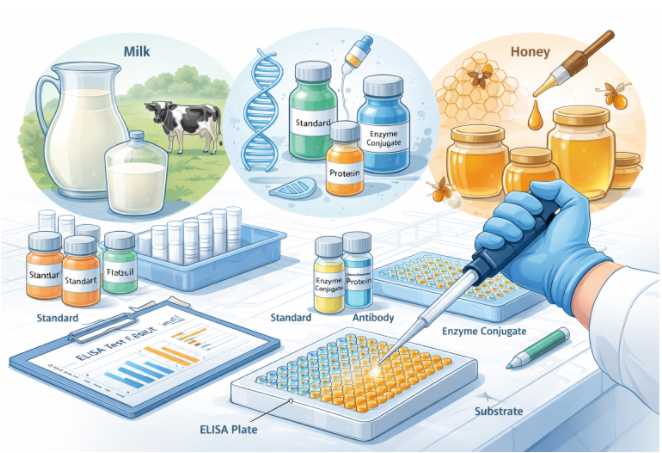
In recent years, enzyme-linked immunosorbent assay (ELISA) has become one of the most widely adopted analytical approaches for screening antibiotic residues. The technique combines immunological specificity with relatively simple instrumentation, making it suitable for high-throughput monitoring across a variety of biological matrices. Compared with advanced chromatographic techniques such as HPLC or LC-MS, ELISA offers faster turnaround times and lower operational costs, which makes it particularly valuable during early screening or large-scale surveillance programs.
The growing complexity of biological products—from dairy foods to gene therapy materials—has further increased the demand for sensitive and adaptable detection technologies. ELISA kits designed for specific antibiotics or antibiotic classes now allow laboratories to rapidly evaluate residue levels in different biological systems while maintaining compliance with regulatory standards.
The Principle of ELISA for Antibiotic Residue Detection
ELISA is an immunoassay that relies on highly specific antigen–antibody interactions. In antibiotic residue testing, antibodies designed to recognize a specific antibiotic molecule bind to the compound present in the sample. The assay then uses enzyme-labeled secondary antibodies or conjugated antigens to produce a measurable signal, typically through a colorimetric reaction.
Most antibiotic detection assays employ a competitive ELISA format because antibiotics are small molecules that cannot simultaneously bind two antibodies. In this format, the antibiotic present in the sample competes with an enzyme-labeled antibiotic analogue for binding to immobilized antibodies. As the concentration of antibiotic in the sample increases, less labeled antigen binds to the antibody, leading to a weaker signal. By comparing the signal intensity with a calibration curve generated from known standards, researchers can determine the antibiotic concentration in the tested sample.
One major advantage of ELISA is its capacity to detect residues at very low concentrations, often in the nanogram or microgram per kilogram range. The technique also allows multiple samples to be analyzed simultaneously using microplate formats, significantly improving laboratory efficiency.
Sample Preparation Across Different Biological Products
Different biological products require different sample preparation strategies before ELISA testing. Proper sample handling is essential to remove interfering substances, improve assay accuracy, and ensure reproducible results.
For dairy products such as milk, sample preparation typically involves centrifugation or filtration to remove fat and particulate matter. In some cases, simple dilution is sufficient because ELISA kits are designed to tolerate common milk components. These procedures help ensure that antibodies can interact freely with antibiotic molecules without interference from complex proteins or lipids.
In the context of biopharmaceutical production, sample preparation often involves purified materials such as plasmid DNA, recombinant proteins, or fermentation intermediates. These samples usually require minimal processing, although buffer compatibility and dilution factors must be carefully controlled to maintain antibody binding efficiency.
Special biological products such as honey present additional analytical challenges due to their viscosity and high sugar content. Researchers commonly dilute honey samples with buffered solutions or perform extraction steps to improve detection accuracy. These preparation steps help ensure that the assay remains sensitive while minimizing matrix interference.
Applications in Milk and Dairy Product Monitoring
Milk is one of the most intensively studied biological products for antibiotic residue detection. Antibiotics are frequently administered to dairy cattle to treat infections, particularly mastitis. If withdrawal periods are not strictly followed, residues may remain in milk and enter the human food supply.
A recent study conducted by researchers including Raza (2024) investigated the presence of penicillin and oxytetracycline residues in milk samples collected from different sources, including raw milk, bulk milk, and ultra-high-temperature (UHT) processed milk. Using ELISA screening kits, the study detected antibiotic residues in approximately 29.78% of tested samples, with average concentrations around 98.43 ± 6.86 μg/kg.
The research also compared ELISA with high-performance liquid chromatography (HPLC). While HPLC demonstrated greater sensitivity for extremely low concentrations, ELISA proved highly effective as a rapid screening method. Because it requires less specialized equipment and shorter analysis time, ELISA is particularly suitable for large-scale monitoring programs within dairy production systems.
Another regional surveillance study conducted in Iran evaluated antibiotic residues in cattle milk using ELISA-based screening. The results revealed that nearly half of the tested samples contained at least one antibiotic residue, highlighting the importance of routine monitoring and strict regulation of veterinary antibiotic use.
Monitoring Antibiotic Residues in Biopharmaceutical Production
Antibiotics are frequently used in biotechnology laboratories to maintain selective pressure during microbial fermentation or plasmid propagation. For example, kanamycin, ampicillin, or gentamicin may be added to bacterial culture media to ensure the stability of recombinant plasmids. Although these antibiotics are essential for efficient production, their residues must be carefully controlled in final biological products.
In the development of gene therapies, vaccines, and recombinant proteins, regulatory authorities require manufacturers to demonstrate that antibiotic residues are absent or below established safety thresholds. ELISA assays provide a practical tool for routine quality control during production and purification processes.
A study focusing on cell and gene therapy raw materials examined antibiotic residues in plasmid DNA preparations and recombinant protein products. Researchers used ELISA kits targeting kanamycin and gentamicin residues to evaluate multiple production batches. The results showed that, under well-controlled manufacturing conditions, antibiotic levels were consistently below the detection limits of the assays. These findings confirmed the suitability of ELISA for monitoring antibiotic contamination in advanced therapeutic products.
By enabling rapid screening of raw materials and intermediate products, ELISA helps manufacturers detect contamination early in the production process and maintain consistent product quality.
Detecting Antibiotics in Specialized Biological Products
Beyond dairy and pharmaceutical materials, antibiotic residues may also appear in specialized biological products such as honey or bee-derived substances. Antibiotics are sometimes used in apiculture to control bacterial infections in bee colonies. However, improper use can lead to residues in honey, raising concerns about food safety and international trade regulations.
Recent research has focused on developing highly specific ELISA methods to detect fluoroquinolone residues in honey. In one study, scientists established an indirect competitive ELISA capable of detecting ofloxacin residues with remarkable sensitivity. After optimizing antigen conjugation and antibody selection, the assay achieved an IC50 value of approximately 1.17 ng/mL.
The method demonstrated strong analytical performance, with recovery rates reaching 84.1% and minimal cross-reactivity with structurally related antibiotics. These characteristics make the assay particularly useful for monitoring antibiotic contamination in honey and other bee products. The study also highlights how targeted antibody development can significantly improve ELISA sensitivity and specificity.
Advantages and Limitations of ELISA-Based Detection
ELISA offers several advantages that make it attractive for antibiotic residue screening. The assay is relatively easy to perform, requires minimal specialized equipment, and can process dozens of samples simultaneously. These features make it highly suitable for routine monitoring in laboratories responsible for food safety or biopharmaceutical quality control.
Another strength of ELISA lies in its specificity. Carefully designed antibodies can recognize particular antibiotics or classes of antibiotics with high selectivity. This capability allows researchers to tailor assays for specific regulatory requirements or targeted surveillance programs.
However, ELISA also has certain limitations. Compared with chromatographic techniques such as HPLC or LC-MS, ELISA may have slightly higher detection limits and may occasionally produce cross-reactivity with structurally similar compounds. For this reason, ELISA is often used as an initial screening method, while confirmatory analysis may be performed using chromatographic techniques when necessary.
Despite these limitations, ELISA remains one of the most practical tools for rapid antibiotic residue detection across diverse biological matrices.
Future Trends in ELISA-Based Antibiotic Monitoring
As biological products become more complex and regulatory standards continue to evolve, researchers are actively working to improve ELISA technologies. One major direction involves the development of high-affinity monoclonal antibodies that can detect antibiotics at even lower concentrations. Advances in antibody engineering and recombinant antibody production are making these improvements increasingly feasible.
Another emerging trend is the integration of ELISA with automated platforms and high-throughput screening systems. Automation reduces manual errors and allows laboratories to analyze hundreds of samples within a short timeframe, which is particularly valuable for large monitoring programs.
Researchers are also exploring multiplex immunoassays capable of detecting multiple antibiotics simultaneously. Such systems could dramatically improve testing efficiency, especially in industries where multiple antibiotics may be present.
These ongoing innovations are expected to further expand the role of ELISA in antibiotic residue monitoring across food safety, environmental analysis, and advanced biopharmaceutical manufacturing.
References
- Kneebone J, et al.; Short communication: Rapid antibiotic screening tests detect antibiotic residues in powdered milk products. J Dairy Sci. 2010, 93(9):3961-4.
- Al-Amri I, et al.; Determination of residues of pesticides, anabolic steroids, antibiotics, and antibacterial compounds in meat products in Oman by liquid chromatography/mass spectrometry and enzyme-linked immunosorbent assay. Vet World. 2021, 14(3):709-720.
Related Products
| Cat. No. | Product Name | Sample | |
| DEIA040 | Ampicillin | Vaccine | Inquiry |
| DEIABL-QB25 | Benzyl penicillin | Biological samples | Inquiry |
| DEIA6881 | Chloramphenicol | Biological samples, fish, shrimp, eggs, honey, meat (beef, chicken and pork), milk, milk powder, condensed milk and serum | Inquiry |
| DEIA6881V2 | Chloramphenicol | Vaccine | Inquiry |
| DEIA042 | Colistin | Beef, pork, chicken | Inquiry |
| DEIABL-QB20 | Erythromycin | Tissue(muscle), cell supernatant, vaccine, water, honey, milk | Inquiry |
| DEIA047 | Gentamicin | Vaccine, cell culture supernatant | Inquiry |
| DEIA-WZ6884 | High Sensitivity Gentamicin | Cell lysate, urine, serum, recombinant protein, fermentation liquid | Inquiry |
| DEIA048 | Kanamycin | Biological samples | Inquiry |
| DEIA-WZ048V | High Sensitivity Kanamycin | Biological samples | Inquiry |
| DEIA043 | Neomycin | Cell culture supernatant, vaccine, milk | Inquiry |
| DEIA-XYZ35 | Oxytetracycline | Biological samples, honey, butter, fermented milk, feed, egg, cheese, milk, meat, meat products (sausage), fish and shrimp | Inquiry |
| DEIA020 | Streptomycin | Vaccine, cell culture supernatant | Inquiry |
| DEIA-WZ020 | High Sensitivity Streptomycin | Serum, urine, recombinant protein | Inquiry |
| DEIANJ11 | Human Vancomycin | Human serum, plasma | Inquiry |