ASM Microbe 2026
June 4-7, 2026 – Washington, DC, USA
ADLM 2026
July 26-30, 2026 – Anaheim, CA, USA

What is Monomethyl Auristatin E (MMAE)

In the realm of cancer treatment, researchers are constantly striving to develop innovative therapeutic options that can effectively target malignant cells while minimizing damage to healthy tissues. One such breakthrough in the field of targeted cancer therapy is Monomethyl Auristatin E (MMAE). This potent cytotoxic agent has shown remarkable promise in selectively destroying cancer cells, offering new hope for patients battling various types of cancer.
Browse all MMAE products

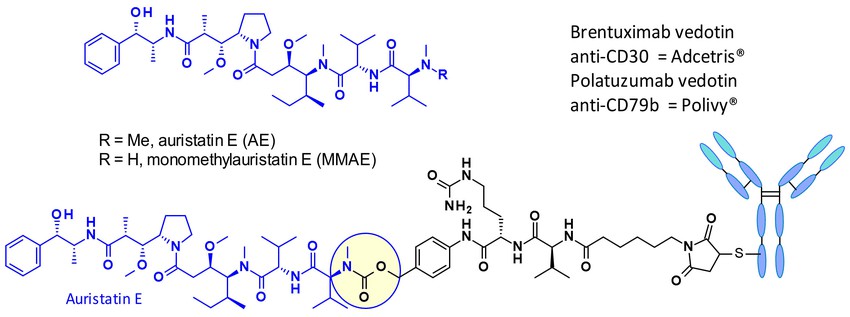
Structure of auristatin E (AE), MMAE, and commercially approved auristatin-based ADCs: Target Antigen.Figure 1. Structure of auristatin E (AE), MMAE, and commercially approved auristatin-based ADCs: Target Antigen.
(Source: Kostova, V. et al., 2021)

Understanding MMAE

MMAE is a synthetic antineoplastic agent derived from peptides found in the marine shell-less mollusc Dolabella auricularia, known as dolastatins. MMAE demonstrated remarkable potency in preclinical studies, exhibiting exceptional activity against various lymphomas, leukemia, and solid tumors both in vitro and in vivo. Its potency can reach up to 200 times that of vinblastine, another commonly used antimitotic drug for Hodgkin lymphoma and other cancers.

However, due to its inherent toxicity, MMAE cannot be administered as a standalone drug. Instead, it is conjugated with a monoclonal antibody (MAB) to form MMAE-MAB conjugates, with the linking structure referred to as vedotin in International Nonproprietary Names. This conjugation allows for targeted delivery of MMAE to cancer cells, enhancing its therapeutic efficacy while minimizing adverse effects on healthy tissues.

Mechanism of Action

MMAE exerts its cytotoxic effects by disrupting microtubule assembly, thereby inhibiting cell division and causing cell death. Upon binding to tubulin, MMAE prevents the polymerization of tubulin subunits into microtubules, leading to the disruption of the cellular cytoskeleton. This disruption hinders vital cellular processes, such as mitosis and intracellular transport, ultimately leading to apoptosis (programmed cell death) in cancer cells.

Antibody-Drug Conjugates (ADCs)

One of the most promising applications of MMAE lies in its utilization as an integral component of antibody-drug conjugates (ADCs). ADCs are a groundbreaking class of biopharmaceuticals that combine the specificity of monoclonal antibodies with the cytotoxic effects of MMAE. These ADCs are designed to selectively target cancer cells expressing specific surface antigens, delivering MMAE directly to the tumor site.

The linker that connects MMAE to the monoclonal antibody in ADCs is designed to be stable in extracellular fluid. However, once the ADC binds to the targeted cancer cell antigen and enters the cancer cell, the linker is cleaved by cathepsin, an enzyme present within the cell. This enzymatic cleavage releases the toxic MMAE, activating its potent anti-mitotic mechanism.

Quantification of MMAE-conjugated ADCs

Quantifying MMAE-conjugated ADCs is an essential step in their development and characterization. Accurate quantification allows researchers to determine the drug-to-antibody ratio (DAR), which indicates the average number of MMAE molecules attached to each antibody molecule in the ADC.

Various methods are available for quantifying MMAE-conjugated ADCs, and their selection depends on factors such as sensitivity, accuracy, and compatibility with the specific ADC formulation. Here are some commonly used techniques:

  • UV-Visible Spectroscopy: UV-Visible spectroscopy measures the absorption of light by molecules in the ultraviolet and visible range. By utilizing the characteristic absorption wavelength of MMAE, this technique can estimate the concentration of MMAE in the ADC. However, it does not provide direct information about the DAR.
  • Liquid Chromatography-Mass Spectrometry (LC-MS): LC-MS is a powerful analytical technique that combines liquid chromatography with mass spectrometry detection. It allows the separation, identification, and quantification of MMAE and its conjugates. LC-MS can provide an accurate measurement of the DAR by quantifying the intact ADC and its variants.
  • Enzyme-Linked Immunosorbent Assay (ELISA): ELISA is an immunological assay that uses specific antibodies to detect and quantify a target molecule. In the case of MMAE-conjugated ADCs, ELISA can be designed to capture the ADC and detect the presence of MMAE using a secondary antibody. This method provides both qualitative and quantitative information about the ADC and the DAR.
  • Liquid Chromatography-Tandem Mass Spectrometry (LC-MS/MS): LC-MS/MS is a highly sensitive and specific technique that combines liquid chromatography with tandem mass spectrometry. It allows for the separation, identification, and quantification of MMAE and its metabolites. LC-MS/MS can be used to quantify MMAE in ADCs and determine the DAR.

Accurate quantification of MMAE-conjugated ADCs is crucial for assessing their stability, potency, and performance. It enables researchers to optimize the formulation, manufacturing process, and dosing strategies, leading to the development of safer and more effective ADC-based therapies for cancer treatment.

Therapeutic Applications

MMAE has shown significant promise in the treatment of various cancers, particularly hematological malignancies and solid tumors. It has been extensively studied in clinical trials and has demonstrated notable efficacy and tolerability. Some of the key therapeutic applications of MMAE include:

  • Hematological Malignancies: MMAE has shown remarkable activity against blood cancers, such as Hodgkin's lymphoma and non-Hodgkin's lymphoma.
  • Breast Cancer: MMAE has also shown promise in the treatment of breast cancer, particularly HER2-positive breast cancer. It has been incorporated into ADCs, such as ado-trastuzumab emtansine (T-DM1), which has demonstrated improved outcomes in patients who have progressed on other HER2-targeted therapies.
  • Solid Tumors: MMAE is being investigated as a potential treatment option for various solid tumors, including lung cancer, ovarian cancer, and bladder cancer. Preclinical and early clinical studies have shown encouraging results, highlighting the potential of MMAE in expanding therapeutic options for these malignancies.

References

  1. Kostova V, et al. The chemistry behind ADCs. Pharmaceuticals. 2021, 14(5): 442.
  2. Junutula J R, et al. Site-specific conjugation of a cytotoxic drug to an antibody improves the therapeutic index. Nature Biotechnology. 2008, 26(8): 925-932.

MMAE-Related Antibodies

TargetCat. No.Product NameHostIsotypeApplication
MMAECABT-B8992Anti-MMAE monoclonal antibody, clone 3F3MouseIgG1ELISAInquiry
CABT-B8993Anti-MMAE monoclonal antibody, clone 3F3 [Biotin]MouseIgG1ELISAInquiry
CABT-L3100Rabbit Anti-vc-PAB-MMAE polyclonal antibodyRabbitIgGELISAInquiry
CABT-L3101Mouse Anti-vc-PAB-MMAE monoclonal antibody, clone C22G22MouseIgGELISAInquiry
CABT-L3103Mouse Anti-MMAE / F monoclonal antibody, clone C23B3MouseIgGELISAInquiry
CABT-ZB1143Mouse Anti-MMAE monoclonal antibody, clone 3F3 [HRP]MouseIgG1ELISAInquiry
CABT-ZB1144Mouse Anti-MMAE monoclonal antibody, clone 3F3 [AF647]MouseIgG1ELISAInquiry
CABT-B8997Anti-MMAE polyclonal antibodyMouseIgGELISAInquiry
TubulinDPABH-14246Anti-beta II Tubulin (aa 107-137) polyclonal antibodyRabbitIgGWB, IHC-PInquiry
DPABH-16143Anti-Detyrosinated alpha Tubulin (C-terminal) polyclonal antibodyRabbitIgGWB, IHC, ELISA, ICC, IFInquiry
DPABH-18998Magic™ Anti-Alpha Tubulin (aa 1-100) polyclonal antibodyChickenIgGWB, ICC/IFInquiry
DPABH-15855Anti-Alpha Tubulin polyclonal antibodyRabbitIgGWB, IF/ICCInquiry
DPABH-03418Anti-beta II Tubulin (aa 243-445) polyclonal antibodyRabbitIgGWB, ICC/IFInquiry
CABT-LM00264Anti-Acetyl-α-Tubulin monoclonal antibody, clone 7-22C-2MouseIgG2bWB, IPInquiry
CABT-LM00265Rabbit Anti-Tubulin monoclonal antibody, clone KG52-61RabbitIgGWB, ICC, IHC-P, FCInquiry
DMABT-Z60028Anti-Human Tubulin Monoclonal antibody, Clone AN3/4RatIgG2aELISA, IHC-Fr, IP, RIA, WB, FC, ICC/IF, IHC, IHC-P, IHCInquiry
CABT-L2972Mouse Anti-Human β-tubulin III monoclonal antibody, clone JID797MouseIgGIHCInquiry
CABT-B927Anti-Tuba1 polyclonal antibodyRabbitIgGIHC-P, WB, IHC-WmtInquiry
CABT-B928Anti-Tuba1l polyclonal antibodyRabbitIgGWB, IHC-WmtInquiry
CABT-B391Anti-alpha Tubulin polyclonal antibodyRabbitIgGIHC-P, WB, IHC-WmtInquiry
CABT-B392Anti-alpha Tubulin monoclonal antibody, clone HU225MouseIgG2aICC/IF, IHC-Fr, IHC-P, WBInquiry
DPAB-DC4846Anti-Tubulin-alpha (C-terminal) polyclonal antibodyRabbitIgGWBInquiry
CABT-L6111Chicken Anti-Alpha Tubulin polyclonal antibodyChickenIgGWB, ICC, IHCInquiry
DCABH-8880Anti-Tubulin monoclonal antibody, clone EN2B +EN2CMouseIgG1EM, ICC/IF, IP, IHC-P, WB, FCInquiry
CABT-LM00288Anti-Acetyl-α-Tubulin polyclonal antibodyRabbitIgGWBInquiry
DPATB-H81373Anti-delta II tubulin (C-terminal) polyclonal antibodyRabbitIgGWB, IHC-P, IHC-FrInquiry
DPBT-67364RHAnti-Tubulin (C-terminal) polyclonal antibodyRabbitIgGIHC, WBInquiry
DPBT-67229RTAnti-Tubulin polyclonal antibodyRabbitIgGIHC, ELISA, FC, IP, WBInquiry
CABT-Z342LRecombinant Llama Anti-Human alfa-tubulin Monoclonal Antibody, clone Oc25LlamaIP, ELISAInquiry
DMABT-Z60026Anti-Alpha Tubulin monoclonal antibody, clone VW-03 [Dyomics® 547]MouseIgG1ICC, IFInquiry
DMABT-Z59266Anti-beta III Tubulin monoclonal antibody, clone VW-32 [FITC]MouseIgG1ICC, IHC-FoFrInquiry
DCABH-3980Anti-Tubulin monoclonal antibody, clone ZPM2/45 [FITC]RatIgG2aICC/IFInquiry
DMAB-DCC184Anti-Tubulin (aa 1-100) Monoclonal Antibody, clone FQS24809RabbitIgGWBInquiry
DMAB-DCC185Anti-Tubulin (C-terminal) Monoclonal Antibody, clone FQS24808RabbitIgGWBInquiry
DCABH-380Anti-Tubulin monoclonal antibody, clone C4MouseIgMELISA, WB, ICCInquiry
DCABH-0013CLAnti-Alpha Tubulin monoclonal antibody, clone FQS24800rabbitIgGWBInquiry
DMAB9542Anti-Tubulin Monoclonal antibody, clone 6G7MouseIgG1WB, IHCInquiry
DMAB6589Anti-Tubulin monoclonal antibody, clone 656MouseIgGIHC-Fr, IF, WB, ELISAInquiry
DMAB5422MCAnti-Tubulin-Alpha monoclonal antibody, clone EN2HMouseIgG1IHCInquiry
DMAB5423MCAnti-Tubulin-Beta monoclonal antibody, clone EN2CMouseIgG1IHCInquiry
DMABT-52130MPAnti-Porcine Tubulin BETA monoclonal antibody, clone UV-24MouseIgMIHC, ELISA, FC, IP, WBInquiry
DCABH-6005Anti-Tubulin monoclonal antibody, clone ZPM2/45RatIgG2aELISA, WB, ICC/IF, RIA, FC, IHC-FoFrInquiry
CABT-B178Anti-Alpha Tubulin, Neuronal monoclonal antibody, clone BB24MouseIgG2aWB, IHC, IP, IF, ELISAInquiry
CABT-B179Anti-Detyrosinated Alpha Tubulin monoclonal antibody, clone BB23MouseIgG2aWB, IHC, IP, IFInquiry
CABT-B205Anti-Beta Tubulin (aa416-431) monoclonal antibody, clone BB3MouseIgG1WB, IHC, IP, IFInquiry
CABT-B207Anti-Beta Tubulin Type II monoclonal antibody, clone 7C2MouseIgG3WB, IFInquiry
MicrotubuleDMABT-Z59811Anti-Microtubule monoclonal antibody, clone 3.DD.920MouseIgMIHC-PInquiry
CathepsinCABT-L921Rabbit Anti-Cathepsin monoclonal antibody, clone KN21-89RabbitIgGWB, ICC/IF, IHC, FCInquiry

MMAE-Related Antigens

TargetCat. No.Product NameExpression SystemTag/ConjugateApplication
MMAEDAG-WT669BMMAE [BSA]N/ABSAELISA, LFIAInquiry
DAG-WT669HMMAE [HRP]N/AHRPELISA, LFIAInquiry
DAG-WT669MMAE [KLH]N/AKLHImmunogenInquiry
DAG-WT670KVal-Cit-PAB-MMAE [KLH]N/AKLHN/AInquiry
DAG-WT670BVal-Cit-PAB-MMAE [BSA]N/ABSAN/AInquiry
DAG-WT684KMc-MMAE [KLH]N/AKLHN/AInquiry
DAG-WT684BMc-MMAE [BSA]N/ABSAN/AInquiry
DAG-WT685KMC-Val-Cit-PAB-MMAE [KLH]N/AKLHN/AInquiry
DAG-WT685BMC-Val-Cit-PAB-MMAE [BSA]N/ABSAN/AInquiry
DAG-WT687KMC-Val-Cit-PAB-Auristatin E [KLH]N/AKLHN/AInquiry
DAG-WT687BMC-Val-Cit-PAB-Auristatin E [BSA]N/ABSAN/AInquiry
DAG-WT693KFmoc-VC-PAB-MMAE [KLH]N/AKLHN/AInquiry
DAG-WT693BFmoc-VC-PAB-MMAE [BSA]N/ABSAN/AInquiry
DAG-WT696KDBCO-(PEG)3-VC-PAB-MMAE [KLH]N/AKLHN/AInquiry
DAG-WT696BDBCO-(PEG)3-VC-PAB-MMAE [BSA]N/ABSAN/AInquiry
DAG-WT697KMAL-di-EG-Val-Cit-PAB-MMAE [KLH]N/AKLHN/AInquiry
DAG-WT697BMAL-di-EG-Val-Cit-PAB-MMAE [BSA]N/ABSAN/AInquiry
DAG-WT699KN3-PEG3-VC-PAB-MMAE [KLH]N/AKLHN/AInquiry
DAG-WT699BN3-PEG3-VC-PAB-MMAE [BSA]N/ABSAN/AInquiry
DAG-WZ1001Monomethyl auristatin E[HRP]HRPELISAInquiry

MMAE-Related ELISA Kits

TargetCat. No.Product NameSizeSpecies ReactivityApplicationDetection Sample
MMAEDEIABL312MMAE ADC EIA Kit96TQuantitativetissue cell cultures, serumInquiry
DEIABL314Intact MMAE ADC ELISA Kit96THumanQuantitativeSerumInquiry
TubulinDEIA-BJ2625Mouse β-tubulin ELISA Kit96TQuantitativeSerum, plasma, cell culture supernatants, body fluid and tissue homogenateInquiry
CathepsinDEIABL327Cathepsin-Ab ELISA Kit96TQuantitative, QualitativeserumInquiry
Inquiry Basket