
Inquiry Basket
 Loading ......
Tight junctions (TJs) are a protein complex that seals the apical region between two epithelial or endothelial cells and serve as an intercellular adhesion. Tight junctions are made of three major membrane proteins Claudins, Occludin and JAMs. They also contain cytoplasmic scaffold proteins: ZO-1, ZO-2, and ZO-3. Tight junctions not only selectively control the movement of a number of macromolecules, electrolytes and water through the paracellular pathway on the one hand and on the other hand prevent the intermixing of the apical and basolateral membrane proteins of epithelial cells, but are also involved in cell proliferation and differentiation. They are also important for maintaining cell polarity. Claudin is the most abundant transmembrane protein in this structure, is considered the most important structural and functional component of the tight junction and is the main molecule (determinant molecule) that mediates paracellular transport of substances.
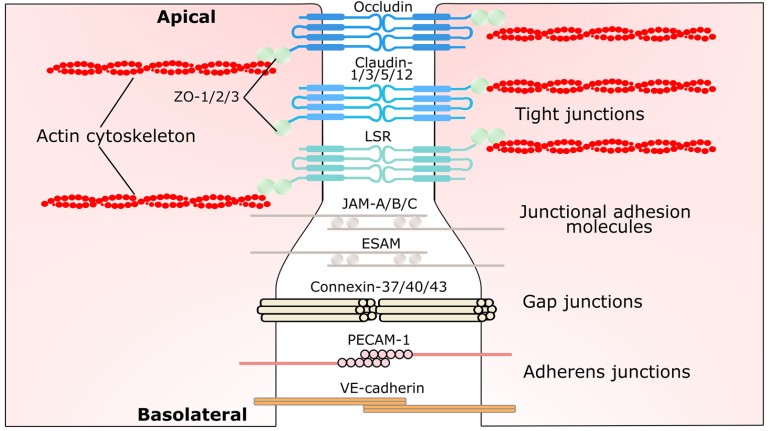 Figure 1. Inter-endothelial connections
(Source: Greene C, et al. 2019)
Claudin is part of the tight junction membrane protein family. The claudin family member has four transmembrane domains, two extracellular loops (ECLs), cytoplasmic N- and C-terminal domains, as well as a short intracellular turn. On the same cell, Claudins form cis dimers or higher order oligomers with other Claudins. These then perform trans interactions between Claudins on other cells to organize Claudin oligomers into tight junction strands. The human Claudin family comprises 27 members, widely distributed in epithelial cells with expression patterns specific to epithelial cell types. Claudins are grouped into two functionally different classes. Claudins in the first group build the paracellular barrier that limits the movement of molecules between the epithelial cells. Claudins in the second group build selective paracellular channels that allow the passage of specific molecules between the epithelial cells. According to sequence homology and functional features, claudins are further grouped into classic members and non-classic members. Of the two extracellular loops, the ECL1, about 50 amino acids long, is important for conferring the selective permeability of tight junctions. ECL2 is smaller (~16 amino acids) and forms a helix-turn-helix motif. Since tight junction formation between adjacent cells requires interactions of surface Claudins, both ECL domains are crucial for tight junction assembly.
 Figure 2. CLDN proteins at tight junctions
(Source: Katoh M, et al. 2024)
Research has demonstrated that Claudin proteins determine the size and charge-selective conductance properties of paracellular pathways. Based on whether Claudin expression increases or decreases transepithelial resistance, Claudins are classified as barrier Claudins and pore-forming Claudins. The functional classification of Claudins depends on their own conformation on one hand, and on the ion permeability characteristics of their expression sites on the other hand. In nephrons, different types of Claudins have been observed to be associated with tubular segments with different permeability properties. The functional classification of Claudins depends on their own conformation on one hand, and on the ion permeability characteristics of their expression sites on the other hand. In nephrons, different types of Claudins have been observed to be associated with tubular segments with different permeability properties.
Different Claudins exhibit varying affinities for cations and anions, with the electrostatic potential in EL1 determining their selectivity for cations and anions. Combining the barrier and pore functions of Claudins, the Claudin family can be further subdivided into cation channel Claudins, anion channel Claudins, cation barrier Claudins, and anion barrier Claudins.
CLDN18.2, a subtype of the Claudin family, is abnormally highly expressed in multiple solid tumors, such as esophageal cancer, gastric cancer, pancreatic ductal adenocarcinoma, lung cancer and ovarian malignancies. It is closely related to poor clinical prognosis. One of the two extracellular loops of CLDN18.2 is thought to mediate its subtype-specific function. The amino acid sequence of CLDN18.2 is only slightly different from that of CLDN18.1. However, due to this small difference in sequence, there are changes in binding affinity to antibody drugs. Therefore, CLDN18.2 is a very specific and promising target for tumor cell-directed therapy. In addition, the intracellular PDZ-binding domain of CLDN18.2 can mediate binding to intracellular actin filaments and thereby strengthen the barrier function of tight junctions.
 Figure 3. Amino acid sequences of Claudin-18.1 and Claudin-18.2
(Source: Kyuno D, et al. 2022)
CLDN18 expression is tightly regulated by genetic and epigenetic changes, as well as by different signaling pathways. The transcriptional regulation of CLDN18.2 requires the binding of the transcription factor cAMP response element-binding protein (CREB) to hypomethylated CpG islands and is strictly controlled by its promoter. CLDN18.2 is also closely associated with important signaling pathways, including EGFR/ERK/MAPK and HER2/HER3. The expression of CLDN18.2 is tightly regulated at the transcriptional level in human pancreatic cancer cells via methylation-dependent regulation and PKC signaling pathway. These signaling pathways may mediate tumor proliferation, invasion and metastasis through the regulation of CLDN18.2 expression.
Claudin-1 is one of the most investigated members of the TJ protein family, and has been found to be aberrantly expressed in several tumors. The extracellular loops of Claudin-1 can be divided into three domains, Cldn-1 31–53, Cldn-1 53–80 and Cldn-1 146–160. The Cldn-1 53–80 domain possesses a key motif that regulates the epithelial barrier integrity and permeability by modulating the structure and function of tight junctions, which is also capable of binding to other tight junctional proteins. Claudin-1 has been shown to be a target gene of HIF-1α, and mediates the epithelial barrier protective effect of HIF-1α by regulating Claudin-1 expression.
Claudin-1 is aberrantly expressed in digestive tract tumors and plays an important role in tumor initiation and progression. In colon tumor development, Claudin-1 is always found to translocate from the cell membrane to cytoplasm. This may cause alteration of the cell membrane, abnormal intracellular and extracellular signaling, and finally tumor metastasis. Claudin-1 was also a target gene of Wnt signaling pathway. Claudin-1 overexpression in colon cancer cells led to increase the transcriptional repressor ZEB-1 of E-cadherin, lost E-cadherin expression, and nuclear translocation of β-catenin to activate Wnt signaling. The activated Wnt signaling also promoted the binding of activated β-catenin to the ZEB-1 promoter, leading to increased transcription of ZEB-1 mRNA and inducing invasion of tumor cells. High Claudin-1 expression also upregulates Wnt target genes such as oncogenes cyclin D1 and c-myc, contributing to tumorigenesis.
Claudin-1 also promotes gastric cancer tumor growth and metastasis by preventing anoikis. Claudin-1 achieves this anti-apoptotic effect through upregulation and activation of β-catenin expression, in addition to the Akt and Src signaling pathways. Claudin-1 facilitates the activation of MMP-2 in association with MMP-14, degrading extracellular matrix and basement membrane components, which favors the migration and invasion of cancer cells. Transfection of Claudin-1 siRNA into gastric cancer cells significantly impairs their proliferation, migration, and invasion capacity, induces apoptosis, and suppresses TNF-α-induced cell motility.
CLDN4, a tight junction protein, is an important member of the Claudin family and is widely observed to be highly expressed or lost in various types of tumors. CLDN4 protein overexpression or loss has been observed in multiple tumors. In kidney cancer, CLDN4-mediated nuclear translocation results in the nuclear translocation of YAP, and YAP can also bind to CLDN4 to drive EMT phenotype. Phosphorylation of EphA2 and PKC can disrupt tight junctions and cause the release of CLDN4 from these junctions. This process promotes the interaction of YAP and ZO-1 with CLDN4, leading to the formation of a complex that translocates to the nucleus. CLDN4 is significantly overexpressed in gastric cancer tissues and cell lines and its function in gastric cancer cells to promote cell proliferation, invasion, and EMT, as well as its correlation with a poor prognosis have been reported. In another study it has been found that knocking down CLDN4 significantly increased PI3K and Akt phosphorylation and the proliferation, migration and invasion of gastric cancer cells and gastric cancer tumor growth and reduced apoptosis and the sensitivity of gastric cancer cells to chemotherapy.
Claudin-5 is mainly expressed in endothelial and epithelial cells of the brain, lung, and gastrointestinal tract; highest expression is seen in the brain and lung. Claudin-5 is a major component of the tight junctions between brain endothelial cells. Claudin-5 expression is responsible for setting the level of endothelial tension, mediated by actin contraction, and thus tight junction tension. This leads to a tighter seal of the barrier in the blood-brain barrier compared to other tissues. In brain endothelial cells, cAMP upregulates CLDN5 gene expression. Loss of tight junction integrity occurs under hypoxic conditions in PKC signaling. FoxO1 is a negative regulator of Claudin-5 expression. FoxO1 and β-catenin cooperate, as both bind to the Claudin-5 promoter region, repressing Claudin-5 transcription and expression. VE-cadherin positively regulates Claudin-5. It is thought to activate AKT, which then phosphorylates FoxO1, and excludes FoxO1 from the nucleus. As Claudin-5 is one of the key molecules forming the blood-brain-barrier, the majority of studies focus on neurological diseases such as neurodegeneration, multiple sclerosis and epilepsy. Loss of Claudin-5 leads to a dysfunction of the blood-brain-barrier, thereby promoting disease onset.
Claudin-10 has two isoforms: Claudin-10a and Claudin-10b, which are created by the use of alternative first exons. In human and mouse, the first exon of Claudin-10a and Claudin-10b is 214 bp and 220 bp in length, respectively. Claudin-10a contains two fewer amino acids in the protein sequence compared to Claudin-10b. While the two isoforms have nearly identical lengths, they show a large difference in ion charge selectivity in the first extracellular loop. Claudin-10a has been described as an anion channel with a selectivity for chloride ions and Claudin-10b as a cation channel selective for sodium ions. A number of diseases have been associated with aberrant expression or malfunction of Claudin-10, the most common of which is the HELIX syndrome caused by mutations in Claudin-10. Patients with mutations in Claudin-10 have been reported to exhibit hypokalemic metabolic alkalosis and hypermagnesemia, sweat gland, salivary gland and lacrimal gland dysfunction, and hypermagnesemia/hypokalemia.
References
| Target | Cat. No. | Product Name | Size | Species | Application | Detection Sample | |
| CLDN1 | DEIA-XYA923 | Claudin 1 ELISA Kit | 96T | Qualitative | Cultured cells | Inquiry | |
| DEIA-LL259 | Rat Cldn1 (Claudin-1) ELISA Kit | 96T | Rat | Quantitative | Serum, plasma, tissue homogenates and other biological fluids | Inquiry | |
| CLDN11 | DEIA-XYA422 | Claudin 10 ELISA Kit | 96T | Qualitative | Cultured cells | Inquiry | |
| DEIA-XYA423 | Claudin 11 ELISA Kit | 96T | Qualitative | Cultured cells | Inquiry | ||
| CLDN2 | DEIA-FN286 | Human CLDN2 (Claudin-2) ELISA Kit | 96T | Quantitative | Serum, plasma, cell culture supernatants, tissue homogenate | Inquiry | |
| DEIA-FN287 | Porcine CLDN2 (Claudin-2) ELISA Kit | 96T | Quantitative | Serum, plasma, cell culture supernatants, tissue homogenate | Inquiry | ||
| CLDN4 | DEIA-XYA427 | Claudin 4 ELISA Kit | 96T | Qualitative | Cultured cells | Inquiry | |
| CLDN5 | DEIA-XYA428 | Claudin 5 ELISA Kit | 96T | Qualitative | Cultured cells | Inquiry | |
| DEIA-XYA429 | Claudin 5 (Phospho-Tyr217) ELISA Kit | 2 x 96T | Qualitative | Cultured cells | Inquiry | ||
| CLDN6 | DEIA-XYA430 | Claudin 6 ELISA Kit | 96T | Qualitative | Cultured cells | Inquiry | |
| CLDN7 | DEIA-XYA432 | Claudin 7 ELISA Kit | 96T | Qualitative | Cultured cells | Inquiry | |
| DEIA-XYA433 | Claudin 7 (Phospho-Tyr210) ELISA Kit | 2 x 96T | Qualitative | Cultured cells | Inquiry | ||
| CLDN9 | DEIA-FN288 | Human CLDN9 (Claudin 9) ELISA Kit | 96T | Quantitative | Serum, plasma, cell culture supernatants, tissue homogenate | Inquiry |
| Target | Cat. No. | Product Name | Host | Isotype | Application | |
| CLDN1 | CABT-L2897 | Mouse Anti-Human Claudin-1 monoclonal antibody, clone JID656 | Mouse | IgG | IHC | Inquiry |
| CLDN15 | CABT-L6363 | Rabbit Anti Human Claudin 15 polyclonal antibody | Rabbit | IgG | WB, ELISA | Inquiry |
| CABT-L6362 | Rabbit Anti Human Claudin 15 polyclonal antibody | Rabbit | IgG | IHC, IF/ICC | Inquiry | |
| CLDN18 | CABT-L1246 | Rabbit Anti-Human Claudin 18 monoclonal antibody, clone 45I25M26 | Rabbit | IgG | ICC, IHC-P, IF, WB | Inquiry |
| CABT-CS565 | Human Anti-Human Claudin 18.2 (Zolbetuximab) Monoclonal antibody, clone Zolbetuximab | Human | IgG1 | ELISA | Inquiry | |
| CLDN3 | CABT-L1247 | Rabbit Anti-Human Claudin 3 (phospho Thr192) monoclonal antibody, clone 5I28M39 | Rabbit | IgG | FC, ICC, IF | Inquiry |
| Target | Cat. No. | Product Name | Expression System | Tag/Conjugate | Application | |
| CLDN18 | DAG-WT1229 | Recombinant Human Claudin 18.2 VLP | HEK293 cells | N/A | ELISA, SPR | Inquiry |
| DAG-WT1230 | Recombinant Human Fluorescent Claudin18.2 VLP | Expi293 | GFP | ELISA, SPR | Inquiry | |
| CLDN6 | DAG-WT1223 | Recombinant Human Claudin 6 VLP | HEK293 cells | N/A | ELISA, SPR | Inquiry |
| DAG-WT1224 | Recombinant Cynomolgus Claudin 6 VLP | HEK293 cells | N/A | ELISA, SPR | Inquiry | |
| DAG-WT1225 | Recombinant Mouse Claudin 6 VLP | HEK293 cells | N/A | ELISA, SPR | Inquiry | |
| DAG-WT1244 | Biotinylated Recombinant Human Claudin 6 VLP | HEK293 cells | N/A | ELISA, SPR | Inquiry |
Loading ......
