
Inquiry Basket
 Loading ......
Fluorescence is a phenomenon that has fascinated scientists for centuries. It is the ability of certain materials to emit light after being excited by a light source. This property has been harnessed in biological research to label and visualize specific molecules in complex biological systems. Fluorophores are the chemical compounds that make fluorescence possible.
Fluorophores are chemical compounds that absorb light at one wavelength and emit light at another, longer wavelength. They are essential tools in biological research, allowing scientists to label and visualize specific molecules in complex systems. Fluorophores can be organic dyes, fluorescent proteins, or quantum dots, and each type has its own unique properties.
For example, organic dyes are small molecules that can be covalently attached to proteins or other biomolecules to label them for imaging. They are relatively inexpensive and widely available but can be less bright and photosensitive than other types of fluorophores. Fluorescent proteins, on the other hand, are genetically encoded proteins that can be expressed in living cells or organisms to label specific structures or molecules. They are highly specific and can be used to label proteins in their native context, but they can be less bright and photostable than synthetic dyes. Quantum dots are semiconductor nanoparticles that can be tuned to emit light at different wavelengths by changing their size or composition. They are highly photostable and can be much brighter than organic dyes or fluorescent proteins, but are often more expensive and can be more difficult to work with than other types of fluorophores.
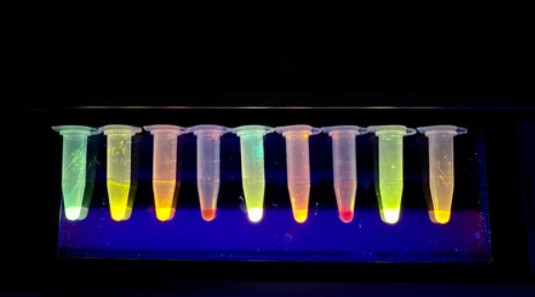 Fig 1. Quantum Dots
When a fluorophore is excited by light at a specific wavelength, one or more of its electrons are promoted to a higher energy state. The fluorophore then rapidly returns to its ground state, emitting light at a longer wavelength than the excitation light. This process is known as fluorescence and the emitted light can be detected and visualized using specialized fluorescent microscopes or other imaging systems.
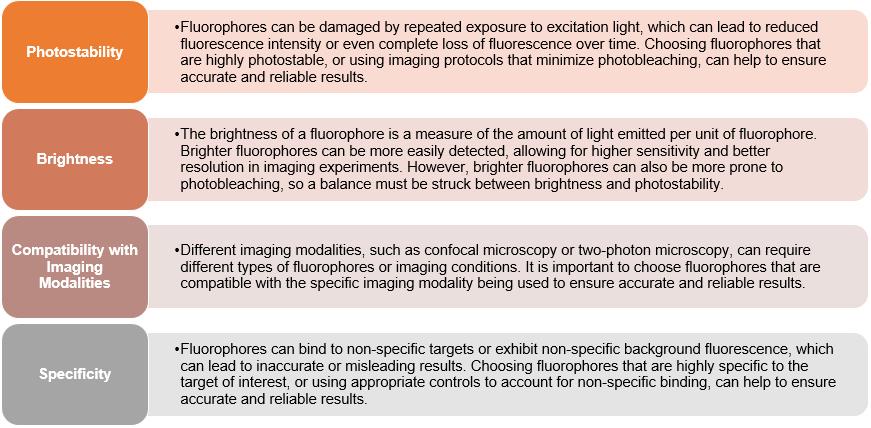
The efficiency of fluorescence depends on several factors, including the excitation and emission spectra of the fluorophore, its quantum yield (the fraction of absorbed photons that result in fluorescence), and its photostability (the ability to resist damage from repeated exposure to excitation light). The choice of a fluorophore can greatly impact the sensitivity and specificity of an imaging experiment.
When using fluorophores in biological research, it is important to consider practical factors that can impact the quality and reliability of results. Some of the most important considerations include:
Multi-color labeling is a common technique in biological research, which requires the use of different fluorophores with distinct emission spectra. Tandem dyes are a type of fluorophore that combine two different dyes into a single molecule, resulting in a unique spectral profile. This enables precise and reliable detection of multiple targets of interest in the same sample.
Tandem dyes consist of a donor fluorophore that provides excitation characteristics and an acceptor fluorophore that provides emission characteristics. The donor fluorophore absorbs light energy of a specific wavelength when excited. This energy is then transferred to the acceptor fluorophore, which emits the transferred energy as fluorescent light of a different wavelength. This energy transfer between the donor and acceptor fluorophores occurs through a phenomenon called Förster or fluorescence resonance energy transfer, which is influenced by factors such as the distance and orientation between the two fluorophores. For instance, PE-Cy7 combines Phycoerythrin (PE) as the donor fluorophore and Cy7 as the acceptor fluorophore. This means that PE-Cy7 will have the excitation characteristics of PE and the emission characteristics of Cy7.
By using tandem dyes, it is possible to excite several fluorophores with a single laser, which are measured by different detectors. For example, Alexa Fluor® 488, PerCP-Cy5.5, PE, and PE-Cy7 are all excitable with a blue laser (488 nm), but they produce green, purple, yellow, and infrared emissions, respectively.
Fluorophores have a wide range of applications in biological research, including:
Loading ......
