
Inquiry Basket
 Loading ......
Ceruloplasmin is a mammalian blood plasma ferroxidase. More than 95% of the copper found in plasma is carried by this protein, which is a member of the multicopper oxidase family. Proteins from this group are able to oxidize substrates through the transfer of four electrons to oxygen. The essential role of Ceruloplasmin in iron metabolism in humans is particularly evident in the case of loss-of-function mutations in the Ceruloplasmin gene resulting in a neurodegenerative syndrome known as aceruloplasminaemia. However, the functions of Ceruloplasmin are not limited to the oxidation of ferrous iron to ferric iron, which allows loading of the ferric iron into transferrin and prevents the deleterious reactions of Fenton chemistry. In recent years, a number of novel ceruloplasmin functions have been reported, and many of these functions depend on the ability of Ceruloplasmin to form stable complexes with a number of proteins.
First proposed by Rydén, was confirmed by sequencing a polypeptide composed of 1046 amino acids. N-glycoside bonds link oligosaccharides to Asn residues in the polypeptide chain. The predominant species (Ceruloplasmin-I) contains four oligosaccharides shaped as two or three antennas, and the minor form (Ceruloplasmin-II) has only three sugar-binding sites. Soon after these findings, the gene encoding single-chain Ceruloplasmin was characterized. An important feature of Ceruloplasmin is its internal homology. An important feature of Ceruloplasmin is its internal homology. An X-ray study of human Ceruloplasmin crystals at 3.1 Å resolution revealed six tightly bound copper ions classified into three types according to their spectral features. In blood plasma, the tightly bound copper ions are not easily released from Ceruloplasmin. To leave the protein, Cu2+ must usually be reduced through the interaction of Ceruloplasmin with another protein or with the cell surface. Extraction of the copper ions in vitro requires strong reducing agents, and after the extraction, the overall conformation of Ceruloplasmin becomes less compact.
Anti-Ceruloplasmin polyclonal antibody
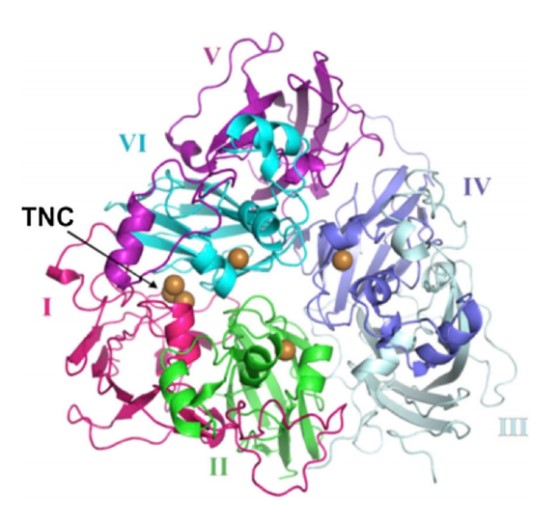 Fig 1. A cartoon representation of human Ceruloplasmin domain structure.
(Source: Biometals, 2019)
Ceruloplasmin has activities of ferroxidase, cuproxidase, which catalyses Cu+ oxidation, superoxide dismutase, glutathione-linked peroxidase and NO-oxidase; accordingly, Ceruloplasmin actively precludes the formation and persistence of free radicals. These properties make Ceruloplasmin an effective antioxidant that prevents oxidative damage to proteins and lipids. Plasma concentrations of Ceruloplasmin in inflammation can increase from 3 to 10 μM, suggesting a role for Ceruloplasmin in the regulation of inflammatory reactions. The proinflammatory activities of certain enzymes are suppressed when they form complexes with Ceruloplasmin. These enzymes include myeloperoxidase, members of the serprocidin family, matrix metalloproteinases 2 and 12, 5-lipoxygenase, and eosinophil peroxidase. Importantly, the inhibition of the mediators of inflammation listed above is not directly linked to Ceruloplasmin oxidase activity. As specified by Chapman et al., ceruloplasmin has both antioxidant and prooxidant properties. Even the ferroxidase activity of Ceruloplasmin that has been regarded as an antioxidant property of Ceruloplasmin for a long time, was shown to evoke its prooxidant effects, at least in some cases, such as in patients with localized aggressive periodontitis. Neutrophils from patients synthesize Ceruloplasmin, which oxidizes Fe2+ to Fe3+, and the ferric ions activate NADH oxidase, increasing the production of reactive oxygen species.
Starting from the 1990s, the interactions of Ceruloplasmin with other proteins were described, expanding the list of possible Ceruloplasmin functions to include participation in iron metabolism by interaction with ferritin, ferroportin 1, and lactoferrin; regulation of neural transmission and inflammation by interaction with neuropeptide PACAP38 and macrophage migration inhibitory factor, respectively; inhibition of the prooxidative properties of myeloperoxidase (MPO) by forming a complex with MPO; and regulation of blood clotting by interaction with protein C. The assumption of the latter interaction was supported by the fact that activation of Ceruloplasmin-like coagulation factors FV and FVIII via limited proteolysis allows these proteins to adopt conformations that favor the formation of their complexes with FIXa and FXa; these complexes participate in the subsequent activation of the coagulation cascade. Anticoagulant protein C is able to inhibit coagulation through FVa and FVIIIa proteolysis, competes with these factors for binding with protein C and thus participates in the regulation of blood clotting. Indeed, the complex formed by protein C and Ceruloplasmin increases the ferroxidase activity of Ceruloplasmin by fivefold and is uncoupled by the HAGMETTYTV decapeptide that mimics the sequence between amino acids 1028 and 1037 in Ceruloplasmin. Concomitantly, the elevated ferroxidase activity of Ceruloplasmin was abrogated. The possibility of direct involvement of Ceruloplasmin in the regulation of blood coagulation should be thoroughly explored, even though the data on the formation of the Ceruloplasmin: protein C complex appear quite reliable.
The role of GPI-Ceruloplasmin in iron homeostasis is the only well-documented function of that species. Indeed, this species has been detected in Sertoli cells, leptomeningeal cells, and immune cells, i.e., lymphocytes/monocytes and macrophages. The molecular mechanism of Ceruloplasmin-mediated control of cellular iron efflux includes its functional antagonism with hepcidin that suppresses iron egress from the cells. In cultured glioma cells, free and membrane-bound Ceruloplasmin behaved as efficient antagonists of hepcidin, suppressing its ability to induce ferroportin degradation in the lysosomes. A crucial role of Ceruloplasmin in ferroportin stabilization was observed in experiments in Ceruloplasmin-depleted macrophages where GPI-Ceruloplasmin is normally colocalized with ferroportin 1 in plasma membrane lipid rafts. Currently, the close proximity of GPI-Ceruloplasmin and ferroportin is not considered evidence of the formation of a complex by these two proteins. However, it appears likely that ferroportin receives iron from the cytoplasm as Fe2+ and that GPI-Ceruloplasmin is needed to oxidize Fe2+ to provide Fe3+ for incorporation into transferrin. To meet these requirements, a direct protein–protein interaction might be the best choice.
References
| Target | Cat. No. | Product Name | Host | Isotype | Application | |
| CP | CPBT-65875SH | Anti-Ceruloplasmin polyclonal antibody | Sheep | IgG | IHC-Fr, ELISA | Inquiry |
| CABT-24888MH | Anti-Ceruloplasmin monoclonal antibody, clone 7dw5 | Mouse | IgG2a | WB, ELISA | Inquiry | |
| CABT-23538MH | Anti-Ceruloplasmin monoclonal antibody, clone 4C22 | Mouse | IgG1 | WB, IHC, IP, ELISA | Inquiry | |
| CAB-1098MH | Anti-Ceruloplasmin monoclonal antibody, clone MAFB4020 | Mouse | IgG2a | ELISA, WB | Inquiry | |
| CAB-10387MH | Anti-Ceruloplasmin monoclonal antibody, clone 4C12 | Mouse | IgG1 | ELISA, WB, IP, IHC-P | Inquiry | |
| DCABH-4906 | Anti-Ceruloplasmin monoclonal antibody, clone FQTJTS7 | Rabbit | IgG | ICC/IF, WB | Inquiry |
| Target | Cat. No. | Product Name | Size | Species Reactivity | Application | Detection Sample | |
| CP | DEIA8513 | Rat CP(Ceruloplasmin) ELISA Kit | 96T | Rat | Quantitative | Serum, plasma, tissue homogenates and other biological fluids | Inquiry |
| DEIASL034 | Human Ceruloplasmin ELISA Kit | 96T | Human | Quantitative | Plasma, serum, urine, milk, saliva and cell culture samples | Inquiry |
Loading ......
