
Inquiry Basket
 Loading ......
In order for proteins to be available for antibody detection, they need to be transferred from within a gel to a membrane, which is a solid support. There are two types of membranes: nitrocellulose (NC) or polyvinylidene fluoride (PVDF). NC membranes have high affinity for proteins and their retention capacity. However, NCs are brittle and do not allow blots to be used for re-probing, whereas PVDF membranes allow blots to be re-probed. The process of transferring proteins from a gel to a membrane while maintaining their relative position and resolution is called transfer blotting. Transfer blotting can be achieved by three different methods:
Simple diffusion is achieved by placing a membrane on top of the gel, followed by a stack of dry filter paper, and placing a weight on the filter paper to facilitate the diffusion process. This method allows the transfer of proteins from one gel to multiple membranes, obtaining several blots of the same gel. The main disadvantage of the diffusion method is that the transfer is not quantitative and only transfers 25-50% of the protein compared to electrophoretic transfer.
This method was developed as an alternative to diffusion blotting and electroblotting. The suction of a pump connected to the slab gel dryer system is used to drive the separated protein from the gel to the nitrocellulose membrane. Both high and low molecular weight proteins can be transferred by this method; however, proteins with a molecular weight below 20 kDa require the use of a smaller pore size (0.2 μm) as they are not readily adsorbed by 0.45 μm membranes. The gel may dry out if the experiment is performed for more than 45 minutes. When using this method, enough buffer should be added. In some cases, low-concentration polyacrylamide gels will stick to the membrane after transfer. In this case, rehydrating the gel helps to separate the nitrocellulose membrane from the gel residue.
Electrophoretic transfer is by far the most widely used transfer method. The main advantages over diffusion or vacuum transfer are speed and transfer completeness.
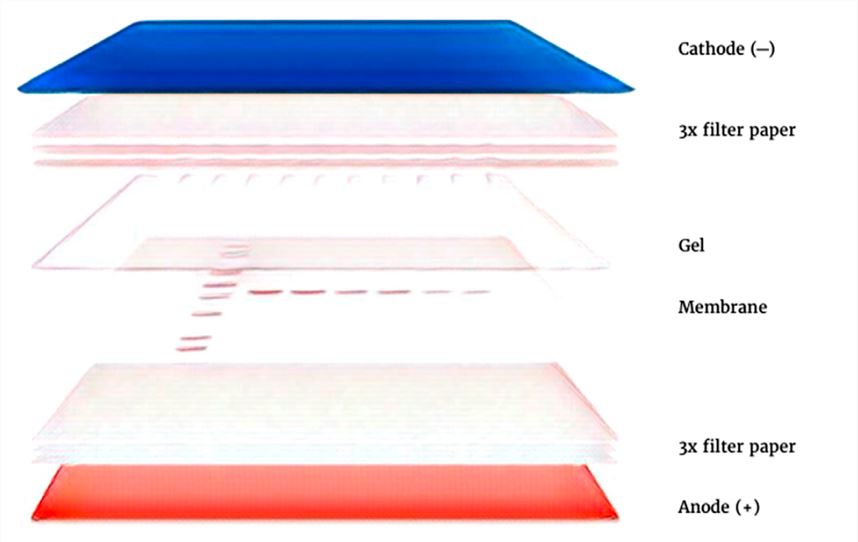 Figure 1. Schematic of a blot sandwich in semidry transfer. (Gwozdz Tomasz, et al.; 2017)
Two commonly used electrophoretic transfer techniques are Wet transfer and semidry transfer. They are all based on the same principle, differing only in the mechanism used to hold the gel/membrane stack and the application of the electric field.
Wet transfer is a traditional technique in which the gel/membrane stack is completely soaked in a buffer tank and an electrical current is applied. This is an efficient but slow technique, using large amounts of buffer. Wet transfer systems typically operate at constant voltage; the mixing of the buffer during the transfer keeps the current relatively constant.
Semidry transfer replaces the buffer reservoir with a stack of buffer-soaked filter paper. Since the plate electrodes are in direct contact with the filter paper, the field strength across the gel is maximized, facilitating fast and efficient transfer. This technique works just as well and is much faster (15-45 minutes) than wet transfer. Most semi-dry transfer methods use more than one buffer system to allow efficient transfer of large and small proteins. However, semidry transfer systems have low buffer capacity and are therefore not suitable for long-term transfers. Semidry transfer is the method of choice for transferring large 2-D gels. It typically operates at constant current; the voltage increases during the transfer process.
For semidry transfer systems, the filter paper and membrane must be cut to the same size as the gel so that the current is forced through the gel. Otherwise, the current would be short-circuited through the overlapping filter paper surrounding the gel. In both types of transfer systems, extra care is required to avoid introducing air bubbles between the filter paper, gel, and membrane. Air bubbles impede transfer, causing "bald spots" (i.e., areas of no transfer) on the transfer membrane.
References
Loading ......
