
Inquiry Basket
 Loading ......
Tandem affinity purification (TAP) is a dual-affinity purification method based on the fusion of two affinity tags to a protein of interest. TAP not only allows purification of a tagged protein, but also allows for isolation of protein complexes interacting with the protein of interest. The TAP tag itself consists of two different affinity tags, each of which is designed to isolate the protein of interest along with its interacting proteins in two successive steps.
TAP was originally done in yeast using a 21-kDa tag composed of ProtA (Protein A of Staphylococcus aureus) and CBP (calmodulin-binding peptide) separated by a TEV protease cleavage site. This tag can be applied on either the C- or N-terminal. Although 20–30% of a protein of interest can be obtained using this method, TAP does not work well in higher eukaryotes.
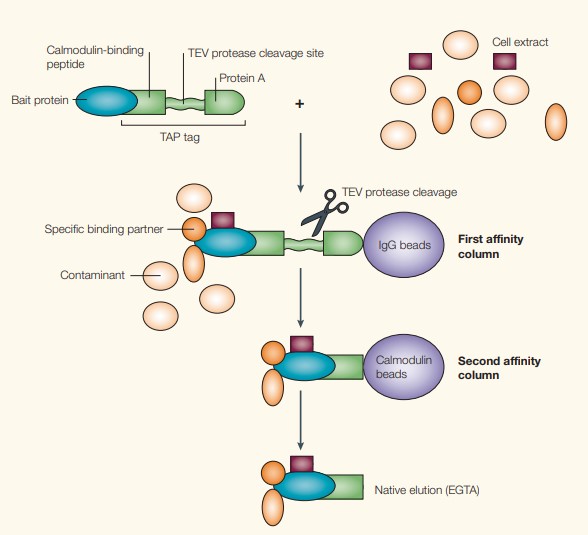 Fig 1. Tandem-affinity purification.
The tandem-affinity-purification (TAP) tag consists of three components: a calmodulin-binding peptide, a tobacco etch virus (TEV) protease cleavage site and Protein A as an immunoglobulin G (IgG)-binding domain. Cells or organisms are generated that contain TAP tagged protein(s). Extracts are then prepared under mild conditions and TAP is carried out. The first column consists of IgG beads. TEV protease cleaves the immobilized multiprotein complexes. Another round of binding is carried out on a second column that consists of calmodulin beads. The native complex is then eluted by chelating calcium using EGTA.
Additionally, such a large tag (21 kDa) can disturb protein function and CBP can interfere with calcium signaling. Although the original ProtA/CBP tag is still the most widely used, these disadvantages have lead to the creation of over 30 TAP variants. Some of them effectively overcome the disadvantages of the original ProtA-CBP tag and achieve improved protein recovery and/or flexibility. These alternative TAP tags, including two commercial systems, some high-recovery tags, two unique tags that enable stringent washes and protein localization, respectively.
InterPlay Mammalian TAP system: The system is specially designed to recover target- interacting proteins in mammalian cells using the TAP method. The two affinity tags used by this system are the streptavidin-binding peptide (SBP) and CBP.
FLAG HA system: FLAG and haemagglutinin (HA) are small epitope tags. Fusion proteins containing them can be purified by affinity resins derived from tag-specific antibodies. In 2002 scientists first used a FLAG-HA tandem tag to isolate protein complexes from HeLa cells.
3x FLAG-His tag: The high recovery of the 3X FLAG-His tag enabled identification of several putative cofactors of Drosophila nuclear receptor family proteins by mass spectrometry. This FLAG-His combination has also been used to isolate protein complexes from mammalian cells.
A major application of the TAP method is to identify proteins interacting with the target protein. However, the TAP method can also be used to analyze the structure or the activity of the purified complex. Finally, the TAP method can also be used to purify recombinant proteins that are expressed at low level in yeast, bacteria, or other organisms.
Identification of proteins functionally interacting with the target protein. To identify proteins interacting with the target protein it is often desirable to concentrate the eluate fractions before loading them on an analytical gel.
Activity tests of the purified complex. Since the TAP purification is performed under gentle native conditions, the purified material can be used for genomic scale. in vitro activity tests. Note, however, that this may not be the case if EGTA or other reagents used in the purification interfere with the integrity or activity of the complex.
Structural studies of purified complexes. The material recovered from TAP purification can also be used for structural studies using electron microscopy, providing that the purified complex is stable, sufficiently large, and concentrated.
Loading ......
