
Inquiry Basket
 Loading ......
Coronavirus disease (COVID-19) is an infectious disease caused by a novel severe acute respiratory syndrome coronavirus 2 (SARS-CoV-2) that initially started in Wuhan province in China and being highly transmissible that has affected more than 200 countries worldwide and declared a Pandemic.
Coronaviruses are a group of enveloped viruses, having a positive single-stranded RNA genome and pathogenic. By metagenomic RNA sequencing and virus isolation from bronchoalveolar lavage fluid samples from patients with severe pneumonia, scientists identified that the causative agent of this emerging disease is a beta-coronavirus that had never been seen before. COVID-19 is caused by the SARS-CoV-2 is a more pathogenic form in comparison to previously identified SARS-CoV (2002) and Middle East respiratory syndrome coronavirus (MERS-CoV, 2013).
As a novel beta-coronavirus, SARS-CoV-2 shares 79% genome sequence identity with SARS-CoV and 50% with MERS-CoV. The six functional open reading frames (ORFs) are arranged in order from 5′ to 3′: replicase (ORF1a/ORF1b), spike (S), envelope (E), membrane (M) and nucleocapsid (N). These proteins share high sequence similarity to the sequence of the corresponding protein of SARS-CoV, and MERS CoV.

Figure 1. SARS-CoV-2 genome. Severe acute respiratory syndrome coronavirus 2 (SARS-CoV-2) genome organization, with functional domains shown in rectangles and the prime drug targets emphasized in the outlined box. [2]
Spike glycoprotein (S protein) plays a significant role in pathogenesis, which CoVs rely on their S proteins for binding to the host cell surface receptor during host cell entry, S protein binds to the host receptor through the receptor-binding domain (RBD) in the S1 subunit. The S1 subunit is involved in the attachment of virions with the host cell membrane by interacting with human ACE2 that subsequently initiates the infection process. The other subunit of the S protein, S2 works as the fusion protein that helps in the fusion of virion with the mammalian cell membrane. During the infection, S protein undergoes conformational changes, understating of these changes is critical to the process of vaccine development. Envelope (E) proteins are a group of relatively small viral proteins (75aa) that help in the assembly and release of the virions. Among the structural proteins of the SARS-CoV-2, E protein is considered as a potential drug target. Nucleocapsid (N) proteins play part in the packaging of viral RNA into ribonucleocapsid, N protein of SARS-CoV-2 is highly conserved across CoVs sharing ~90% sequence identity with that of SARS-CoV, thus, N proteins are also considered as potential drug targets. Membrane (M) proteins are 222 amino acid long structural proteins that function in concurrence with E, N, and S proteins, and plays a major role in the RNA packaging, M proteins as well as the most abundant viral proteins of CoVs that are involved in providing distinct shape to the virus.
 Figure 2. Schematic representation of the SARS-CoV-2 structure and mode of host entry. [3]
Early diagnosis is crucial for controlling the spread of SARS-CoV-2. Molecular detection of SARS-CoV-2 nucleic acid is the gold standard. Although SARS-CoV-2 has been detected from a variety of respiratory sources, including throat swabs, posterior oropharyngeal saliva, nasopharyngeal swabs, sputum and bronchial fluid, the viral load is higher in lower respiratory tract samples. Accordingly, false negatives can be common when oral swabs and used, and so multiple detection methods should be adopted to confirm a COVID-19 diagnosis.
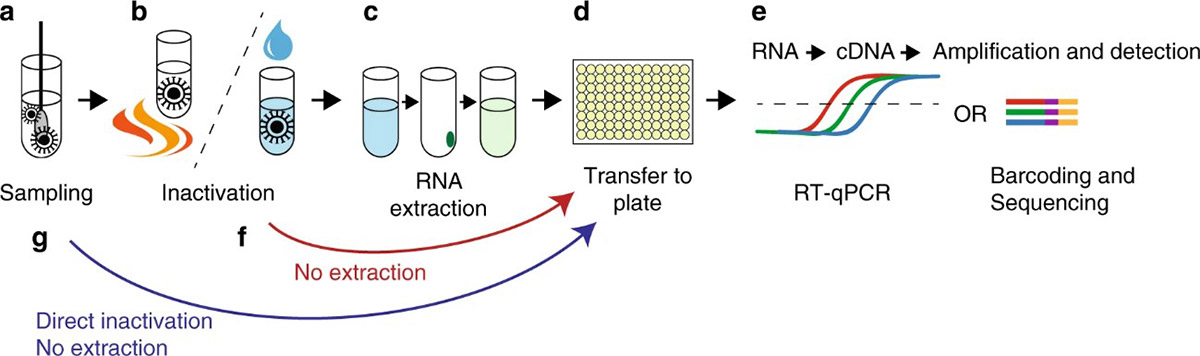 Figure 3. The currently widely used procedure for COVID-19 testing involves. a Collection of patient material and deposition of potential SARS-CoV-2 viral particles in transport medium. B Inactivation of the virus by detergent/chaotropic reagents or by heating. c RNA extraction. d, e Transfer to PCR-plate (96/384-well) format in which cDNA synthesis by RT and detection by qPCR may take place. [4]
Researchers and manufacturers are conducting large-scale clinical trials to evaluate various therapies for SARS-CoV-2. There are several potential therapeutics against SARS-CoV-2. First, inhibition of virus entry, SARS-CoV-2 uses ACE2 as the receptor and human proteases as entry activators; subsequently it fuses the viral membrane with the cell membrane and achieves invasion. Thus, drugs that interfere with entry may be a potential treatment for COVID-19. Umifenovir (Arbidol) is a drug approved in Russia and China for the treatment of influenza and other respiratory viral infections. It can target the interaction between the S protein and ACE2 and inhibit membrane fusion. Second, Inhibition of virus replication, replication inhibitors include remdesivir, favilavir, ribavirin, lopinavir and ritonavir. Remdesivir has shown activity against SARS-CoV-2 in vitro and in vivo. Third, immunomodulatory agents, SARS-CoV-2 triggers a strong immune response which may cause cytokine storm syndrome. Thus, immunomodulatory agents that inhibit the excessive inflammatory response may be a potential adjunctive therapy for COVID-19.
To halt the pandemic, multiple SARS-CoV-2 vaccines have been developed and several have been allowed for emergency use and rollout worldwide. Hundreds of SARS-CoV-2 vaccine development programs have been initiated since the COVID-19 pandemic broke out, with some vaccines approved for widespread use.
SARS-CoV-2 is the third highly pathogenic human coronavirus disease to date, the rapid spreading of this highly contagious disease has posed the severest threat to global health in this century. Tackling this epidemic is a long-term job which requires efforts of every individual.

Loading ......
