ASM Microbe 2026
June 4-7, 2026 – Washington, DC, USA
ADLM 2026
July 26-30, 2026 – Anaheim, CA, USA

Quantitative Antibody Affinity Measurement

Affinity is a crucial parameter for molecular interactions. It is a crucial indicator for understanding molecules and biological processes, drug discovery, and screening, etc.

What Is KD?

KD (Dissociation Constant) is the equilibrium constant for the binding and dissociation of an antibody from an antigen and is used to measure antibody affinity. It is an indicator of antibody-antigen binding relative stability, with smaller values indicating tighter binding and higher affinity.

The KD value is a critical parameter when measuring antibody affinity. It represents the concentration ratio of the proportion of antigen to antibody in a complex equal to the proportion of antigen to antibody dissociated at a given temperature. This is when the antibody-antigen reaction reaches equilibrium. Specifically, the KD value is equal to the dissociation rate constant (koff) divided by the binding rate constant (kon).

The mathematical expression is

KD = koff / kon

At a concentration of KD, half of the antigen forms a complex with the antibody and the other half is in a free state. Therefore, a smaller KD value indicates a tighter antibody binding to the antigen and higher affinity. Conversely, a larger KD value indicates a looser antibody binding to the antigen and a lower affinity.

Measuring and understanding antibodies' KD value is critical for immunological research, biomedical science, and drug development. It can help researchers assess the strength of antibody-antigen interactions, guide drug design and screening, and optimize therapeutic options.

How Is the Kd Value Determined?

The following are some of the methods used to determine the KD value of an antibody's affinity:
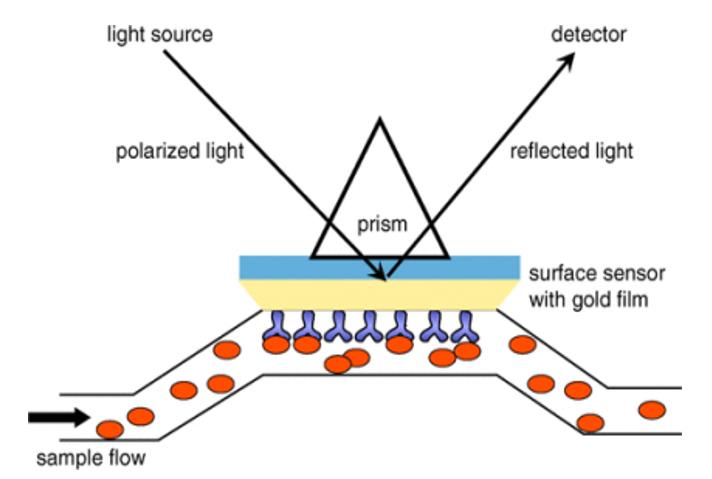
  • Surface Plasmon Resonance (SPR): SPR is a widely used technique for determining KD values. It monitors the binding and dissociation between antibodies and antigens in real time by monitoring optical signal changes. By creating a concentration gradient, the binding and dissociation rates can be plotted and the KD value calculated.

Schematic surface plasmon resonance (SPR) display.Fig 1. Schematic surface plasmon resonance (SPR) display.
(Bakhtiar, Ray, et al., 2013)
  • Biochromatography (Biacore): Biacore is another commonly used technique for determining KD values. It is based on the passage of a fluid through a column with an immobilized antigen. The KD value is determined by monitoring the binding and dissociation of the antibody from the antigen in the fluid. The technique provides kinetic information, including the binding rate constant (kon), dissociation rate constant (koff), and affinity constant (KD).
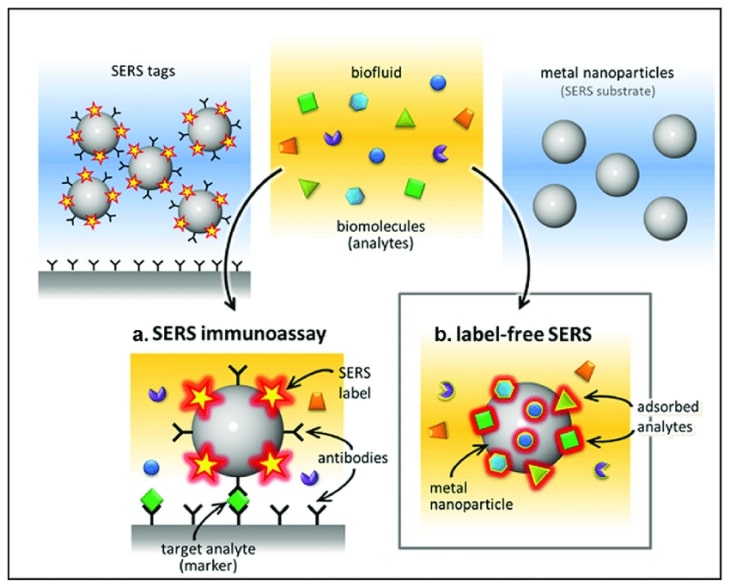
  • Surface-Enhanced Raman Scattering (SERS): SERS is an emerging technique for KD value determination. The SERS technique has high sensitivity and rapid analysis.

Surface-enhanced Raman scattering (SERS) approaches.Fig 2. Surface-enhanced Raman scattering (SERS) approaches.
(Chisanga M, et al., 2019)

  • Biosensor technology: Biosensor technology combines biomolecular recognition and sensor technology for antibody affinity determination. Biosensors include electrochemical sensors, optical sensors, and piezoelectric sensors. These sensors can convert antibody-antigen interactions into electrical, optical, or acoustic signals and determine the KD value by measuring the signal change.
  • Software for molecular affinity analysis: In addition to experimental methods, there are computational methods and software to predict and calculate antibody affinity. These softwares are based on molecular simulations and computational methods. They predict the affinity and KD values of antibodies and antigens based on their structural information. Although these methods have some limitations, they provide valuable information at the initial screening and design stages.

How to Read KD Values?

Reading the KD value requires knowledge of the value and the unit, which is usually measured in moles (M) and represents the equilibrium constant of antibody-antigen binding. We have given an example here of how to read a KD value:

  • Viewing the KD value: The KD value is usually expressed in scientific notation, e.g. 1 x 10^-9 M. This value can be read as "1 multiplied by 10 to the negative 9th power of moles".
  • Understanding the value: The smaller the KD value, the more tightly the antibody binds to the antigen and the higher the affinity. Conversely, a larger KD value indicates a looser antibody binding to the antigen and a lower affinity. Therefore, a smaller KD value indicates stronger antibody affinity.
  • Note the units: KD values are expressed in moles (M) and represent the ratio of antibody to antigen concentration per liter of solution. In practice, units such as nanomolar (nM) or picomolar (pM) may also be used to indicate a smaller range of concentrations.
  • Putting it into context: When reading KD values, their meaning needs to be interpreted in the context of the specific field of study and experimental design.

Different research areas and experimental purposes may have different interpretations of KD values.

What Is the Ideal KD Value?

Most antibodies have KD values in the low micromolar (10-6) to nanomolar (10-7 to 10-9) range. It is generally accepted that high-affinity antibodies are in the low nanomolar range (10-9) and very high-affinity antibodies are in the picomolar range (10-12).

References

  1. Bakhtiar, Ray. Surface plasmon resonance spectroscopy: a versatile technique in a biochemist's toolbox. Journal of Chemical Education, 2013, 90(2): 203-209.
  2. Chisanga M, et al. Enhancing disease diagnosis: biomedical applications of surface-enhanced raman scattering. Applied Sciences, 2019, 9(6).
Inquiry Basket