
Inquiry Basket
 Loading ......
Pseudorabies virus (PRV), also known as porcine herpesvirus type I, infectious medullary paralysis virus, pruritus virus, or Oyezki disease virus. It is a herpes virus that causes fever, itching (excluding pigs), and encephalomyelitis as the main symptoms in various domestic and wild animals such as cows, sheep, pigs, dogs, and cats. Due to the clinical symptoms of this disease resembling rabies, the name " Pseudorabies Virus" was used.
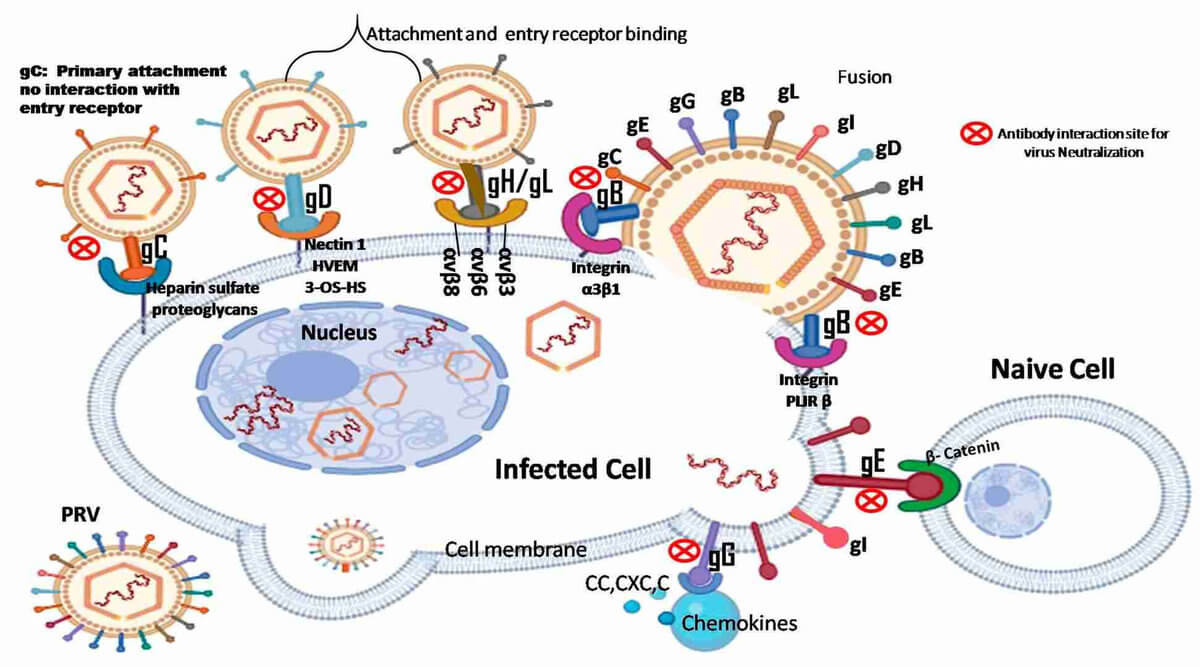 Figrue 1. Schematic diagram of interactions between PRV glycoproteins and various receptors on the host cell membrane. (Bude, Sara Amanuel, et al.2024)
Recent research is increasingly focusing on host factors that PRV exploits, which could offer broader antiviral strategies:
| Diagnosis | Details |
| Neuropeptide S (NPS) and its Receptor (NPSR) | The NPS-NPSR system, associated with inflammation, has been shown to enhance host susceptibility to PRV infection, positioning it as a potential novel target for anti-PRV therapy . |
| WARS2 (Tryptophanyl-tRNA synthetase 2) | A mitochondrial enzyme involved in protein synthesis. PRV infection upregulates WARS2, and studies show that suppressing WARS2 reduces PRV infection rates, while enhancing it increases infection. This manipulation of WARS2 by PRV is regulated via the STING/TBK1/IRF3 signaling pathway and interferon-alpha receptor-1, linking it to the host's type I interferon response . |
| Other Host Receptors | As mentioned, host receptors like Nectin-1 and NRP1, which are critical for viral entry, represent attractive targets for blocking infection using antibodies, soluble receptor decoys, or gene-editing approaches |
| PI3K/Akt Pathway | PRV gD-receptor binding triggers PI3K/Akt activation, which enhances endocytosis and viral gene expression. Inhibitors (e.g., wortmannin, LY294002) reduce viral load in vitro by impairing these processes, while Anti-Pseudorabies virus Polyclonal antibody can dampen pathway activation indirectly by limiting receptor engagement. |
Pseudorabies virus particles are elliptical or circular in shape, and their genome consists of linear dsDNA molecules with a molecular weight of 87 × 106 (approximately 150kb), a (G+C) mol% content of 73%, and icosahedral stereosymmetry. The diameter of virus particles without an envelope located in the nucleus is about 110-150nm, while the diameter of mature virus particles with an envelope located in the cytoplasm is about 150-180nm. There are radially arranged spikes on the surface of the envelope, with a length of about 8-10 nm. This virus is a highly resistant type of herpesvirus and can survive for at least 7 days in different liquids and on object surfaces. This virus is sensitive to lipid solvents such as ether and chloroform, formalin, and ultraviolet radiation. Stable between pH 4 and 9. Strong resistance to heat. Vacuum freeze-dried virus cultures can be stored for many years. This virus can proliferate in various tissue cells. Among them, rabbit kidney and pig kidney cells (including primary or passage cells, etc.) are the most suitable for virus culture. The application of chicken embryos for trophoblastic membrane inoculation, yolk sac and bladder cavity inoculation can also be used for virus proliferation culture.
Respiratory infections are usually asymptomatic in pigs over two months old, but they can lead to miscarriage, high mortality rates in piglets, as well as coughing, sneezing, fever, constipation, depression, seizures, ataxia, circling, and excessive salivation in both piglets and adult pigs. The mortality rate of piglets under one month old is close to 100%, but the mortality rate of pigs aged one to six months is less than 10%. Pregnant pigs can reabsorb their young or give birth to mummified, stillborn, or weakened piglets. In cows, symptoms include severe itching, followed by neurological symptoms and death. The symptoms of dogs include severe itching, numbness in the jaw and throat, howling, and death. Any infected secondary host typically can only survive for two to three days. For most of the 20th century, genital infections seemed to be common in pig herds in many European countries, where boars from boar centers were used for natural services to sows or sows. This disease has always been asymptomatic in affected pigs, and infection is only found on farms when there is itching on the hind legs of cows.
Pseudorabies is highly contagious. This infection is usually believed to be transmitted between pigs through nose to nose contact, as the virus mainly exists in the nasal and oral areas. However, this viewpoint contradicts the results of epidemiological research, which suggests that the decisive transmission within herds is caused by air currents of several meters or more. Correspondingly, it has been found that the risk of highly virulent virus strains spreading from acute infected pig herds to other pig herds through the air is very high. This infection has been found to spread for several kilometers. Otherwise, infection is most commonly transmitted to pig herds through the introduction of acute or latent infections from pigs.
Although there is no specific treatment for acute PRV infection, vaccination can alleviate clinical symptoms in certain age groups of pigs. Usually, it is recommended to vaccinate all pigs on the farm with the modified live virus vaccine on a large scale. Intranasal vaccination of 1 to 7-day-old sows and newborn piglets, followed by intramuscular (IM) vaccination of all other pigs in the farm, can help reduce virus shedding and improve survival rates. The modified live virus replicates in the injection site and regional lymph nodes. The vaccine virus spreads at such a low level that there is minimal mucous transmission to other animals.
PRV can be used to analyze neural circuits in the central nervous system (CNS). For this purpose, attenuated (less toxic) Bartha PRV strains are commonly used as retrograde and anterograde cross neuronal tracers. In the retrograde direction, PRV Bartha is transported through its axons to the neuronal cell body, where it is replicated and dispersed in the cytoplasm and dendritic tree. PRV Bartha released at synapses can infect the axon terminals of synaptic connecting neurons through synapses, thereby spreading the virus. However, the extent to which non synaptic cross neuronal transport may also occur is still uncertain. Using PRV Bartha's time study and/or genetically engineered strains, second-order, third-order, and higher-order neurons can be identified in the neural network of interest.
Pseudorabies virus is a terrifying pathogen with significant economic consequences in animal husbandry. Its complex biology, involving a vast DNA genome and intricate interactions with the host immune and nervous systems, presents ongoing challenges. However, the details of its lifecycle and pathogenesis - from essential glycoproteins to hijacking host factors such as Nectin-1, NRP1, and WARS2- provide a roadmap for combating it. The continuous research on these molecular targets paves the way for more effective diagnosis, vaccines, and antiviral strategies, which may not only be applicable to PRV but also to other related herpes viruses.
Reference
| Target | Cat. No. | Product Name | Host | Isotype | |
| Pseudorabies virus | DPATB-H83610 | Anti-Pseudorabies virus Polyclonal antibody | Rabbit | IgG | Inquiry |
| Target | Cat. No. | Product Name | Host | |
| PRV | DAG-WT1123 | Recombinant Pseudorabies Virus gB | Mammalian cells | Inquiry |
| DAG-WT1124 | Recombinant Pseudorabies Virus gE | Mammalian cells | Inquiry | |
| DAG-WT1125 | Recombinant Pseudorabies Virus Chimeric Protein (gE & gI) | Mammalian cells | Inquiry | |
| DAG-WT1131 | Inactivated Pseudorabies Virus (PRV) | N/A | Inquiry | |
| DAG-WT5854 | Pseudorabies Virus (PRV) Stock (Qualitative) | N/A | Inquiry | |
| gE | DAG-WT4402 | Recombinant Pseudorabies virus gE antigen [His] | Baculovirus-Insect cells | Inquiry |
Loading ......
