
Inquiry Basket
 Loading ......
In the intricate world of cellular signaling, protein phosphorylation plays a central role in regulating various biological processes. Phosphorylation, the addition of a phosphate group to a protein, can rapidly modulate protein function, leading to cascades of events within the cell. However, the opposite process, dephosphorylation, involves the removal of phosphate groups (PO43−) from proteins through a hydrolytic enzyme or hydrolase. It is a reversible post-translational modification (PTM) that is equally important for maintaining the delicate balance of cellular signaling pathways.
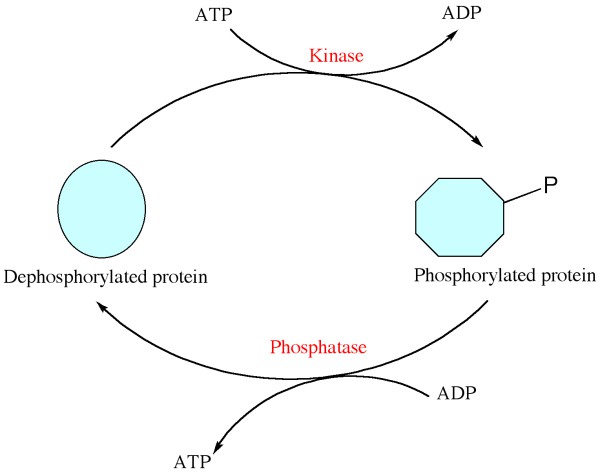 Figure 1. Schematic diagram of phosphorylation and dephosphorylation.
(Source: Raimi, O. G. et al., 2014)
Protein dephosphorylation is primarily mediated by enzymes called phosphatases. These hydrolases catalyze the cleavage of ester bonds, liberating phosphate ions and generating molecules with free hydroxyl groups (-OH). Phosphatases are classified into various subclasses based on their specific targets and cellular localization.
Protein Tyrosine Phosphatases (PTPs)
PTPs are a class of phosphatases that specifically dephosphorylate tyrosine residues on proteins. They play critical roles in diverse cellular processes such as cell growth, differentiation, and intracellular signaling. PTPs are characterized by a conserved catalytic domain known as the PTP domain, which contains a cysteine residue essential for enzyme activity. Through their dephosphorylation activity, PTPs regulate various signaling pathways, including those mediated by receptor tyrosine kinases.
Serine/Threonine Phosphatases
Serine/threonine phosphatases are a group of phosphatases that target serine and threonine residues on proteins. They are involved in the dephosphorylation of proteins within signaling pathways such as the mitogen-activated protein kinase (MAPK) pathway, the protein kinase B (Akt) pathway, and the glycogen synthase kinase 3 (GSK-3) pathway. These phosphatases include the well-known families of protein phosphatase 1 (PP1) and protein phosphatase 2 (PP2), which exhibit diverse substrate specificities and subcellular localizations.
Dual-Specificity Phosphatases (DSPs)
DSPs are a unique class of phosphatases that can dephosphorylate both tyrosine and serine/threonine residues on proteins. They play crucial roles in fine-tuning signaling pathways and ensuring the appropriate cellular response to external stimuli. DSPs often exhibit substrate specificity towards specific MAP kinases, enabling them to regulate the duration and amplitude of MAPK signaling. By dephosphorylating both tyrosine and serine/threonine residues, DSPs contribute to the dynamic control of cellular signaling networks.
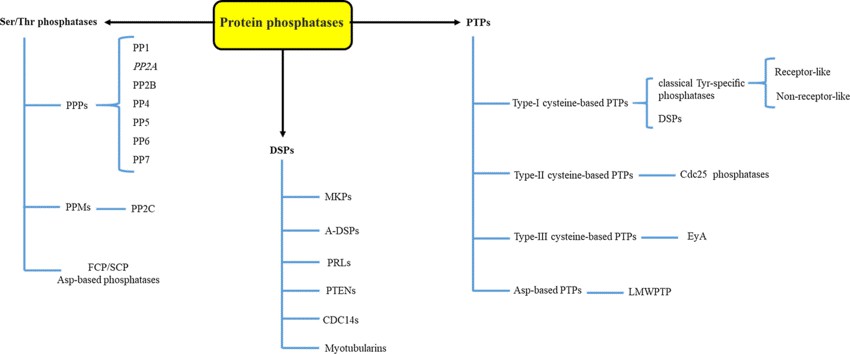 Figure 2. Schematic diagram showing protein phosphatases categorization.
(Source: Javadpour, P. et al., 2019)
References
For research use only, not for use in diagnostic procedures.
| Target | Cat. No. | Product Name | Size | Species Reactivity | Application | Detection Sample | |
| Homocysteine | DEIABL3 | Homocysteine ELISA kit | 96T | Human | Quantitative | plasma, serum | Inquiry |
| DEIA1724 | Human HCY(Homocysteine) ELISA Kit | 96T | Human | Quantitative | serum, plasma, tissue homogenates, other biological fluids | Inquiry | |
| DEIA3576 | HCY(Homocysteine) ELISA Kit | 96T | Universal | Quantitative | Serum, plasma, tissue homogenates and other biological fluids. | Inquiry | |
| DEIABL3-2 | Homocysteic acid ELISA Kit | 96T | Quantitative | Serum, plasma, tissue homogenates, urine | Inquiry | ||
| MAPK1 | DEIA-XYA1368 | p42 MAPK ELISA Kit | 96T | Qualitative | cultured cells | Inquiry | |
| MAPK12 | DEIA-BJ2947 | Chicken P 38 Mitogen-activated Protein Kinase ELISA Kit | 96T | Quantitative | Serum, plasma, cell culture supernatants, body fluid and tissue homogenate | Inquiry | |
| MAPK13 | ABPR-0549 | Human MAPK13 ELISA Matched Antibody Pair | ELISA | Inquiry | |||
| MAPK14 | DEIA-BJ1083 | Rat MAPK(P38 Mitogen-Activated Protein Kinase) ELISA Kit | 96T | Rat | Quantitative | Serum, plasma, tissue homogenates, other biological fluids | Inquiry |
| DEIA6456 | [pThr180/Tyr182]p38 ELISA Kit | 96T | Quantitative | cell lysates | Inquiry | ||
| DEIA-XYA1928 | p38 MAPK ELISA Kit | 96T | Qualitative | cultured cells | Inquiry | ||
| DEIA-BJ2223 | Rat Phosphorylation P38 Mitogen-activated Protein Kinase ELISA Kit | 96T | Quantitative | Serum, plasma, cell culture supernatants, body fluid and tissue homogenate | Inquiry | ||
| DEIA-XYA1929 | p38 MAPK (Phospho-Thr179+Tyr181) ELISA Kit | 2 x 96T | Qualitative | cultured cells | Inquiry | ||
| DEIA-XYA1930 | p38 MAPK (Phospho-Thr180) ELISA Kit | 2 x 96T | Qualitative | cultured cells | Inquiry | ||
| DEIA-XYA1931 | p38 MAPK (Phospho-Tyr182) ELISA Kit | 2 x 96T | Qualitative | cultured cells | Inquiry | ||
| DEIA-XYA1932 | p38 MAPK (Phospho-Tyr322) ELISA Kit | 2 x 96T | Qualitative | cultured cells | Inquiry | ||
| MAPK15 | DEIA-XYA617 | ERK8 ELISA Kit | 96T | Qualitative | cultured cells | Inquiry | |
| DEIA-FN875 | Mouse Mapk15 (Mitogen-activated protein kinase 15) ELISA Kit | 96T | Quantitative | serum, plasma, cell culture supernatants, tissue homogenate | Inquiry | ||
| DEIA-XYA618 | ERK8 (Phospho-Thr175+Tyr177) ELISA Kit | 2 x 96T | Qualitative | cultured cells | Inquiry | ||
| MAPK3 | DEIA-XYA2028 | MAPK3 ELISA Kit | 96T | Qualitative | cultured cells | Inquiry | |
| DEIA-XYA1369 | p44/42 MAP Kinase ELISA Kit | 96T | Qualitative | cultured cells | Inquiry | ||
| DEIA6371 | [pThr202/Tyr204] Erk1/2 ELISA Kit | 96T | Quantitative | cell lysates | Inquiry | ||
| DEIA7187 | ERK 1/2 ELISA Kit | 96T | Quantitative | cell lysis | Inquiry | ||
| DEIA-XYA1370 | p44/42 MAP Kinase (Phospho-Thr202) ELISA Kit | 2 x 96T | Qualitative | cultured cells | Inquiry | ||
| DEIA-XYA1371 | p44/42 MAP Kinase (Phospho-Tyr204) ELISA Kit | 2 x 96T | Qualitative | cultured cells | Inquiry | ||
| MAPK6 | DEIA-XYA615 | ERK3 ELISA Kit | 96T | Qualitative | cultured cells | Inquiry | |
| DEIA-XYA616 | ERK3 (Phospho-Ser189) ELISA Kit | 2 x 96T | Qualitative | cultured cells | Inquiry | ||
| MAPK8 | DEIA-XYA1080 | JNK1/2/3 ELISA Kit | 96T | Qualitative | cultured cells | Inquiry | |
| DEIA-XYA1081 | JNK1/2/3 (Phospho-Thr183) ELISA Kit | 2 x 96T | Qualitative | cultured cells | Inquiry | ||
| DEIA-XYA1082 | JNK1/2/3 (Phospho-Thr183+Tyr185) ELISA Kit | 2 x 96T | Qualitative | cultured cells | Inquiry | ||
| S-Adenosyl Homocysteine | DEIA-FN1319 | SAH (s-adenosylhomocysteine) ELISA Kit | 96T | Quantitative | serum, plasma, cell culture supernatants, tissue homogenate | Inquiry | |
| Tyrosine | DEIANS071 | Nitrotyrosine ELISA Kit | 96T | N/A | Quantitative | cell lysates, serum, plasma and purified proteins | Inquiry |
| DEIA3981 | Nitrotyrosine ELISA Kit | 96T | Human | Quantitative | Cell Lysate, Other biological fluids, Plasma, Serum, Urine | Inquiry | |
| DEIA087J | Nitrotyrosine ELISA Kit | 96T | Human | Quantitative | EDTA plasma, serum | Inquiry | |
| DEIA088J | Nitrotyrosine ELISA Kit | 96T | Human | Quantitative | stool, serum, EDTA plasma | Inquiry | |
| DEIA100J | Tyrosine ELISA Kit | 96T | Human | Quantitative | EDTA plasma, serum | Inquiry | |
| DEIA-PYR064 | Tyrosine Colorimetric Assay Kit | 100T | Quantitative | serum, plasma, urine, other body fluids | Inquiry | ||
| tyrosine hydroxylase | DEIA-XYA1809 | Tyrosine Hydroxylase (Phospho-Ser8) ELISA Kit | 2 x 96T | Qualitative | cultured cells | Inquiry | |
| DEIA-XYA1806 | Tyrosine Hydroxylase (Phospho-Ser19) ELISA Kit | 2 x 96T | Qualitative | cultured cells | Inquiry | ||
| DEIA-XYA1807 | Tyrosine Hydroxylase (Phospho-Ser31) ELISA Kit | 2 x 96T | Qualitative | cultured cells | Inquiry | ||
| DEIA-XYA1808 | Tyrosine Hydroxylase (Phospho-Ser40) ELISA Kit | 2 x 96T | Qualitative | cultured cells | Inquiry |
Loading ......
