
Inquiry Basket
 Loading ......
Protein biotinylation is a fundamental biochemical technique that plays a critical role in various scientific disciplines, including molecular biology, biochemistry, and proteomics. The process involves the covalent attachment of biotin, a water-soluble B vitamin, to specific proteins. Due to the small size and versatility of biotin, biotinylation is often rapid and specific and is unlikely to interfere with the intrinsic function of the molecule, allowing researchers to selectively label and manipulate proteins for a wide range of applications.
Biotin, also known as vitamin H or coenzyme R, is a small water-soluble B vitamin that plays a crucial role in various biochemical processes. Its unique structure consists of a tetrahydrothiophene ring fused to a ureido ring, with a valeric acid side chain attached. The ureido ring contains a nitrogen atom with a lone pair of electrons, which is the key functional group in biotin.
One of the remarkable properties of biotin is its high affinity for streptavidin and avidin, proteins derived from Streptomyces bacteria and egg whites, respectively. This strong non-covalent interaction forms the basis of many biotinylation techniques, where biotin serves as a versatile tag for proteins. This property is often exploited in detection and purification methods. Biotin's water solubility is another important aspect that makes it suitable for various biological applications. It can be easily dissolved in aqueous solutions, allowing compatibility with physiological conditions and biological systems.
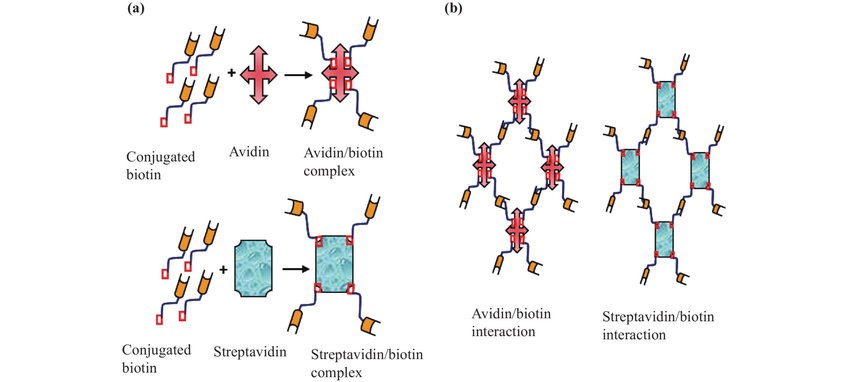 Figure 1. Avidin/biotin and streptavidin/biotin complex formation.
(Source: Haque, S. T. et al., 2022)
Biotinylation techniques are fundamental in molecular biology and biochemistry, allowing selective labeling, detection, and manipulation of proteins. Two main methods are employed for protein biotinylation: chemical biotinylation and enzymatic biotinylation.
Chemical biotinylation is a widely used technique to yield nonspecific biotinylation through the formation of covalent bonds. It involves the application of chemical reagents that react with specific functional groups on the protein to introduce biotin tags. This technique offers versatility, simplicity, and compatibility with a wide range of proteins. Chemical biotinylation includes:
The most common chemical reagents used for biotinylation are N-hydroxysuccinimide (NHS) esters of biotin. These reagents, such as biotin-NHS and biotin-PEG-NHS, contain a biotin molecule attached to an NHS ester group. The NHS ester group is reactive toward primary amines, such as the ε-amino group of lysine residues or the N-terminus of proteins. When the biotin-NHS ester is added to a protein solution, it reacts with these primary amines, resulting in the covalent attachment of biotin to the protein.
It is important to note that chemical biotinylation is a random labeling technique, meaning that biotin tags can be attached to multiple sites on the protein. This non-specific nature of labeling may result in potential steric hindrance or interference with protein function, particularly in cases where the attachment site is critical for protein activity. However, the degree of non-specific labeling can be minimized by optimizing the reaction conditions and carefully controlling the reaction time and reactant concentrations.
Enzymatic biotinylation is a powerful technique used to specifically attach biotin molecules to proteins. It involves the enzymatic transfer of biotin by biotin ligase enzymes to specific target proteins. Enzymatic biotinylation offers several advantages over chemical biotinylation, including site-specificity, high efficiency, and compatibility with native protein structures and functions.
The key enzyme involved in enzymatic biotinylation is biotin ligase. Biotin ligases are proteins that recognize a specific peptide sequence known as the acceptor peptide or target sequence, and catalyze the covalent attachment of biotin to a specific lysine residue within that sequence. The acceptor peptide is typically a short peptide sequence derived from a naturally occurring biotinylated protein, such as biotin carboxyl carrier protein (BCCP) or the biotin domain of acetyl-CoA carboxylase.
Enzymatic biotinylation is compatible with a wide range of protein types, including recombinant proteins, fusion proteins, and native proteins. It can be performed in vitro using purified proteins or in vivo by expressing the target protein along with the biotin ligase enzyme in a suitable host system. This flexibility allows researchers to biotinylate proteins in different experimental settings and tailor the biotinylation approach to their specific needs.
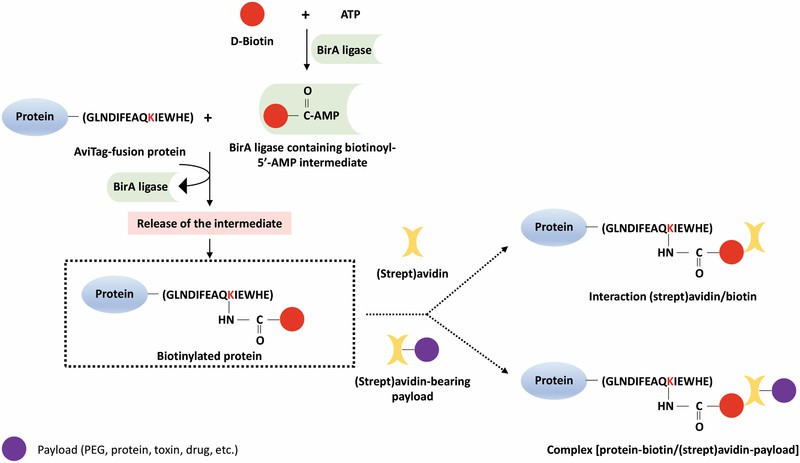 Figure 2. Site-specific enzymatic biotinylation using BirA ligase.
(Source: Rondon, A. et al., 2021)
Protein biotinylation analysis refers to the methods and techniques used to detect, quantify, and study biotinylated proteins. These analyses are crucial for understanding protein function, interactions, and cellular processes. Some common protein biotinylation analysis methods include:
Biotinylation offers numerous applications in biological research and diagnostics:
References
For research use only, not for use in diagnostic procedures.
| Target | Cat. No. | Product Name | Expression System | Tag/Conjugate | Application | |
| Biotin | DISNJ33 | Biotin Standard (98%) | N/A | N/A | ELISA | Inquiry |
| DAGA-074K | Biotin [KLH] | N/A | KLH | Immunogen | Inquiry | |
| DAG3197-HRP | Biotin [HRP] | N/A | HRP | ELISA | Inquiry | |
| DAG3197 | Biotin [BSA] | N/A | BSA | N/A | Inquiry | |
| D-Biotin | DAG3281 | D-Biotin [BSA] | N/A | BSA | IHC, ICC | Inquiry |
| Streptavidin | DAG-T1439 | Streptavidin [[Gold] | N/A | Gold | N/A | Inquiry |
| DAG4455 | Streptavidin [DyLight350] | N/A | DyLight350 | N/A | Inquiry | |
| DAG4456 | Streptavidin [FITC] | N/A | FITC | FC, IHC | Inquiry | |
| DAG4457 | Streptavidin [R-PE] | N/A | R-PE | FC | Inquiry | |
| DAG-T1140 | Streptavidin Streptavidin | E. coli | Unconjugated | N/A | Inquiry | |
| DAG-T1141 | Streptavidin [Proxidase] | E. coli | Proxidase | N/A | Inquiry | |
| Avidin | DAG3276 | Avidin [HRP] | N/A | HRP | ELISA, WB, IHC | Inquiry |
| DAG4331 | Avidin [Biotin] | N/A | Biotin | IHC, ELISA, WB | Inquiry |
| Target | Cat. No. | Product Name | Size | Species Reactivity | Application | Detection Sample | |
| Biotin | DEIA-Z77801 | Biotin ELISA Kit | 96T | Quantitative | serum, plasma, food | Inquiry | |
| DEIA281 | Biotin ELISA Kit | 96T | NA | Quantitative | Food | Inquiry | |
| DEIA9990 | Biotin ELISA Kit | 96T | Universal | Quantitative | Serum, plasma, tissue homogenates and other biological fluids | Inquiry |
Loading ......
