
Inquiry Basket
 Loading ......
Advancements in metabolomics and proteomics have revealed the significant impact of metabolites on post-translational modifications (PTMs), including acylation modifications of proteins. Metabolites can influence acylation processes by either providing acyl groups or modulating the activity of acyltransferases and deacylases. These findings highlight the intricate relationship between metabolites and protein acylation.
Acylation modifications play a crucial role in various cellular processes related to both normal physiology and disease. They have been found to influence protein subcellular localization, stability, transcriptional activity, enzymatic activity, protein-protein interactions, and protein-DNA interactions. By altering the physicochemical properties of proteins, acylation provides precise regulation of physiological and pathological processes within organisms.
Studying protein acylation is instrumental in understanding the regulatory mechanisms of metabolism under different physiological and pathological conditions. It allows researchers to gain insights into how acylation impacts various cellular processes and provides numerous drug targets for cardiovascular diseases, tumors, metabolic diseases, inflammation, and infectious diseases.
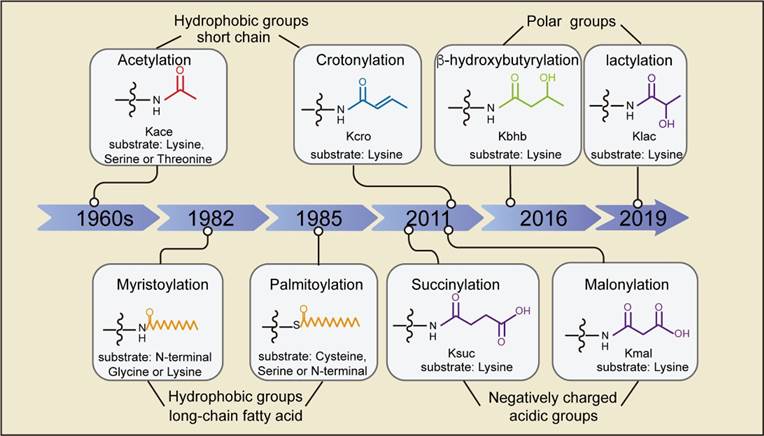 Figure 1. Timeline of the historical milestone for the discovery of protein acylation, and the chemical structures of acyl groups.
(Source: Shang, S. et al., 2022)
Protein acylation can occur through different mechanisms, both enzymatic and non-enzymatic. Enzymatic acylation is the more common type and involves the action of specific enzymes known as acyltransferases. These enzymes transfer acyl groups from donor molecules, such as acyl-CoA, to specific amino acid residues on target proteins. The acyl groups can vary in structure, including acetyl, succinyl, malonyl, crotonyl, β-hydroxybutyryl, lactyl, myristoyl, and palmitoyl. Each type of acylation imparts distinct chemical properties to the modified protein, influencing its function and localization within the cell.
Acetylation involves the addition of an acetyl group (-COCH3) to the ε-amino group of lysine residues. This modification is dynamically regulated by acetyltransferases (HATs) and deacetylases (HDACs). Acetylation influences protein stability, DNA-binding affinity, and protein-protein interactions, thereby affecting cellular processes such as gene expression, cell cycle regulation, and signal transduction.
Succinylation refers to the addition of a succinyl group (-CO-CH2-CH2-CO2H) to lysine residues. Succinylation is carried out by a group of different enzymes, including sirtuin deacetylases (SIRTs) and succinyltransfers. This modification has been implicated in cellular metabolism, particularly in the regulation of mitochondrial function and energy production. Succinylation can affect protein stability, enzymatic activity, and protein-protein interactions.
Protein malonylation refers to the process of covalently binding a malonyl group (such as malonyl-CoA and other donors) to the lysine residue of the substrate protein under the catalysis of an enzyme. This process is reversible. Malonylation plays an important role in metabolic processes, especially energy metabolism and photosynthesis, and can affect fatty acid synthesis, mitochondrial respiration, glycolysis, inflammatory response, etc.
Protein crotonylation exists in core histones and some non-histone proteins of a variety of organisms. Similar to other types of PTM, protein crotonylation is a reversible modification with important functions such as the promotion of gene expression and regulation. Among crotonylations, the most common one is lysine crotonylation.
β-Hydroxybutyrylation is a recently discovered PTM that involves the addition of a β-hydroxybutyryl group to lysine residues in proteins. This modification has been linked to cellular metabolism, particularly in the context of ketone body utilization during fasting or ketogenic diets. β-Hydroxybutyrylation can influence protein-protein interactions and regulate protein function.
Lactoylation, a novel PTM, is a novel contributor to the epigenetic landscape. It controls diverse physiological and pathological contexts through integrated mechanisms. Recently, protein lactylation has been reported to play a critical role in regulating complex biological functions, including inflammation, neoplastic diseases, fibrosis, Alzheimer's disease (AD), embryonic development, stemness maintenance, and neuromodulation.
Myristoylation involves the attachment of a 14-carbon unsaturated fatty acid, myristic acid, to the N-terminal glycine residue of proteins. This lipid modification facilitates the association of proteins with cellular membranes, enabling their proper localization and functioning. Myristoylation is crucial for the membrane anchoring of various signaling proteins.
Palmitoylation is the covalent connection between fatty acids (such as palmitic acid) and cysteine, while the covalent connection frequency with serine and threonine residues of proteins is relatively low, and proteins are usually membrane proteins. This reversible modification is executed by palmitoyl acyltransferases (PATs) and depalmitoylating enzymes. This lipid modification is involved in membrane targeting, protein trafficking, and modulating protein-protein interactions. It is particularly important for the localization and function of peripheral membrane proteins.
Almost every acylation modification is closely related to tumor progression, not only changing the characteristics of tumor cells themselves, but also participating in the formation of a suppressive immune microenvironment. For example,
Targeting protein acylation processes and modulating protein-protein interactions mediated by acylation hold promise as potential therapeutic strategies for cancer treatment. Continued research in this field, along with the development of innovative approaches and interventions, may pave the way for improved cancer therapies in the future.
References
For research use only, not for use in diagnostic procedures.
| Target | Cat. No. | Product Name | Expression System | Tag/Conjugate | Application | |
| N-Acetylcysteine | DAG292S | Acetylcysteine [HSA] | N/A | HSA | ELISA | Inquiry |
| DAG462S | Acetylcysteine [HRP] | N/A | HRP | ELISA | Inquiry | |
| DAG561S | Acetylcysteine [HSA-Biotin] | N/A | HSA-Biotin | ELISA | Inquiry | |
| DAGPY-H83045B | Synthetic Acetylcysteine [BSA] | N/A | BSA | ELISA | Inquiry | |
| DAG3264 | N-Acetyl-Cysteine [BSA] | N/A | BSA | N/A | Inquiry | |
| Cysteine | DAG3280 | L-Cysteine [G-BSA] | N/A | G-BSA | IHC, ICC | Inquiry |
| L Serine | DAGS076 | L-Serine standard | N/A | N/A | ELISA | Inquiry |
| D-Serine | DAG3403 | D-Serine [BSA] | N/A | BSA | ICC, IHC | Inquiry |
| Serine | DAG3404 | L-Serine [G-BSA] | N/A | G-BSA | ICC, IHC | Inquiry |
| E. coli Serine protease inhibitor | DAG-P2957 | Recombinant E. coli serine protease inhibitor | E. coli | Unconjugated | SDS-PAGE | Inquiry |
| DAG-P2309 | Recombinant E. coli Serine protease inhibitor Protein (a.a. 1-162) | E. coli | Unconjugated | HPLC, SDS-PAGE | Inquiry | |
| DAG-P2085 | Recombinant E. coli Serine protease inhibitor Protein (a.a. 21-162) [His] | E. coli | Unconjugated | SDS-PAGE | Inquiry | |
| L-Threonine | DAG3412 | L-Threonine [G-BSA] | N/A | G-BSA | N/A | Inquiry |
| Target | Cat. No. | Product Name | Size | Species Reactivity | Application | Detection Sample | |
| S-Adenosyl Homocysteine | DEIA-FN1319 | SAH (s-adenosylhomocysteine) ELISA Kit | 96T | Quantitative | serum, plasma, cell culture supernatants, tissue homogenate | Inquiry |
Loading ......
