
Inquiry Basket
 Loading ......
Procalcitonin (PCT) is a small protein that is synthesized by the C-cells in thyroid glands. It is considered to be the main marker of disorders that are accompanied by systemic inflammation and sepsis. In addition to sepsis and infection, the level of PCT can increase e.g. as a result of surgery, polytrauma, heat shock, burn injuries or cardiogenic shock. Monitoring PCT levels after cardiac surgery or heart transplantation helps to differentiate an acute graft rejection from bacterial or fungal infections.
Initially, pre-procalcitonin is synthesized by the C-cells of the thyroid. Pre-procalcitonin mainly comprises an N-terminal of 82 amino acids, active calcitonin (a 32-peptide), and katacalcin (a 21-peptide). Pre-procalcitonin enters the endoplasmicreticulum, where it undergoes glycosylation and enzymatic cleavage of the signal peptide to form Procalcitonin (PCT). PCT is then further processed by various proteases, first by cleaving the N-terminal peptide to form a 57-peptide (N-ProCT, aa 1-57), and subsequently degrading to produce mature calcitonin and katacalcin (aa 96-116). Mature calcitonin is amidated at the C-terminal to form active calcitonin (aa 60-91).
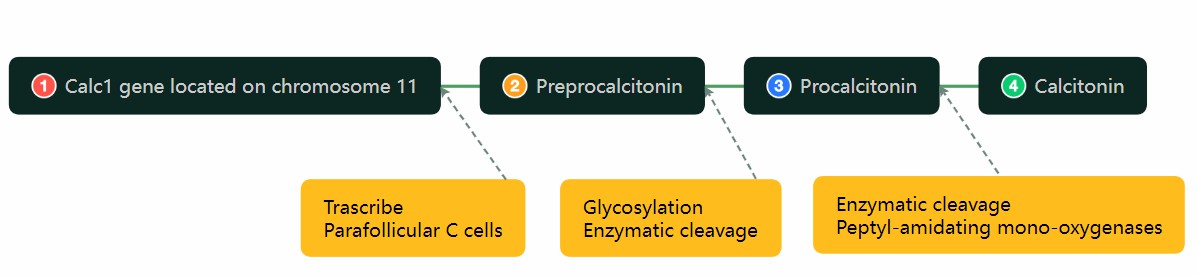 Figure 1. Normal synthesis pathway of PCT and CT
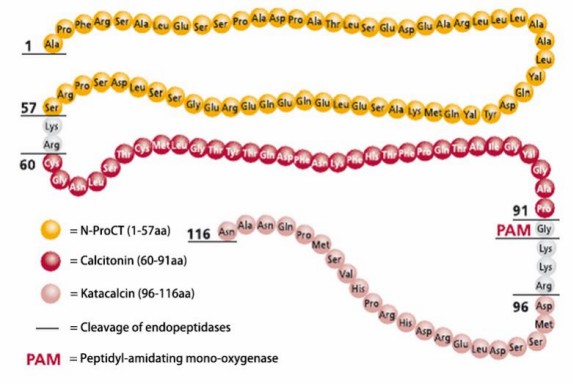 Figure 2. PCT molecule
PCT is a good marker of bacterial infection and the severity of inflammation. It is typically present at low concentrations in the peripheral blood of healthy individuals, often undetectable, but can be produced in various tissues and by multiple cell types during inflammation, especially bacterial infections. Besides, it has been confirmed in multiple studies that monitoring the PCT level changes following cardiac surgery or heart transplantation helps differentiating acute graft rejection from bacterial and fungal infections.
CT, however, plays a role in calcium homeostasis by reducing the levels of calcium in the blood. It works in conjunction with Parathyroid Hormone (PTH) and Vitamin D to regulate calcium and phosphorus metabolism in the body. It does so by inhibiting osteoclast activity and stimulating osteoblast growth, thereby inhibiting bone decalcification and preventing calcium loss, leading to a decrease in blood calcium levels. It also inhibits renal tubular re-absorption of phosphorus, increasing urinary phosphate excretion and consequently reducing blood phosphate levels.
For the development of PCT immunoassays we offer monoclonal antibodies that are specific to different fragments of the PCT molecule.
PCT antibody pair: DMAB1357MH and DMABT-H1296MH
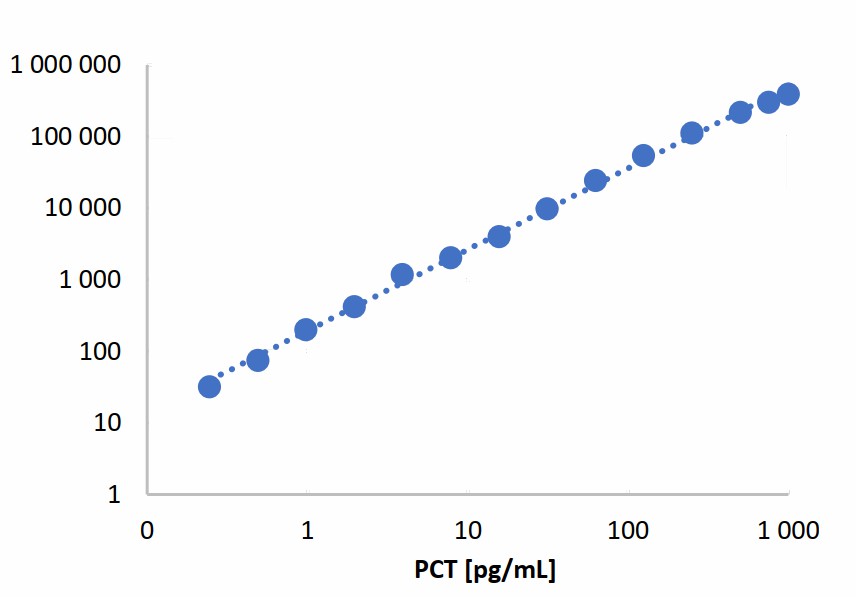 Figure 3. Calibration curves for h-PCT CLIA.
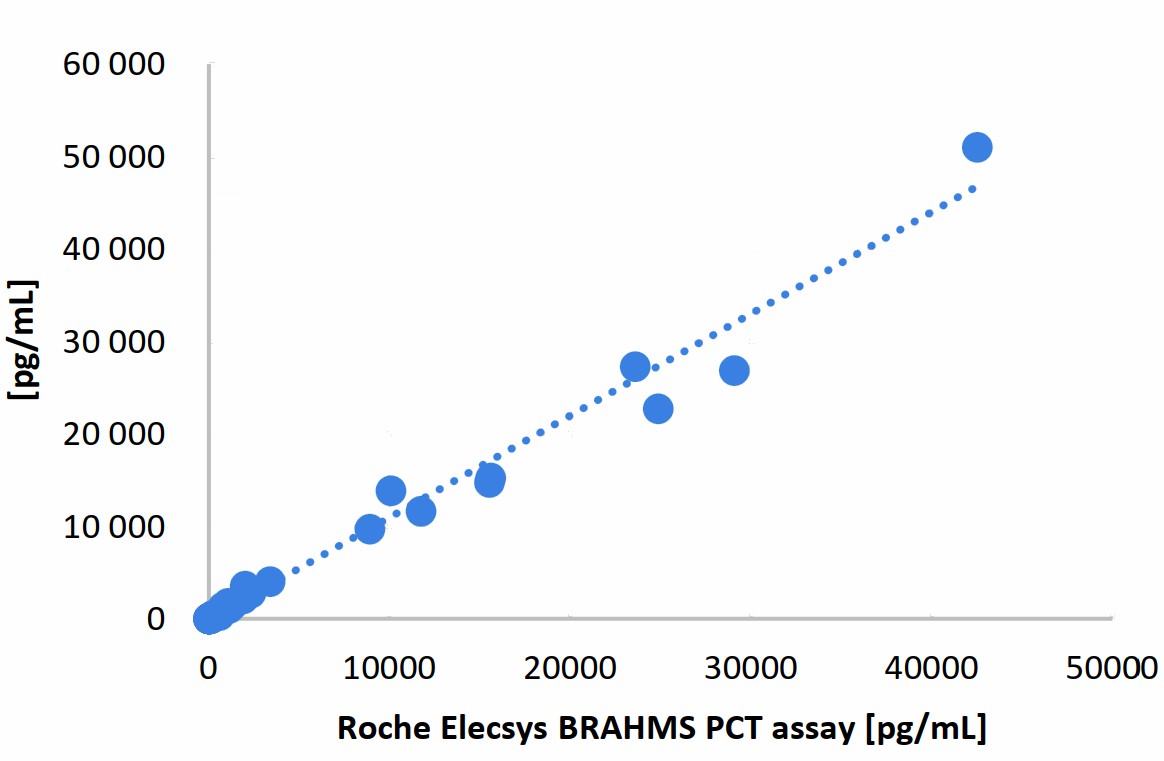 Figure 4. Correlation of the developed assays with the Roche Elecsys® BRAHMS PCT assay.
CT antibody pair: DCABY-4599 and DCABY-4600
 Figure 5. The correlation between proprietary Acridine Ester CLIA CT testing reagents and Control Kits (Roche).
 Figure 6. Evaluation of clinical samples (N=38) in an Acridine Ester CLIA test kit compared to a control kit.
 Figure 7. Acridine Ester CLIA CT Standard Curve.
Creative Diagnostics provides a series of antibody products specific to different fragments of the PCT molecule for immunoassays development. These specificity-measured antibodies can be used for the detection of the full-length or partially processed PCT molecule. In addition to the antibodies, we also offers recombinant, full-length PCT antigen that can be used as a calibrator in PCT or calcitonin immunoassays.
 Figure 8. The amino acid sequence of human PCT
| Cat. | Product name | Specificity | Applications (Pairing Table: Capture - Detection) | |
| DMAB1357MH | Anti-PCT monoclonal antibody, clone 14C10 | Epitope: Calcitonin domain (aa 72 - 81) No cross-reaction with: Calcitonin, Katacalcin, CGRP1 and CGRP2. | Best sensitivity pair for human PCT detection in LFIA and CLIA. DMAB1357MH - DMABT-H1296MH | Inquiry |
| DMABT-H1296MH | Anti-PCT monoclonal antibody, clone 34C23 | Epitope: N-term PCT (aa 11-25) No cross-reaction with: Calcitonin, Katacalcin, CGRP1 and CGRP2. | Best sensitivity pair for human PCT detection in LFIA and CLIA. DMAB1357MH - DMABT-H1296MH | Inquiry |
| DMAB1352MH | Anti-PCT monoclonal antibody, clone 39G12 | Epitope: N-term PCT (aa 21-40) | Recommended pair for human PCT detection in ELISA. DMAB1352MH - CABT-L6524Z | Inquiry |
| CABT-L6524Z | Anti-PCT monoclonal antibody, clone 33B22 | Epitope: Katacalcin domain (aa 96-105) | Recommended pair for human PCT detection in ELISA. DMAB1352MH - CABT-L6524Z | Inquiry |
| DCAB-TJ170 | Magic™ Anti-PCT monoclonal antibody, clone 29C8 | Epitope: Katacalcin domain (aa 102-111) | Recommended pair for human PCT detection in ELISA. DCAB-TJ170 - CABT-WN1111 | Inquiry |
| CABT-WN1111 | Anti-Calcitonin monoclonal antibody, clone 25B3 | Epitope: Calcitonin domain (aa 72 - 81) | Recommended pair for human PCT detection in ELISA. DCAB-TJ170 - CABT-WN1111 | Inquiry |
| DMABP-L38 | Mouse Anti-PCT monoclonal antibody, clone IN089 | Epitope: N-term PCT | Recommended pair for human PCT detection in LFIA and CLIA. DMABP-L38 - DMABP-L39 DMABP-L38 - CABT-L6523Z (Sensitivity: 0.2ng/ml) | Inquiry |
| DMABP-L39 | Mouse Anti-PCT monoclonal antibody, clone IN330 | Epitope: Katacalcin domain (C-term PCT) | Recommended pair for human PCT detection in LFIA. DMABP-L38 - DMABP-L39 (Sensitivity: 0.2ng/ml) | Inquiry |
| CABT-L6523Z | Mouse Anti-PCT monoclonal antibody, clone IN192 | Epitope: Calcitonin domain (Middle region PCT) | Recommended pair for human PCT detection in LFIA and CLIA. DMABP-L38 - CABT-L6523Z (Sensitivity: 0.2ng/ml) | Inquiry |
| DCABH-001H | Mouse Anti-PCT monoclonal antibody | Epitope: Katacalcin domain (aa 96-116) Specificity: React with human PCT No cross-reaction with: Canine PCT | Recommended pair for human PCT detection in LFIA and CLIA. DCABH-001H - DCABH-002H | Inquiry |
| DCABH-002H | Mouse Anti-PCT monoclonal antibody | Epitope: Calcitonin domain (aa 78-81) Specificity: React with human PCT | Recommended pair for human PCT detection in LFIA and CLIA. DCABH-001H - DCABH-002H | Inquiry |
| DMAB1342MH | Mouse Anti-PCT monoclonal antibody | Epitope: Katacalcin domain (aa 90-113) Specificity: React with human PCT | Inquiry | |
| DMAB1337MH | Mouse Anti-PCT monoclonal antibody | Epitope: N-term PCT (aa 26-60) Specificity: React with human PCT | Inquiry |
| Cat. | Product name | Specificity | Applications | |
| DCABY-4599 | Mouse Anti-Calcitonin monoclonal antibody, clone 10B11 | Epitope: Calcitonin domain (QTAIGVGAP) Specificity: React with active CT, distinguishing it from the mature CT present in the PCT peptide, enhancing the specificity of the assay. | Best pair for human calcitonin detection in CLIA and LFIA. DCABY-4599 - DCABY-4600 | Inquiry |
| DCABY-4600 | Mouse Anti-Calcitonin monoclonal antibody, clone 14D11 | Epitope: Calcitonin domain (DFNKFHT) Specificity: React with active CT, distinguishing it from the mature CT present in the PCT peptide, enhancing the specificity of the assay. | Best pair for human calcitonin detection in CLIA and LFIA. DCABY-4599 - DCABY-4600 | Inquiry |
| CABT-WN1149 | Anti-Calcitonin monoclonal antibody, clone 24C0 | Epitope: Calcitonin domain (aa 60 - 69) | Recommended pair for human calcitonin detection in ELISA. CABT-WN1149 - CABT-WN1112 | Inquiry |
| CABT-WN1113 | Anti-Calcitonin monoclonal antibody, clone 35C3 | Epitope: Calcitonin domain (aa 72 - 81) | Recommended antibody pair for human calcitonin detection ELISA. CABT-WN1113 - CABT-WN1149 | Inquiry |
| CABT-WN1112 | Anti-Calcitonin monoclonal antibody, clone 24G3 | Epitope: Calcitonin domain (aa 72 - 81) | Recommended antibody pair for human calcitonin detection ELISA. CABT-WN1149 - CABT-WN1112 | Inquiry |
We also provide related kits and antigens. Please click the link below.
Loading ......
