
Inquiry Basket
 Loading ......
P53 is a powerful tumor suppressor, which is encoded by the TP53 gene on human chromosome 17. As a transcription factor, p53 orchestrates the expression of target genes that can promote cell cycle arrest, apoptosis, DNA repair, and more. Furthermore, p53 can exert antiproliferative effects also by transcription-independent mechanisms.
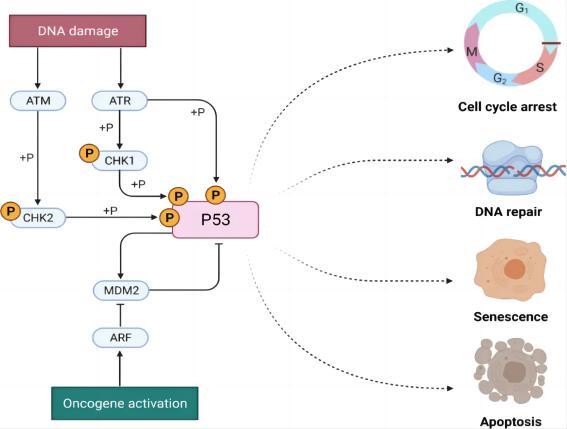 Fig. 1: Biological function of p53
Mutations in the TP53 gene abrogate the tumor suppressor activities of its encoded protein, p53. The TP53 gene is mutated in approximately half of all human malignancies, including those of the breast, colon, lung, liver, prostate, bladder, and skin. Cancer-associated TP53 mutations are predominantly missense mutations, causing single amino acid substitutions. Typically, most cancer-associated mutations fall into one of two categories:
1. DNA contact mutants, in which p53 residues responsible for sequence-specific binding to DNA are altered.
2. conformational or structural mutants, in which the protein becomes extensively misfolded.
Although many hundreds of different p53 mutations have been recorded, some of them are particularly common and are therefore referred to as hotspot mutations. such as R175, G245, R248, R249, R273 and R282, have been so far identified.
The p53 involved in a number of pathways affects oncogenic biological processes including cell proliferation, G2/M phase, and apoptosis. Activation of p53 induces senescence and cell-cycle arrest under excessive oncogenic stress and this is a crucial mechanism regulating the inhibition of tumorigenesis. P53 tumor suppressive function might also work through the recruitment or regulation of other tumor suppressor proteins, such as p53 directly binding to the promoter of ITIH5 in melanoma cells, promoting ITIH5 transcription and therefore suppressing melanoma cell proliferation and migration. ZEB1 and ZEB2 are transcription factors that induce epithelial–mesenchymal transition (EMT), while p53 inhibits EMT by suppressing ZEB1 and ZEB2 expression.
In contrast to wild-type p53 anti-tumor activity, mutant p53 proteins have oncogenic action in culture cells, and promote metastasis and genomic instability in mice models. Although having lost the ability to interact directly with p53-binding sites within the DNA, mutp53 can still piggyback on other transcription factors to drive tumor-promoting gene transcription. In addition to the cell-autonomous activities, mutp53 can also modulate the tumor microenvironment (TME), rendering it more cancer supportive, respectively. For example, mutp53 can support tumor progression by modulating exosome content in a manner that leads to reprogramming of macrophages to an M2 state, thereby generating a more favorable TME25.
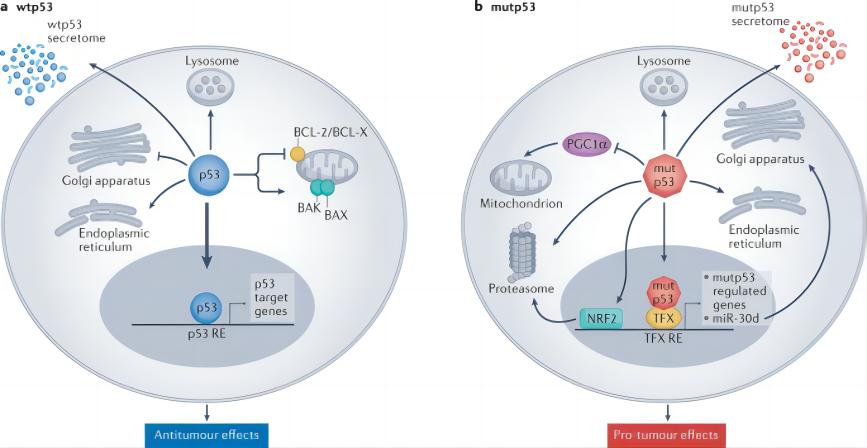 Fig. 2: Tumor-suppressive effects of wild-type p53 and oncogenic effects of mutant p53
P53 stability in response to genotoxic stress is regulated by a variety of post-translational modification (PTMs), including phosphorylation, acetylation, methylation, glycosylation, and ubiquitination, which plays a crucial role in regulating of p53 stability and localization, thereby affecting p53 ability to modulate cell proliferation and cell death.
Phosphorylation of p53 mainly occurs at Ser6, Ser9, Ser15, Thr18, Ser20, Ser33, Ser37, Ser46, Thr55, and Thr81 residues in the N-terminal activation domain, and some phosphorylation occurs at the C-terminal linker and Ser315, 371, Ser376, Ser378 and Ser392. Phosphorylation at most sites is caused by DNA damage, and some of these sites, such as Thr55 and Ser376, are inhibited under genotoxic stress.
Another important modification of p53 is acetylation. p53 is specifically acetylated by p300/CBP at Lys370, Lys372, Lys373, Lys381 and Lys382 and by PCAF at Lys320. Acetylation enhances the DNA binding of p53 and stimulates p53 to mediate reverse transcription activation of its downstream target genes by recruiting coactivators. It can also regulate the stability of p53 by inhibiting the ubiquitination of MDM2. Phosphorylation and acetylation of p53 are interdependent, and N-terminal phosphorylation can enhance its interaction with acetylase p300/CBP.
Several studies have shown that transfection of cancer cells with wild-type p53 expressing plasmids can induce apoptosis and/or growth arrest. Several clinical research investigations using viral and non-viral vectors delivering p53 genes, alone or combined with other therapeutic agents, have been completed so far.
PhiKan083 and PK7088 are small chemicals that bind p53 and generate the Y220C mutant, stabilizing it and boosting the amount of wild-type p53. Other molecules, including PRIMA-1, PRIMAmet/APR-246, CP-31398, and SCH29074, bind to mutant p53 proteins and interact with DNA binding domains to facilitate proper mutant protein folding and p53 function recovery. COTI-2's third-generation thiosemicarbazone, as well as particular peptides, have recently been shown to convert reactive mutant p53 protein to a form with wild-type characteristics. These drugs have been demonstrated to have anticancer action in preclinical models expressing mutant p53. Two of these drugs, APR-246 and COTI-2, have made it to clinical trials so far. In January 2020, the FDA granted breakthrough designation to APR-246 for MDS treatment, and a phase III multicenter randomized trial for the combined treatment was initiated (NCT03745716).
Creative Diagnostics developed a panel of high quality materials targeting p53 to assist our global customers in their research of the functions, oncogenic pathways, and potential treatment of p53 and Tp 53.
| Cat. No. | Product Name | Applications | ||
| Monoclonal antibodies | CABT-Z360A | Recombinant Alpaca Anti-Human p53 DBD Monoclonal Antibody, clone Oc4 | IP, ELISA | Inquiry |
| CABT-Z361A | Recombinant Alpaca Anti-Human p53 TAD Monoclonal Antibody, clone Oc39 | IP, ELISA | Inquiry | |
| CABT-L2805 | Mouse Anti-Human p53 monoclonal antibody, clone JID164 | IHC | Inquiry | |
| CABT-ZB409 | Mouse Anti-Human p53 monoclonal antibody, clone C-G45 | ELISA(Cap) | Inquiry | |
| CABT-ZB411 | Mouse Anti-Human p53 monoclonal antibody, clone C-Q4 | ELISA(Det), FC, IP, WB, IHC-P, IHC-F | Inquiry | |
| DCABH-9955 | Mouse Anti-Human TP53 monoclonal antibody, clone EP-8 | WB, IP, IHC-P, FC, ICC/IF | Inquiry | |
| CABT-50213MH | Mouse Anti-Human TP53 monoclonal antibody, clone BP53-12 [FITC] | FC | Inquiry | |
| CABT-50215MH | Mouse Anti-Human TP53 monoclonal antibody, clone DO-13 | IHC-Fr, IHC-P | Inquiry | |
| CABT-50217MH | Mouse Anti-Human TP53 monoclonal antibody, clone Pab1801 | IP, WB | Inquiry | |
| CABT-50219MH | Mouse Anti-Human TP53 monoclonal antibody, clone DO-11 | IHC-Fr, IP, IHC-P, WB | Inquiry | |
| CABT-50221MH | Mouse Anti-Human TP53 monoclonal antibody, clone FP3-2 | IP, IHC-P, WB | Inquiry | |
| DCABH-1311 | Mouse Anti-Human TP53 monoclonal antibody, clone 3C8F5 | WB, ELISA | Inquiry | |
| DCABH-1809 | Mouse Anti-Human TP53 monoclonal antibody, clone 4E6 | WB, IHC-P, FC, ICC/IF | Inquiry | |
| DCABH-4644 | Mouse Anti-Human TP53 monoclonal antibody, clone 0E4EF4 [Alexa Fluor® 488] | FC | Inquiry | |
| DCABH-9956 | Mouse Anti-Human TP53 monoclonal antibody, clone EP-2 | IHC-P, ICC/IF, WB | Inquiry | |
| DCABH-8383 | Mouse Anti-Human TP53 monoclonal antibody, clone EP-2 [Biotin] | FC | Inquiry | |
| DCABH-8384 | Mouse Anti-Human TP53 monoclonal antibody, clone EP-2 [PE] | FC | Inquiry | |
| DCABH-9884 | Mouse Anti-Human TP53 monoclonal antibody, clone EP-8 [Biotin] | WB, IP, IHC-P, FC, ICC/IF | Inquiry | |
| DCABY-1366 | Mouse Anti-Human TP53 monoclonal antibody, clone 2338DU466.207.264 | WB | Inquiry | |
| CABT-50203MP | Mouse Anti-Human TP53 monoclonal antibody, clone DO-1 [Biotin] | FC | Inquiry | |
| CABT-50206MP | Mouse Anti-Human TP53 monoclonal antibody, clone DO-1 | IHC-Fr, ELISA, IP, IHC-P, WB | Inquiry | |
| CABT-50209MP | Mouse Anti-Human TP53 monoclonal antibody, clone DO-1 [R-PE] | FC | Inquiry | |
| CABT-50222MP | Mouse Anti-Human TP53 monoclonal antibody, clone 240 | IHC-Fr | Inquiry | |
| DCABH-5155 | Mouse Anti-Human TP53 monoclonal antibody, clone QBc2731 | ICC, IHC-Fr, IHC-P, IP | Inquiry | |
| DCABH-2712 | Rabbit Anti-Human TP53 monoclonal antibody, clone TZ121-7 | WB, ICC/IF, IHC, IP | Inquiry | |
| DCABH-3536 | Rabbit Anti-Human TP53 monoclonal antibody, clone I32-F [FITC] | FC | Inquiry | |
| DCABH-3557 | Rabbit Anti-Human TP53 monoclonal antibody, clone Z6 [DyLight® 488] | ICC/IF | Inquiry | |
| Polyclonal antibodies | DPAB2697RH | Rabbit Anti-Human TP53 polyclonal antibody | WB | Inquiry |
| DPAB-DCC009 | Rabbit Anti-Human TP53 Polyclonal Antibody | ELISA, WB, IHC | Inquiry | |
| DPABH-01483 | Rabbit Anti-Human TP53 ( aa 250-350) polyclonal antibody | ICC/IF, WB, IHC-P | Inquiry | |
| DPABH-25036 | Rabbit Anti-Human TP53 Polyclonal Antibody | WB, IP, IHC, ChIP | Inquiry | |
| DPABH-25040 | Rabbit Anti-Human TP53 Polyclonal Antibody | WB, IP, IHC | Inquiry | |
| DPABH-16766 | Rabbit Anti-Human TP53 polyclonal antibody | IHC-P, ELISA | Inquiry | |
| DPABH-25072 | Rabbit Anti-Human TP53 (aa 13-17) polyclonal antibody | IHC-Wmt, WB, IHC-P, ICC/IF | Inquiry | |
| Phospho-specific antibodies | CABT-L4171 | Rabbit Anti-Human TP53 (phospho S6) polyclonal antibody | WB, IHC, IP, ELISA | Inquiry |
| CABT-L4172 | Rabbit Anti-Human TP53 (phospho S9) polyclonal antibody | WB, IHC, ELISA | Inquiry | |
| CABT-L1642 | Rabbit Anti-Human TP53 (phospho S15) monoclonal antibody, clone 25I72M35 | WB, ELISA | Inquiry | |
| DPABH-25003 | Rabbit Anti-Human TP53 (phospho S15) polyclonal antibody | WB, IHC-P, ICC/IF | Inquiry | |
| CABT-L4177 | Rabbit Anti-Human TP53 (phospho T18) polyclonal antibody | WB, ELISA | Inquiry | |
| DPABH-16639 | Rabbit Anti-Human TP53 (phospho S20) polyclonal antibody | WB, ELISA, IHC-P, ICC/IF | Inquiry | |
| DCABH-4908 | Rabbit Anti-Human TP53 (phospho S20) monoclonal antibody, clone FQS3267(3) | WB, ELISA, IHC-P | Inquiry | |
| DCABH-1307 | Mouse Anti-Human TP53 (phospho S20) monoclonal antibody, clone 28C7 | WB, ELISA, IHC-P | Inquiry | |
| CABT-L4168 | Rabbit Anti-Human TP53 (phospho S33) polyclonal antibody | WB, ELISA | Inquiry | |
| DPABH-25023 | Rabbit Anti-Human TP53 (phospho S37) polyclonal antibody | WB, ICC/IF | Inquiry | |
| DCABH-1310 | Mouse Anti-Human TP53 (phospho S46) monoclonal antibody, clone 47 | ChIP, FC, FRET, ICC, IF, WB | Inquiry | |
| CABT-L4170 | Rabbit Anti-Human TP53 (Phosphon S46) polyclonal antibody | WB, ELISA | Inquiry | |
| CABT-L4174 | Rabbit Anti-Human TP53 (phospho T81) polyclonal antibody | IHC, ELISA | Inquiry | |
| DCABH-1315 | Mouse Anti-Human TP53 (phospho S315) monoclonal antibody, clone 29 | WB, IP | Inquiry | |
| CABT-L4167 | Rabbit Anti-Human TP53 (phospho S315) polyclonal antibody | WB, IHC, IP, ELISA | Inquiry | |
| CABT-L4169 | Rabbit Anti-Human TP53 (phospho S366) polyclonal antibody | WB, IHC, ELISA | Inquiry | |
| CABT-L4175 | Rabbit Anti-Human TP53 (phospho S376) polyclonal antibody | IHC, ELISA | Inquiry | |
| CABT-L4176 | Rabbit Anti-Human TP53 (phospho S378) polyclonal antibody | WB, ELISA | Inquiry | |
| CABT-L4173 | Rabbit Anti-Human TP53 (phospho T387) polyclonal antibody | IHC, ELISA | Inquiry | |
| DCABH-2994 | Rabbit Anti-Human TP53 (phospho S392) monoclonal antibody, clone FQ2990Z | WB, IP, IHC-P, ICC | Inquiry | |
| CPBT-66379RP | Rabbit Anti-Human TP53 (phospho S392) polyclonal antibody | WB | Inquiry | |
| Mutation-specific antibodies | DMAB-DCC108 | Mouse Anti-Human TP53 (mutation R175H) Monoclonal Antibody, clone XH117 | ELISA, WB, IHC | Inquiry |
| DPAB-DCC010 | Rabbit Anti-Human TP53 (mutation R175H) Polyclonal Antibody | ELISA, WB, IHC, IP | Inquiry | |
| DPAB-DCC011 | Rabbit Anti-Human TP53 (mutation R282W) Polyclonal Antibody | ELISA, WB, IHC, IP | Inquiry | |
| DMAB-DCC109 | Mouse Anti-Human TP53 (mutation R282W) Monoclonal Antibody, clone XH119 | ELISA, WB, IHC, IP | Inquiry | |
| Acetyl-specific antibodies | CABT-L4165 | Rabbit Anti-Human TP53 (Acetyl-Lys319) polyclonal antibody | WB, IF, ELISA | Inquiry |
| CABT-L4163 | Rabbit Anti-Human TP53 (Acetyl-Lys372) polyclonal antibody | WB, IHC, ELISA | Inquiry | |
| CABT-L4166 | Rabbit Anti-Human TP53 (Acetyl-Lys379) polyclonal antibody | IHC, IF, ELISA | Inquiry | |
| CABT-L1641 | Rabbit Anti-Human TP53 (Acetyl-Lys382) monoclonal antibody, clone 20 I24M25 | FC, ICC, IF, WB | Inquiry | |
| CABT-L4164 | Rabbit Anti-Human TP53 (Acetyl-Lys386) polyclonal antibody | IHC, IF, ELISA | Inquiry | |
Loading ......
