
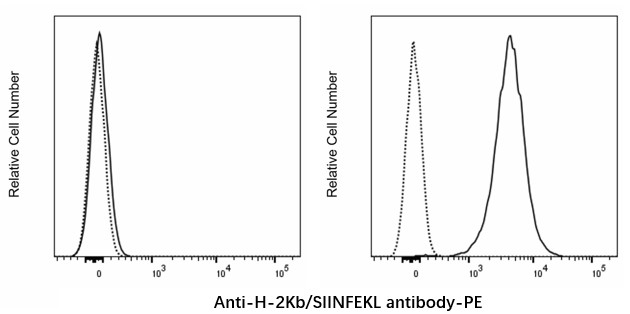
 Fig. 5 FC analysis of H-2Kb/SIINFEKL expression on C57BL/6 mouse splenic leucocytes with (Left) or without (Right) prior SIINFEKL peptide treatment.
Inquiry Basket
 Loading ......
Ovalbumin (OVA), a major allergen protein present in egg whites, is also widely used as a model antigen in immunological studies due to its immunostimulant properties. Many researchers have reported T-cell and B-cell epitopes of OVA in the context of allergic immune responses. Due to its particularly valuable for studying T cell responses, OVA epitope peptides have also been extensively utilized in cancer immunotherapy and vaccine development.
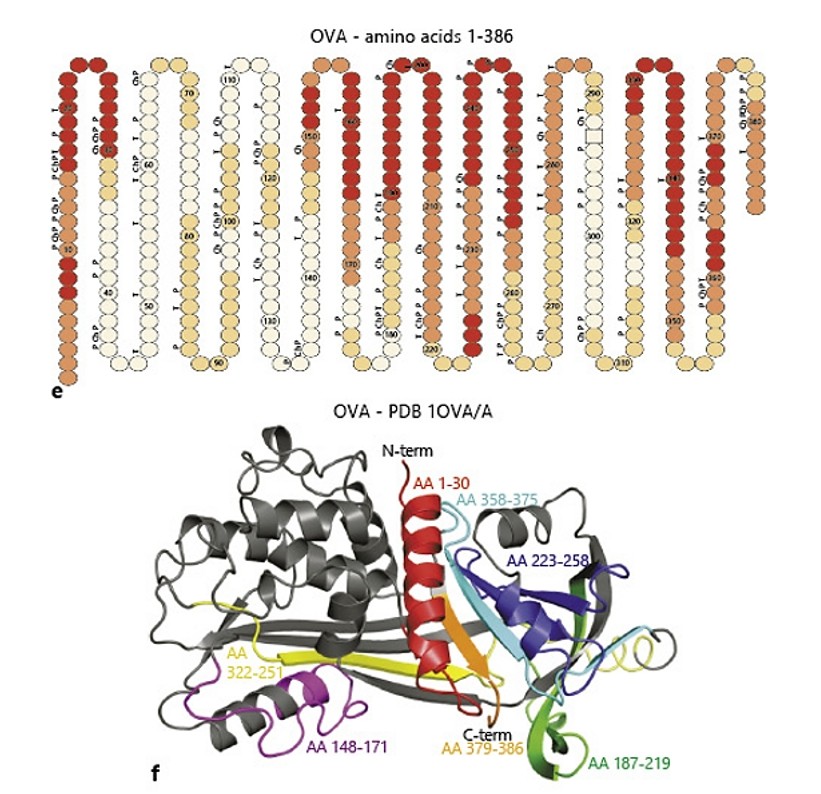 Fig. 1 Epitope mapping on OVA protein.
(Suprun M et al. Int Arch Allergy Immunol. 2022)
OVA is widely used as a model allergen for studying IgE-mediated hypersensitivity and food allergies. A number of studies have reported the partial T and B cell epitope mapping of OVA using murine models and allergic patients' sera. Analysis of IgE binding epitopes in mice provides potential strategies for design of specific immunotherapy.
This MHC class II epitope is recognized by CD4+ T helper cells and is crucial for orchestrating adaptive immune responses. As an immunodominant epitope of OVA, OVA323-339 accounts for 50% of the OVA-specific B-cell response and 60–70% of the OVA-specific T-cell response. It is reported that OVA323-339 can induce Th2-dominant immune responses, and the splenocyte proliferative response to OVA323-339 is possibly IgE-related much like that of OVA. Research on this peptide enhances understanding of how T helper cells contribute to allergic inflammation and antibody production.
Researchers have mapped and analyzed human patients and BALB/c mouse IgE epitopes present on the ovalbumin protein. These important epitopes are summarized in Table 1. In addition, In the BALB/C mouse model, the structural heterogeneity of IgE epitopes generated after exposure to an allergen through different routes (oral, intraperitoneal and subcutaneous entry route) also have been characterized (Table 2). Such research can be exploited in the development of peptide-based vaccines, the production of recombinant hypoallergenic molecules or the determination of cross-reactivity between food allergens.
Table 1. Comparison of human and BALB/c mouse OVA IgE sequential epitopes
| Human | BALB/c Mouse | |
| Epitope regions on OVA primary sequence | aa 38-49 | aa 53-60 |
| aa 95-102 | aa 77-84 | |
| aa 191-200 | aa 103-108 | |
| aa 243-248 | aa 127-136 | |
| aa 251-260 | aa 275-280 | |
| aa 301-306 | ||
| aa 323-332 | ||
| aa 375-384 |
Table 2. Disparity in OVA epitope recognition through different routes
| Oral Entry Route | Intraperitoneal entry Route | Subcutaneous Entry Route |
| aa 53-60 | aa 55-60 | aa 55-58 |
| aa 77-84 | ||
| aa 103-108 | ||
| aa 127-136 | aa 127-136 | |
| aa 275-280 | aa 277-282 | aa 279-282 |
| aa 301-306 | aa 303-308 | |
| aa 323-332 | aa 323-332 | |
| aa 375-384 |
OVA can be used as a model antigen for standardized evaluation of immune response, enabling researchers to compare the efficacy of various vaccine formulations in terms of antibody production and T-cell activation. It is also widely used in preclinical models to assess vaccine efficacy against infectious diseases and cancer, particularly through OVA-derived epitopes like SIINFEKL, which stimulate specific T-cell responses against tumors. Also, OVA epitopes can be used as model targets to investigate T-cell responses against tumors. By utilizing OVA epitopes, researchers can explore various methodologies to enhance anti-tumor immunity, including the formulation of vaccines that promote a strong CD8+ T-cell response.
 Fig.2 Reactivity of antibody 25-D1.16 with H-2Kb complexed with SIINFEKL peptide.
(Porgador A et al. Immunity. 1997)
This peptide is a class I (Kb)-restricted peptide epitope of OVA recognized by CD8+ T cells, presented by the class I MHC molecule (H-2Kb). Angel Porgador produced a monoclonal antibody (25-D1.16) specific for peptide SIINFEKL-MHC class I complexes. This reagent has obvious utility for flow-cytometric phenotyping of APCs isolated from various tissues or organs. Similarly, antibodies against peptide–human class I complexes, which present on tumors, could potentially be used to identify patients whose cells express specific complexes prior to attempting therapeutic vaccination, to observe vaccinated patients for survival of cells lacking the target antigen, or to target cytotoxic drugs or radionuclides to the tumor.
Creative Diagnostics offers a variety of antibodies against OVA epitope peptides (aa 61-68, aa 191-202, aa 257-264, aa 323-339, aa 363-374, etc.) to assist your scientific research. These antibody target widely reported epitopes or epitopes similar to IgE epitopes in human patients. Our products cover a wide range of applications and can be conjugated with various labels according to customer needs. Product performance is as follows.
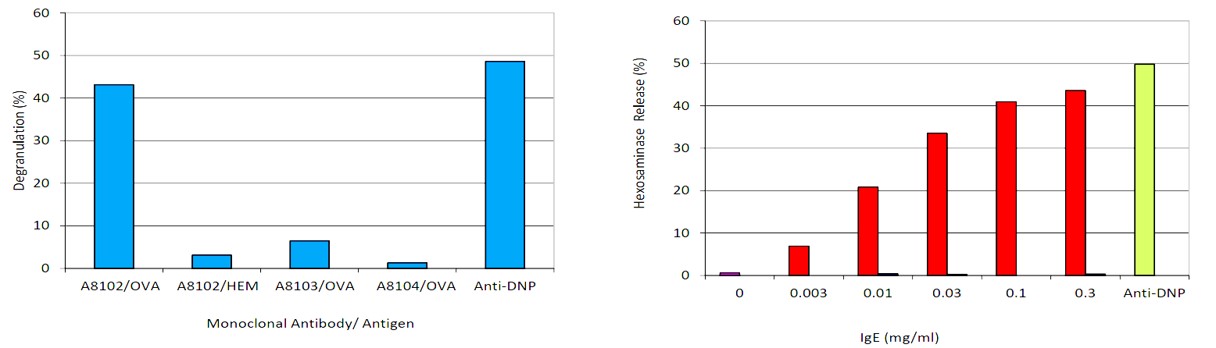 Fig.3 Degranulation of mast cells by monoclonal IgE antibody. Comparing the three antibodies (Left); Dose response effect of A8102 and A8103 (Right).
(Cat. No CABT-L0502Y, CABT-L0504Y, CABT-L0503Y)
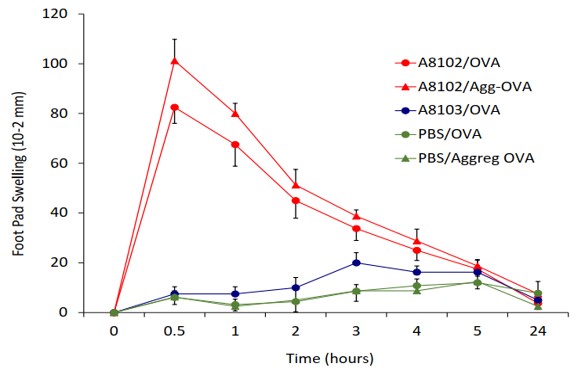 Fig.4 In vivo experiment of foot pad hypersensitivity.
(Cat. No CABT-L0502Y, CABT-L0504Y)
References
| OVA (aa 61-68) antibodies | ||||
| Cat. No. | Product Name | Isotype | Application | |
| CABT-L0502Y | Mouse Anti-OVA (61-68 peptide) monoclonal antibody, clone A8102 | IgE | ELISA | Inquiry |
| CABT-L0507Y | Mouse Anti-OVA (61-68 peptide) monoclonal antibody, clone A8105 | IgG1 | ELISA | Inquiry |
| CABT-L0502YB | Mouse Anti-OVA (61-68 peptide) monoclonal antibody, clone A8102 [Biotin] | IgE | ELISA | Inquiry |
| CABT-L0507YB | Mouse Anti-OVA (61-68 peptide) monoclonal antibody, clone A8105 [Biotin] | IgG1 | ELISA | Inquiry |
| CABT-L0502YH | Mouse Anti-OVA (61-68 peptide) monoclonal antibody, clone A8102 [HRP] | IgE | ELISA | Inquiry |
| CABT-L0507YH | Mouse Anti-OVA (61-68 peptide) monoclonal antibody, clone A8105 [HRP] | IgG1 | ELISA | Inquiry |
| OVA (aa 191-202) antibodies | ||||
| Cat. No. | Product Name | Isotype | Application | |
| CABT-L0509Y | Mouse Anti-OVA (191-202 peptide) monoclonal antibody, clone A8107 | IgG2b | ELISA | Inquiry |
| CABT-L0509YB | Mouse Anti-OVA (191-202 peptide) monoclonal antibody, clone A8107 [Biotin] | IgG2b | ELISA | Inquiry |
| CABT-L0509YH | Mouse Anti-OVA (191-202 peptide) monoclonal antibody, clone A8107 [HRP] | IgG2b | ELISA | Inquiry |
| OVA (aa 257-264) antibodies | ||||
| Cat. No. | Product Name | Isotype | Application | |
| DPABB-JX226 | Rabbit Anti-OVA (aa 257-264) polyclonal antibody | IgG | WB, ELISA | Inquiry |
| DPABB-JX227 | Rabbit Anti-OVA (aa 257-264) polyclonal antibody [Biotin] | IgG | WB, ELISA | Inquiry |
| DMAB22584 | Mouse Anti-Mouse OVA257-264 peptide bound to H-2Kb monoclonal antibody, clone 25-D1.16 | IgG1 | FC, Functional assays | Inquiry |
| DMAB22582 | Mouse Anti-Mouse OVA257-264 peptide bound to H-2Kb monoclonal antibody, clone 25-D1.16 [PE] | IgG1 | FC, Functional assays | Inquiry |
| DMAB22583 | Mouse Anti-Mouse OVA257-264 peptide bound to H-2Kb monoclonal antibody, clone 25-D1.16 [Biotin] | IgG1 | FC, Functional assays | Inquiry |
| DMAB22585 | Mouse Anti-Mouse OVA257-264 peptide bound to H-2Kb monoclonal antibody, clone 25-D1.16 [APC] | IgG1 | FC, Functional assays | Inquiry |
| OVA (aa 323-339) antibodies | ||||
| Cat. No. | Product Name | Isotype | Application | |
| DPAB27549 | Rabbit Anti-OVA (aa 323-339) polyclonal antibody | IgG | ELISA | Inquiry |
| DPAB27550 | Rabbit Anti-OVA (aa 323-339) polyclonal antibody [Biotin] | IgG | ELISA | Inquiry |
| OVA (aa 363-374) antibodies | ||||
| Cat. No. | Product Name | Isotype | Application | |
| CABT-L0503Y | Mouse Anti-OVA (363-374 peptide) monoclonal antibody, clone A8104 | IgG1 | ELISA | Inquiry |
| CABT-L0504Y | Mouse Anti-OVA (363-374 peptide) monoclonal antibody, clone A8103 | IgE | ELISA | Inquiry |
| CABT-L0503YB | Mouse Anti-OVA (363-374 peptide) monoclonal antibody, clone A8104 [Biotin] | IgG1 | ELISA | Inquiry |
| CABT-L0504YB | Mouse Anti-OVA (363-374 peptide) monoclonal antibody, clone A8103 [Biotin] | IgE | ELISA | Inquiry |
| CABT-L0503YH | Mouse Anti-OVA (363-374 peptide) monoclonal antibody, clone A8104 [HRP] | IgG1 | ELISA | Inquiry |
| CABT-L0504YH | Mouse Anti-OVA (363-374 peptide) monoclonal antibody, clone A8103 [HRP] | IgE | ELISA | Inquiry |
| Other OVA antibodies | ||||
| Cat. No. | Product Name | Isotype | Application | |
| CABT-L0505Y | Mouse Anti-OVA monoclonal antibody, clone A8101A | IgA | ELISA | Inquiry |
| CABT-L0506Y | Mouse Anti-OVA monoclonal antibody, clone A8108M | IgM | ELISA | Inquiry |
| CABT-L0508Y | Mouse Anti-OVA monoclonal antibody, clone A8106G | IgG2a | ELISA | Inquiry |
| CABT-L0510Y | Mouse Anti-OVA monoclonal antibody, clone A8210G | IgG2c | ELISA | Inquiry |
| HMABPY118 | Mouse Anti-OVA monoclonal antibody, clone 3c | IgG | ELISA, LFIA | Inquiry |
Loading ......
