
Inquiry Basket
 Loading ......
Multiplex immunoassays allow simultaneous detection of various analytes within the same test sample. However, current platforms capable of multiplexing are often complex and expensive. Here, we describe a low-cost planar array on a chip capable of simultaneously detecting up to 80 different analytes using the MagArray MR-110 chip reader. Each chip is composed of 80 giant magnetoresistive sensors on which sandwich ELISA immunoassays are built with magnetic nanotags (MNT), an alternative to fluorescent or enzymatic labels. This technology utilizes a magnetic nanoparticle technology derived from the computer disk drive industry for use in diagnostics and makes the MagArray platform an easy-to-operate (i.e., easy as plugging a USB drive into a computer), small (i.e., 22 × 13.5 × 11 cm), portable system (i.e., less than 1 kg) with no moving parts and/or microfluidics. When compared to conventional ELISA, the MagArray system is capable of detecting analyte(s) (i.e., in this case carcinoembryonic antigen [CEA]) at a much lower concentration and across a wider dynamic range. In addition to superior performance in sensitivity, dynamic range, multiplexibility, and size, the MagArray system also possesses the following unique characteristics:
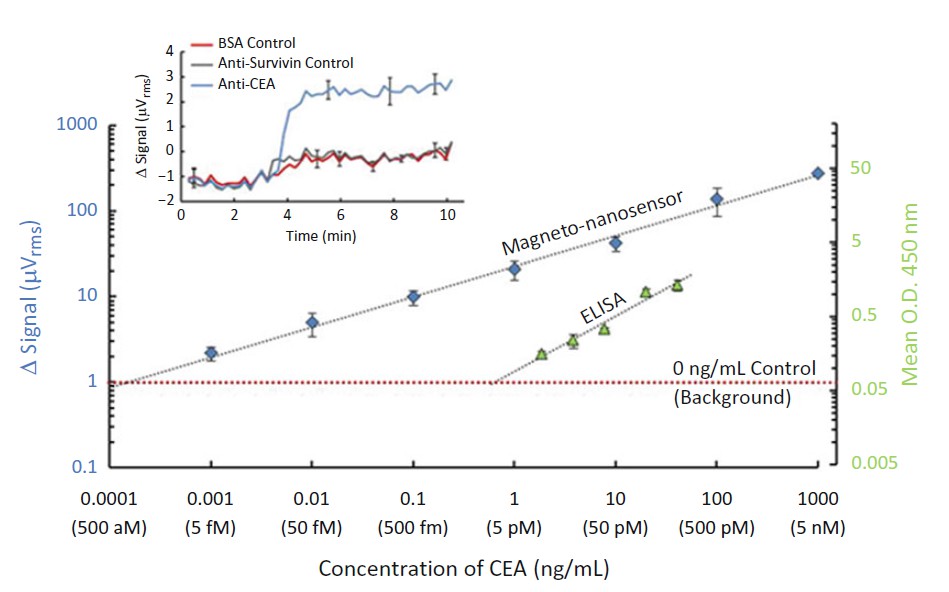 Figure 1. Comparison of conventional ELISA to MagArray sensitivities for the biomarker CEA.
Each chip has 8 built-in reference sensors, passivated and chemically isolated from the reaction well, that are used for establishing the level of electrical signal which is independent of assay chemistry during an assay (i.e., baseline or reference signal). The steps of the standard assay are described below, while the shortened steps for the express assay are described in the Notes.
1. Make sure that the capture antibody solution does not have any surfactant. This will ruin your experiment. In addition, glycerol has also been known to decrease assay effectiveness.
View all Matched Antibody Pairs
2. Care should be taken not to scratch or let the face of chip come into contact with towels, pipette tips, or other materials. The sensor surfaces should never be touched.
3. For the express assay, all the reagents (i.e., sample, detector antibodies, and magnetic particles) are added at once, then the assay is measured right away and results obtained within 2–5 min. This was demonstrated to work with whole blood.
4. Make sure not to introduce any air bubbles when adding any reagents onto the chip as it might be detrimental to the quality of the results obtained.
5. The incubation times and temperatures can play a critical role in the assay optimization. The proposed incubation times and temperatures are the default commonly used, but once the assay is optimized for the reagents, consideration should be taken to shorten assay time by reducing incubation times and increasing or decreasing temperatures. The chip reader software automatically corrects for temperature variations during the assay and does not require the user to activate it.
Reference
Loading ......
