
Inquiry Basket
 Loading ......
Messenger RNA (mRNA) vaccine is a new vaccine technology developed in recent years. Compared with traditional vaccines, mRNA vaccines have the advantages of high safety, good balanced immunity, short development cycle and low production cost. With the rapid development of mRNA modification and delivery technology, mRNA technology has rapidly matured, showing broad application prospects in tumor treatment, prevention and treatment of viral diseases, etc. SARS-CoV-2 mRNA vaccine has been developed and successfully applied at a record speed, paving the way for the promotion of mRNA technology in the future.
First, mRNA vaccines require the design of a DNA template to be transcribed in vitro. The DNA template should contain at least an Open Reading Frame (ORF) and a 5' untranslated region (5' UTR) and 3 'UTR on its flanks. A primer binding site containing available RNA polymerase (eg. T7, T3 or SP6 phage RNA polymerase) is then required to initiate in vitro transcription1.
In vitro transcription (IVT) is a process in which designed template DNA strands are transcribed into RNA strands according to the principle of base complementarity. Transcription begins after RNA polymerase recognizes the transcription promoter. Modified nucleotides can be used to further stabilize RNA and reduce immunogenicity during in vitro transcription2.
In vitro transcribed RNA has a highly immunogenic 5 'triphosphate portion. Tri-phosphorylated RNA is recognized by pattern recognition receptor (PRR) in the cytoplasm and induces Type-I interferon (IFN I) response3. To prevent RNA from being recognized as foreign, its triphosphate must be removed and a 5 'cap added.
Poly(A) tails can slow down the degradation process of RNA from RNA exonuclease and improve RNA stability and translation efficiency. Poly (A) tails are typically 100-250 nucleotides long, but the optimal length depends on the target cell type. The use of modified adenosine can further improve the stability of poly(A) tails and make them resistant to cellular ribonuclease degradation4.
After in vitro transcription, the mRNA needs to be purified and its concentration determined to exclude abnormal, truncated and degraded products. Clinically, mRNA is purified by chromatography to remove short template fragments due to transcription failure or double-stranded (ds) RNA due to self-complementary 3 'extensions, both of which are common causes of impurities.
Encapsulation of mRNA with polymeric nanoparticles protects them from degradation, and their specific chemical properties facilitate cellular uptake and endosomal escape. Polyethylenimine (PEI) is a cationic polymer widely used in nucleic acid transportation, and jetPEI®, a commercial linear PEI derivative, has been used for mRNA transfection in vivo and in vitro. Low molecular PEI modified by aliphatic chain can reduce toxicity5.
Protein derivative-mRNA complex refers to the direct conjugation of proteins such as protamine to RNA. This complex enters the cell through endocytosis and is conjugated by toll-like receptor (TLR), Myeloid Differentiation Marker 88 (MyD88) dependent pathway to activate the immune system.
LNPs was originally developed for the delivery of small interfering RNA (siRNA), and has become the most widely used material for delivering mRNA in vivo6.
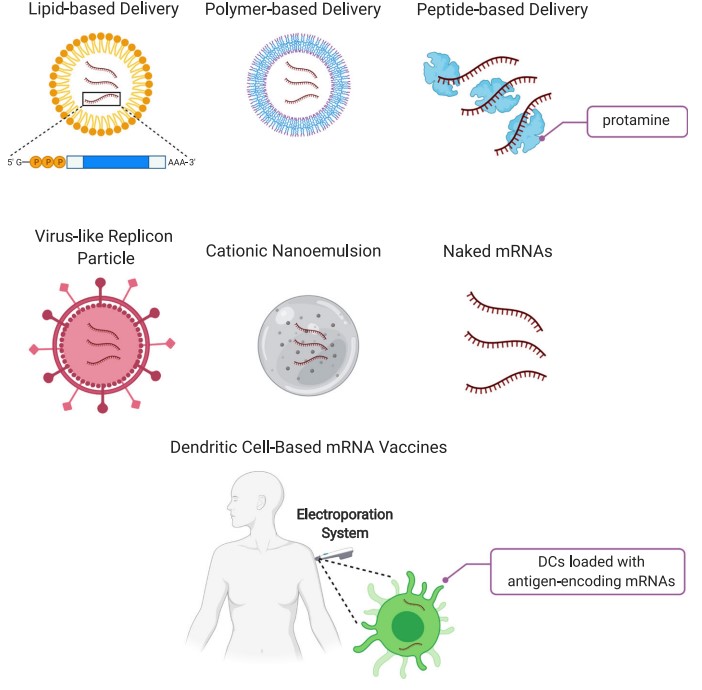 Figure 1. Major delivery methods for mRNA vaccines7
Exogenous mRNA is generally considered to be immunogenic, exhibiting RNA-virus-like characteristics and activating innate immune cells through TLR. TLR belongs to a group of innate immune response PRR that act as "receptors" for pathogen-associated molecular patterns (PAMP) to detect PAMP. mRNA can be recognized by Antigen presenting cell (APC) and activate TLR, such as TLR3, TLR7 and TLR88. Once TLR detects PAMP, it primes the innate immune response by continuously activating the adaptive immune response.
Retinoic acid-inducible gene I (RIG-I) -like receptor (RLR) in non-immune cells and melanoma differentiation-associated gene 5 (MDA5) sense exogenous mRNA and mediate the production of cytokines and chemokines in mice. Innate immune cells (such as DC and macrophages) are recruited to the injection site of mRNA9. Although early induction of powerful cytokines is beneficial for vaccine efficacy, the vaccine cannot be fully effective because cytokines can cause severe systemic side effects such as autoimmunity or impair the immune response of the mRNA vaccine.
After an injection of the mRNA vaccine, the protein it encodes is translated and presented to the immune system, triggering acquired immunity. The proteins encoded by mRNA are translated and taken up by APC (such as DC) through micro-endocytosis, endocytosis or phagocytosis, which may form phagosomes or endosomes containing antigenic proteins10. Major histocompatibility complex I (MHC-I) and major histocompatibility complex II (MHC-II) were presented on DC. APC can deliver exogenous antigens to CD4+T cells via MHC-II and cross present them to CD8+T cells on MHC-I. The resulting induction of cytotoxic T lymphocytes is called cross excitation. CD4+T cells help B cells and CD8+T cells. Finally, clonal amplification of antigen-specific B and T cells results in the elimination of target cells.
While peptide-based vaccines are MHC limited, mRNA vaccines allow combinations of mRNA that encode different antigens. mRNA electroporated dendritic cells possess a variety of MHC-I and II restrictive peptides and can induce polyclonal CD4+ and CD8+T cell responses. CD4+ helper T cells are very important for effectively inducing cytotoxic T lymphocyte (CTL) and B cell responses11, and mRNA vaccine can further improve the immune response in the presence of helper epitopes. The induction of CD4+T cell response is autophagy mediated by the introduction of mRNA into dendritic cells. Finally, vaccine compositions can include mRNA that encode immunomodulatory proteins, further enhancing their potency.
Given the shrinking timelines for drug development, access to faster and higher-throughput analytical methods has become vital. Indeed, it is essential that analytical approaches for use during mRNA product development and quality-control (QC) testing must keep pace to ensure the identity, safety, and efficacy of these new prophylactic and therapeutic modalities.
Emphasis should be placed on lipid-related toxicity. Non-specific immune reaction, degradation products produced during preparation and storage, the safety of positive polymer material itself, and the accumulated safety risk of various impurities can be considered comprehensively.
The proportion of mRNA modification, poly A tail adding efficiency, cap adding efficiency, degree of dephosphorylation, mRNA degradation fragment, mRNA integrity and sequence accuracy, dsRNA and mRNA content should be fully studied. Among them, uncapped, phosphorylated mRNA and dsRNA have non-specific immune stimulation, which are the most concerned impurities in immunology. mRNA modification has two sides. On the one hand, it increases the stability of mRNA, but also enhances the non-specific immune response of mRNA. Cap ratio, poly(A) length and mRNA integrity may affect the effectiveness of the product. mRNA capping process, capping structure, capping raw material impurities, in vitro and in vivo expression efficiency of capped mRNA, in vitro and in vivo immunogenicity are also the focus of pharmaceutical research.
In addition to CQA of conventional nanomaterials, the following aspects should also be paid attention to: (1) charge. Zeta potential not only affects the stability of nanoparticles, but also affects the entry, endosomal escape and adverse reactions of nanoparticles. (2) Particle size distribution; (3) pH. The preparation contained cationic polymer, and pH could affect the composite of the material and mRNA. (4) Encapsulation rate of mRNA by nanoparticles; (5) integrity, function and content of encapsulated mRNA; (6) mRNA release.
The impurities in quality research mainly include process-related impurities and product-related impurities. High attention should be paid to the impurities affecting safety, and full research should be conducted on them, including the generation/introduction of related impurities, process removal, and the degree of monitoring. (1) Related impurities of poly positively charged materials, including impurities generated by material synthesis and possible impurities generated in the process of mRNA composite; (2) Oxidation and related degradation products of unsaturated lipids; (3) Particulate matter generated by nanoparticle aggregation is also a potential impurity and should be evaluated according to the actual situation; (4) Unassembled lipid molecules, cationic substances and free mRNA. Unassembled lipid molecules affect the stability of LNPs. Free mRNA is easy to degrade, and may also cause non-specific immune stimulation, affecting the safety and efficacy of the product.
References
| Cat No. | Product Name | Compatible Samples | |
| DEIA-BZ002 | Double-stranded RNA (dsRNA, modified) ELISA kit | synthetic mRNA solution | Inquiry |
| DEIA-BZ001 | mRNA (nucleoside-2'-O-)-methyltransferase ELISA Kit | synthetic mRNA solution | Inquiry |
| DEIA-BZ003 | Vaccinia Capping Enzyme ELISA kit | synthetic mRNA solution | Inquiry |
| DEIANS026 | DNase I ELISA Kit | synthetic mRNA solution | Inquiry |
| DEIANS032 | T7 RNA Polymerase ELISA Kit | synthetic mRNA solution | Inquiry |
| DEIANS033 | RNase Inhibitor ELISA Kit | synthetic mRNA solution | Inquiry |
Creative Diagnostics now offers a set of antibodies against mRNA enzymes that can be used for analyzing the type and quality of mRNA enzymes used in mRNA production. Target specifications include T7 RNA polymerase, RNase Inhibitor, DNase I, Pyrophosphatase, capping enzyme, RNMT, and MTPAP. These selected antibodies combine high specificity and sensitivity, and are fully characterized by different applications.
| Enzymes | Cat. No. | Product Name | Applications | |
| T7 RNA Polymerase | CABT-B8990 | Rabbit Anti T7 RNA Polymerase Polyclonal Antibody | WB, ELISA | Inquiry |
| CABT-B8990H | Rabbit Anti T7 RNA Polymerase Polyclonal Antibody [HRP] | WB, ELISA | Inquiry | |
| RNH1/RNase Inhibitor | DPABH-08841 | Rabbit Anti RNH1 (424-454) Polyclonal Antibody | ICC/IF, WB | Inquiry |
| CABT-L7840 | Mouse Anti RNH1 Monoclonal Antibody, Clone 2I34 | WB, ELISA, FC, ICC/IF | Inquiry | |
| DNase I | DCABH-11305 | Rabbit Anti DNASE1 Monoclonal Antibody | ELISA, ICC/IF | Inquiry |
| CABT-L7841 | Mouse Anti DNASE1 Monoclonal Antibody, Clone C5 | WB, IP, IF, IHC, ELISA | Inquiry | |
| CABT-L2071 | Rabbit Anti DNASE1 Polyclonal Antibody | WB, IF | Inquiry | |
| Pyrophosphatase, Inorganic (yeast) | CABT-L7842 | Rabbit Anti Inorganic Pyrophosphatase Polyclonal Antibody | IF, ELISA, DB, IB | Inquiry |
| CABT-L7843 | Rabbit Anti Inorganic Pyrophosphatase Polyclonal Antibody, Biotin | IF, ELISA, DB, IB | Inquiry |
| Enzymes | Cat. No. | Product Name | Applications | |
| Capping Enzyme | CABT-L7844 | Rabbit Anti mRNA-capping Enzyme Polyclonal Antibody | ICC, WB | Inquiry |
| CABT-B11251 | Mouse Anti mRNA-capping Enzyme Monoclonal Antibody | WB | Inquiry | |
| DPABH-28350 | Rabbit Anti mRNA-capping Enzyme Polyclonal Antibody | WB, IP, IF, ELISA | Inquiry | |
| RNMT/mRNA Cap 2´-O-MethyltransFerase | CABT-BL3171 | Mouse Anti RNMT Monoclonal Antibody, Clone 4I4-2E23 | WB, IP, IF, IHC, ELISA | Inquiry |
| CABT-BL3170 | Rabbit Anti RNMT (30-130) Polyclonal Antibody | WB, ICC/IF, IHC | Inquiry | |
| CABT-L7845 | Rabbit Anti RNMT Polyclonal Antibody | WB, ICC/IF, IP | Inquiry |
| Enzymes | Cat. No. | Product Name | Applications | |
| MTPAP/PolyA Polymerase | DPABH-04497 | Rabbit Anti MTPAP Polyclonal Antibody | WB, ICC/IF, IP | Inquiry |
| CABT-L7846 | Mouse Anti MTPAP Monoclonal Antibody, Clone 2E4 | WB, ICC/IF, IHC-P | Inquiry | |
| CABT-L7847 | Rabbit Anti MTPAP(Center) Polyclonal Antibody | WB, IHC-P, ELISA | Inquiry |
Creative Diagnostics provides a panel of highly sensitive antibiotics ELISA kits to analyze antibiotic residues. These kits are suitable as good impurity detection tools to be used in the bioproduction process.
| Cat. No. | Product Name | Compatible Samples | |
| DEIA048 | Kanamycin ELISA Kit | Vaccine, Cell Culture | Inquiry |
| DEIA-WZ048V | High Sensitivity Kanamycin ELISA Test Kit | Cell lysate, Urine, Serum, Recombinant protein, Fermentation liquid | Inquiry |
| DEIA047 | Gentamicin ELISA Kit | Vaccine, Cell Culture | Inquiry |
| DEIA-WZ6884 | High Sensitivity Gentamicin ELISA Test Kit | Cell lysate, Urine, Serum, Recombinant protein, Fermentation liquid | Inquiry |
| DEIA040 | Ampicillin ELISA Kit | Vaccine | Inquiry |
| DEIA-WZ020 | High Sensitivity Streptomycin ELISA Test Kit | Serum, Urine, Recombinant protein | Inquiry |
| DEIA6881V2 | Chloramphenicol ELISA Kit | Vaccine | Inquiry |
| Kanamycin ELISA Kit | High Sensitivity Kanamycin ELISA Kit | Gentamicin ELISA Kit | High Sensitivity Gentamicin ELISA Kit | |
| Compatible Samples | Vaccine, TE buffer, culture supernatant | Cell lysate, urine, serum, fermentation liquid, recombinant protein | Vaccine, culture supernatant | Urine; serum, fermentation liquid, recombinant protein |
| LOD | 0.5 ng/mL | 0.1 ng/mL | 0.1 ng/mL | 0.02 ng/mL |
| LOQ | 0.5 ng/mL | 0.2 ng/mL | 0.1 ng/mL | 0.02 ng/mL |
| Assay Range | 0.5-40.5 ng/mL | 0.2-16.2 ng/mL | 0.1-8.1 ng/ml | 0.02-1.5 ng/mL |
| Precision [Intra-assay CV] | 0.5 ng/mL - 6% 1.5 ng/mL - 7% 4.5 mg/mL - 7% 13.5 ng/mL - 12% | 16.2 ng/mL - 8% 0.2 ng/mL- 10% | 0.1 ng/mL- 3% 0.3 ng/mL- 8% 0.9 ng/mL- 4% 2.7ng/mL- 9% | 0.02 ng/mL 10% 1.5 ng/mL 9% |
| Accuracy [Recovery/Matrix Interference] | 81-102% | 80-120% | 85-105% | 85-115% |
| Number of Wash Steps | 1 | 1 | 2 | 1 |
| Total time to result | 1h | 45 mins | 75 mins | 50 mins |
Loading ......
