
Inquiry Basket
 Loading ......
GST tags are protein affinity tags for protein purification. Glutathione S-transferase (GST) from Schistosoma japonicum is a naturally occurring 26 KDa protein found in eukaryotic cells. Glutathione S-transferase (GST) has been utilized for single-step purification of fusion proteins. In addition to advantages in expression and purification, GST-tagged fusion proteins have proved useful in studies on protein-DNA interactions, protein-protein interactions, and as antigens for vaccine studies.
GST tag can be fused to either the C- or N-terminus of a protein, but we highly recommend adding it to the N-terminus. So far it has been successfully used to purify proteins from bacterial cells, yeast, and mammalian cells. Generally, there are two purposes for choosing GST tags, one is to improve the solubility of protein expression, and the other is to increase the expression level of protein.
GST affinity tag to aid in the purification of recombinant proteins. The 26KDa GST moiety binds with high affinity to glutathione coupled to a Sepharose matrix. This binding is reversible and the protein can be eluted under mild, non-denaturing conditions by the addition of reduced glutathione to the elution buffer. A specific protease site engineered between the GST moiety and the protein of interest allows removal of the GST moiety from the target recombinant protein. The GST can be removed from the sample by re-chromatography on a glutathione column, and the protein of interest purified to homogeneity by other techniques such as gel filtration or ion exchange.
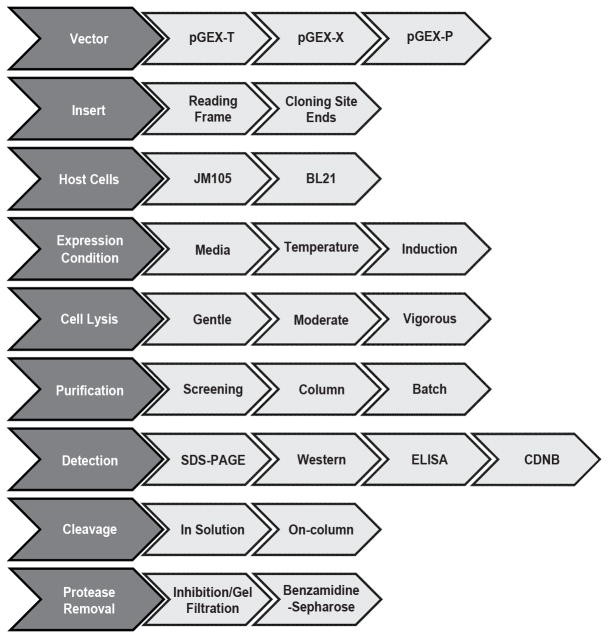 Fig1. Flow diagram illustrating the key decision-making steps for designing and executing a successful GST fusion protein purification.
(Methods Mol Biol, 2011)
After protein expression and purification, it is necessary to determine whether to remove the tag according to different protein applications. If the tag is large, whether to remove it should be considered according to the downstream application. If the GST fusion portion is to be removed, it can be excised with a site-specific protease. The detection method can be detected by GST antibody or expressed target protein specific antibody.
GST fusion proteins can be detected by a colorimetric assay with the GST substrate 1-chloro-2,4-dinitrobenzene (CDNB) or with anti-GST antibodies. Precipitations of GST fusion proteins with glutathione-coupled beads are commonly used for the detection of protein-protein or protein-DNA interactions.
Increase the solubility of foreign proteins; can be expressed in different hosts, with a wide range of applications.
Easy removal with different proteases.
The antigenicity and biological activity of the protein are well preserved, and the stability of the exogenous protein is improved.
High specificity, convenient and mild purification.
Larger molecular weight may affect protein function and downstream experiments.
If the protein is insoluble, it is difficult to purify it by denaturing methods.
Reference
Loading ......
