
Inquiry Basket
 Loading ......
The sister peptides, glucagon-like peptides 1 and 2 (GLP-1 and -2) are all encoded in the proglucagon gene (GCG). GLP-1 and GLP-2 bind to their respective receptors (GLP-1R & GLP-2R) and play different roles. GLP-1 based therapies are successfully applied for type-2 diabetes (T2D) and obesity, and GLP-2 plays an important role in intestinal growth and adaptation. In recent years, intestinal rehabilitation in patients with short bowel syndrome (SBS) using GLP-2 analogs has made great progress. Compared with the track-crowded GLP-1 field, GLP-2 related research is still a blue ocean waiting for researchers to explore.
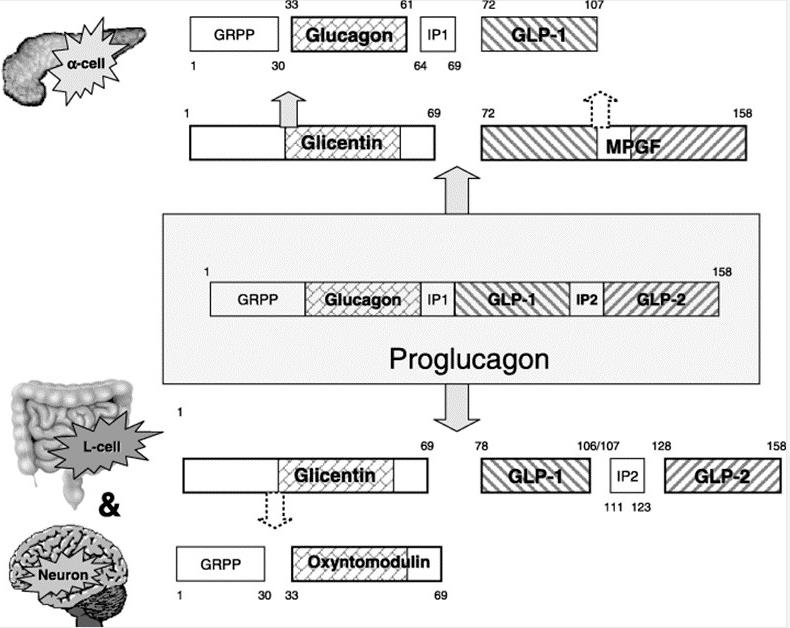 Fig. 1 Main products of proglucagon processing
(Wallis K.; et al. Aliment Pharmacol Ther. 2007)
GLP-2 is a single-chain polypeptide of 33 amino acid residues, which is produced by a tissue-specific post-translational processing of the 160 amino acid proglucagon molecule in enteroendocrine L cells. GLP-2 is associated with intestinal growth and adaptation in a variety of pathological conditions and it is an important intestinotrophic growth factor and mediator of intestinal adaptation. GLP-2 acts through a specific G protein-coupled receptor (GLP-2R), which is predominantly located in the proximal small intestine. GLP-2 is degraded through cleavage of N-terminal histidine and alanine by the ubiquitously expressed proteolytic enzyme DPP-4. The half-life of intravenous GLP-2 is only 7 min in healthy humans.
Short bowel syndrome (SBS) is a rare malabsorptive disorder mostly secondary to surgical resection of the small intestine. By binding with GLP-2R, GLP-2 can induce the proliferation of intestinal crypt cells, inhibit the apoptosis of intestinal epithelial cells and gastric acid secretion, promote the repair of damaged intestinal mucosa and absorption of intestinal nutrients. Thus, GLP-2 is considered a promising target for the treatment of SBS.
Studies shows that, ileum-resected SBS patients who were given native GLP-2 experienced clinically significant improvements in bowel quality and function. However, due to the short half-life of native GLP-2, the development of long-acting GLP-2 analogs is the main research direction of scientists.
GLP-2 has a short half-life of only 7 minutes. Generally, the biologically active GLP-2(1-33) is broken down at the alanine residue in position 2 from the N-terminus, catalyzed by the proteolytic enzyme dipeptidyl peptidase-4 (DPP-4), and it is thereby transformed into the biologically less active metabolite GLP-2(3-33). GLP-2 analogs contain one or more substitutes for specific components of natural peptides; additionally, they both retain the pharmacological activity of natural GLP-2 and exhibit a more stable structure, longer half-life, and stronger bonding with targets.
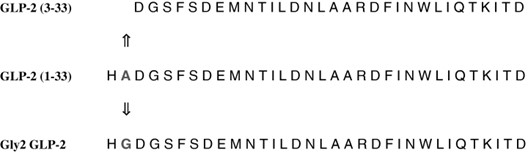 Fig. 2 Amino acid sequence of GLP-2
(Wallis K.; et al. Aliment Pharmacol Ther. 2007)
Teduglutide: Teduglutide is a GLP-2 analog in which an alanine in the natural peptide is replaced by glycine, eliminating the degradation site of dipeptidyl peptidase IV. The terminal half-life is 3.0-5.5 hours via the subcutaneous route in humans.
Glepaglutide: Glepaglutide is a peptide that contains 9 amino acid substitutions and 6 lysine residues at the end of the C-terminus. It is a new GLP-2 analog with a half-life of 50 hours. The application of Glepaglutide in patients with SBS is still in the clinical research stage.
Apraglutide: Apraglutide is a novel, long‐acting GLP‐2 analog designed for once-weekly dosing. In rat intravenous pharmacokinetic studies, the clearance rates of native hGLP-2, teduglutide, glepaglutide, and apraglutide were 25, 9.9, 2.4, and 0.27 mL/kg/min, respectively, with half-lives of 6.4, 19, 18, and 159 minutes, respectively.
References
Creative Diagnostics provides a series of antibody products against GLP-2 and GLP-2R, which can be used for pharmacokinetic studies and promote the exploration and development of drugs for the treatment of SBS.
GLP-2 is a 33-aa peptide corresponding to aa 146-178 of glucagon. GLP-2 is liberated in the intestinal L cells after glucagon processing.
GLP2R is a G protein-coupled receptor superfamily member. GLP-2Rs have been demonstrated in human enteroendocrine cells, enteric neurons and also subepithelial myofibroblasts.
We also provide related kits and antigens. Please click the link below.
GLP-2 Related Kits, Antigens
GLP-2R Related Kits, Antigens
Glucagon Related Products. Please view more.
Loading ......
