
Inquiry Basket
 Loading ......
Gentamicin functions as a strong aminoglycoside antibiotic frequently utilized to combat infections from Gram-negative bacteria. All pharmaceuticals operate under the principle that their therapeutic efficacy is heavily influenced by their formulation quality. The paper examines gentamicin's formulation components along with content analysis and impurity detection methods which are crucial for validating the medication's safety and therapeutic effectiveness.
Formulation analysis plays a crucial role in the development of pharmaceutical drugs by ensuring the right combination of ingredients that determine the drug's performance.
Drug formulation influences its effectiveness and governs both stability and safety standards. Gentamicin requires a reliable and repeatable formulation to achieve proper therapeutic outcomes while reducing toxicity and treatment failures. Drug formulations which are complex mixtures can experience performance changes due to minor alterations in their composition.
Proper formulation analysis is crucial for:
A full formulation analysis reviews the drug composition while identifying the active ingredient levels and any present impurities. The formulation of gentamicin requires consideration of both its active ingredient and the supporting excipients.
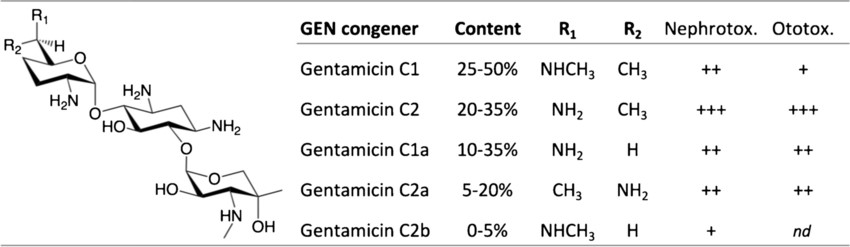 Figure 1. Chemical composition of gentamicin drug products and the previously reported relative toxicity of its individual congeners. (Sources: Gross S, et al. 2024)
A gentamicin formulation consists of its active ingredient alongside excipient components. The drug formulation contains non-active excipients which assist with maintaining drug stability and help deliver and absorb the medication. Typical gentamicin formulations may include the following:
| Component | Function |
| Gentamicin | Active ingredient (antibiotic) |
| Water for injection | Solvent |
| Sodium chloride | Buffer, stabilizing agent |
| Sulfur dioxide | Antioxidant |
| Other excipients | pH stabilizers, preservatives |
All formulation components require meticulous selection to maintain gentamicin's therapeutic benefits and prevent unwanted adverse effects. Water used for injection should contain no impurities while stabilizers must maintain gentamicin efficacy until the expiration date.
Content determination serves as an essential component of quality control during the production of gentamicin. Precise measurement of gentamicin levels in formulations guarantees proper patient dosing essential for therapeutic effectiveness and safety. Content determination methods vary widely but the most frequently used techniques are:
HPLC becomes the method of choice for gentamicin analysis because it delivers high precision and sensitivity while effectively separating the drug from formulation components to ensure accurate gentamicin content measurement.
Impurity Detection: Safeguarding Drug Safety
The identification of impurities stands as a fundamental part of the analytical process for gentamicin formulations. The existence of impurities threatens both the safety and effectiveness of a drug. The formulation process introduces impurities through multiple sources.
Detecting impurities allows for the maintenance of gentamicin's medical therapeutic efficiency and safety. Manufacturers of drug formulations frequently employ contemporary analytical methods such as HPLC-MS to detect and quantify impurities.
| Type of Impurity | Source | Detection Methods |
| Synthesis-related impurities | Incomplete chemical reactions | HPLC, Mass Spectrometry |
| Degradation products | Exposure to light, heat, or moisture | HPLC, UV-Vis Spectroscopy |
| Microbial contamination | Improper sterilization or storage | Microbial testing, HPLC |
Manufacturers use HPLC and MS together to obtain detailed impurity profiles which help them achieve compliance with strict safety standards. When pharmaceutical companies detect impurities they can implement corrective measures to eliminate toxic substances from their final products.
The analysis of gentamicin formulations remains challenging despite technological progress in analytical methods. These include:
The FDA in the United States together with the EMA in Europe and WHO internationally establish guidelines to verify that gentamicin formulations meet global safety and efficacy standards. The guidelines establish rigorous boundaries for impurity levels and demand thorough stability testing along with batch-to-batch consistency measures.
The United States Pharmacopeia (USP) has created detailed monographs for gentamicin that define acceptable standards for content levels and purity among other quality characteristics. Following these guidelines is crucial to maintain the effectiveness and safety of gentamicin for patients.
The development of pharmaceutical technologies brings about advancements in drug formulation analysis methods. Nanotechnology alongside biosensors and artificial intelligence (AI) represent groundbreaking advancements that promise to improve both efficiency and accuracy in formulation analysis. Artificial intelligence systems can forecast the stability of gentamicin formulations over time through examination of past data together with current environmental conditions.
The expansion of personalized medicine suggests that future formulation analysis will become more individualized. The development of gentamicin formulations could become more specialized to address specific patient groups or particular disease conditions.
Gentamicin formulation analysis ensures that these antibiotic stays both effective and safe for patient use. Through detailed examination of gentamicin formulations including their composition and impurities pharmaceutical manufacturers ensure their products achieve peak quality standards. The comprehensive approach safeguards patient health while simultaneously driving the advancement of the pharmaceutical industry. The advancement of emerging technologies will result in more sophisticated formulation analysis leading to improved safety and effectiveness in future drug delivery systems.
References
| Target | Cat. No. | Product Name | Host | Isotype | Application | |
| Gentamicin | HMABPY043 | RHA™ anti-Gentamicin monoclonal antibody, clone GM | Mouse | IgG | ELISA, LFIA | Inquiry |
| DPBT-68266SG | Anti-Gentamicin polyclonal antibody | Sheep | IgG | ELISA | Inquiry | |
| DMAB3403 | Anti-Gentamicin monoclonal antibody, clone A104 | Mouse | IgG2a | IA | Inquiry | |
| DMAB3404 | Anti-Gentamicin monoclonal antibody, clone A103 | Mouse | IgG2a | ELISA | Inquiry | |
| DMAB6614 | Anti-Gentamicin monoclonal antibody, clone monoclonal,H5-10 | Mouse | IgG2a | cELISA, IFIA | Inquiry | |
| DMAB6615 | Anti-Gentamicin monoclonal antibody, clone monoclonal, clone CloneH11-18 | Mouse | IgG1a | cELISA, IFIA | Inquiry | |
| DMAB6616 | Anti-Gentamicin monoclonal antibody, clone monoclonal,H17-33 | Mouse | IgG1a | cELISA, IFIA | Inquiry | |
| DMABT-54913MG | Anti-Gentamicin monoclonal antibody, clone HF2 | Mouse | IgG1 | IA | Inquiry | |
| DMABT-54914MG | Anti-Gentamicin monoclonal antibody, clone HF3 | Mouse | IgG1 | IA | Inquiry |
| Target | Cat. No. | Product Name | Expression System | Tag/Conjugate | Application | |
| Gentamicin | DAG4468 | Gentamicin [BSA] | N/A | BSA | N/A | Inquiry |
| DISNJ17 | Gentamicin Sulfate Standard | N/A | N/A | ELISA | Inquiry | |
| DAGA-043K | Gentamicin [KLH] | N/A | KLH | Immunogen | Inquiry | |
| DAGA-032H | Gentamicin [HRP] | N/A | HRP | ELISA | Inquiry | |
| DAG4468O | Gentamicin [OVA] | N/A | OVA | ELISA, LFIA | Inquiry | |
| DAG-WT2703 | Gentamicin control | N/A | Unconjugated | Immunoassays | Inquiry |
| Target | Cat. No. | Product Name | Size | Species | Application | Detection Sample | |
| Gentamicin | DEIA047 | Gentamicin ELISA Kit | 96T | N/A | Quantitative | Vaccine, cell culture | Inquiry |
| DEIA6884 | Gentamicin ELISA Kit | 96T | N/A | Quantitative | serum, plasma, cell lysates, tissue homogenates, and food samples | Inquiry | |
| DEIA-WZ6884 | High Sensitivity Gentamicin ELISA Test Kit | 96T | Quantitative | biological samples | Inquiry |
Loading ......
