Introduction of Fluorescent FISH Protocol
The Latin phrase "in situ" literally means "on site" or "in position." In situ hybridization (ISH) is a technique that uses probes to allow detection, visualization, and localization of specific and complementary segments deoxyribonucleic acid (DNA) or ribonucleic acid (RNA) within cells or tissue.
Probes are composed of complementary nucleic acid sequences to the target sequence and a label to allow for detection. Probe nucleic acid sequences can be composed for double stranded DNA (dsDNA), single stranded DNA (ssDNA), RNA, or synthetic oligonucleotides. Labels can be radioactive or nonradioactive, including enzymatic or fluorescent labels, which are the focus of this chapter. While radioactive probes are more sensitive, nonradioactive probes are more commonly used and have a better safety profile.
FISH Analysis
Fluorescent in situ analysis (FISH) differs from conventional cytogenetics in that it uses interphase nuclei, while conventional cytogenetic analysis requires metaphase nuclei. FISH analysis is also better at detecting cryptic translocations than cytogenetics. However, FISH analysis can only detect abnormalities limited to the sequences detected by the probe sets whereas conventional cytogenetics casts a wider net. Break-apart probe sets are used to identify whether or not a specific region of interest is involved in a rearrangement; the translocation partner is not identified using a break apart probe. These are typically used where there are multiple possible translocation partners, which makes more traditional FISH approaches impractical. The normal pattern for break apart probes is two yellow signals. In the presence of one translocation involving the location of interest, the abnormal pattern would be one yellow signal, one red signal, and one green signal. Dual fusion probes are testing for the presence of a specific translocation partner. The normal pattern for dual fusion probes is two red signals and two green signals. In the presence of one translocation in the location of interest, the pattern would be two yellow signals, one red signal, and one green signal. Also, additions and deletions of the probe areas can be identified with enumeration probes. If there are three signals seen with a centromeric probe, this most likely represents a trisomy. Similarly, if there is only one signal seen with a centromeric probe, this most likely represents a monosomy. However, if there are additional signals or loss of a signal in a telomeric probe, it is uncertain if the addition/loss is of the entire chromosome or that particular portion of the chromosome. A strategy used to differentiate partial from complete loss of a chromosome can include combining centromeric and telomeric probes; an example would be in the myelodysplastic (MDS) FISH order sets where 5 cen/del(5q) or 7 cen/del(7q) pairs are employed.
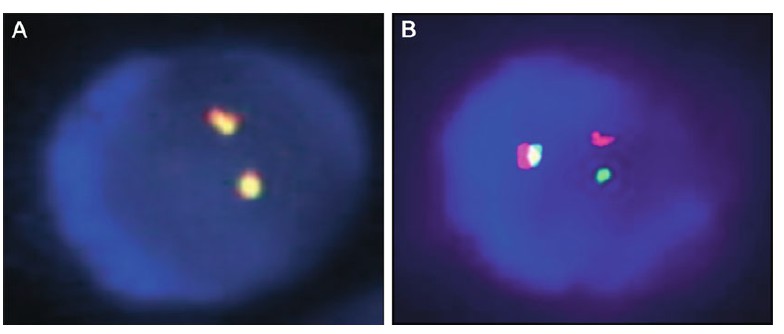 Figure 1. Dual color break-apart t(14q32) (IGH) probe set (1000Xmagnification).
Applications for FISH continue to grow with commercial FISH panels available for acute lymphocytic and myeloid leukemias, B-cell lymphomas, myelodysplasia, myeloproliferative neoplasms, and plasma cell neoplasms as well as individual probe sets for neural tumors, pediatric tumors, and constitutional genetic abnormalities.
Materials of Fluorescent FISH Protocol
Cellular preparations, such as blood, bone marrow, or cellular touch preparation slides are the preferred specimens. Slides of paraffin embedded tissue cut at 5 microns can also be used. The preferred collection tube for blood and bone marrow is sodiumheparin, which is the green top tube. However, ethylenediaminetetraacetic acid (EDTA) acid citrate dextrose (ACD) tubes are also acceptable; these are the purple/lavender and yellow top tubes, respectively. Decalcified paraffin tissue is an unsuitable specimen for FISH analysis (see Note 1).
Reagent Preparation
- Probe reagents.
- DAPI II Counterstain: 125 ng 4.6-siamino-2-phenlindole (DAPI), glycerol, buffer.
- NP-40 (nonionic polyoxylene surfactant).
- 20XSSC salts (sodium chloride and sodium citrate).
- Absolute ethanol.
- Absolute methanol.
- Glacial acetic acid.
- Acetone.
- Phosphate buffered saline (PBS) 10X(pH 7.4) or 1X(pH 7.2).
- 37% formaldehyde
- 2 M magnesium chloride 100X.
- NaOH pellets.
- RMPI with L-glutamine, HEPES.
- Penicillin–Streptomycin.
- Fetal bovine serum (FBS).
- Potassium chloride.
- Potassium chloride solution 0.075 M.
- Deionized water, Type I.
- HCl.
- 1 N NaOH.
- Glass slides.
- Magnetic stirrer and stir bar.
- pH meter.
- 0.45 μm pore filtration unit.
- Glass and plastic bottles.
Cell Pellet Preparation
- Patient/research specimen.
- Carnoy's fixative.
- Polypropylene 15 mL centrifuge tubes.
- Pipettes, 2–100 μL range, with pipette tips.
- Water bath, set at 37°C.
- Centrifuge.
- Vacuum aspiration system.
- Phase contrast microscope.
- Sterile transfer pipette.
- Microcentrifuge tubes, 2.0 mL.
- Deionized water, Type I.
- Humidifier and humidity chamber.
FISH Hybridization and Posthybridization Wash
- Positive and negative control slides.
- Probes.
- VP2000 Processor with clean reagent bins or equivalent.
- Programmable temperature-controlled slide processing system.
- Charcoal filter unit.
- Thermometer.
- Coplin jars.
- Magnetic stirrer and stir bar.
- Cover glass, 22 mmX22 mm.
- Cover glass, 12 mm circles.
- Forceps.
- Pipettes, 2–100 μL range, with pipette tips.
- Vortex mixture.
- Calculator.
- Timer.
- Graduated cylinders.
- Glass and plastic bottles.
- Disposable syringe.
- pH meter.
- Slide boxes with lids.
- Milli-Q water, DNA grade (Type I).
- Immersion oil.
- Rubber cement.
- Slide warmer.
- Mettler Balance.
- Weight boats.
- DAPI II Counterstain.
- Deionized water.
- Fluorescent microscope, equipped with DAPI and appropriate wavelength filters (preferably also with digital imaging capabilities).
View all Antibodies Products
Methods of Fluorescent FISH Protocol
Carry out all procedures at room temperature, unless specified otherwise. All reagents should be used before their expiration dates. All tubes/specimens should be labeled with at least two patient identifiers. All hazardous materials should be properly disposed according to regulations. All biologic specimens should be handled as if it is a possible infectious agent, and appropriate personal protective equipment and safe laboratory practices should be worn and practiced, respectively, at all times.
The following procedure is courtesy of the University of Arkansas for Medical Sciences Molecular Lab Procedure Manual:
Reagent Preparation
- Probe solution: many probe solutions are supplied premixed in hybridization buffer and require no additional mixing.
- To make 20XSSC stock, mix 66 g of 20XSSC salts with 200 mL of deionized water. Mix thoroughly using a stir bar and a magnetic stirrer. Measure the pH with a pH meter and adjust to a pH of 5.3 with concentrated HCl. Then bring total volume to 250 mL with deionized water. Finally, filter through a 0.45 μM pore filtration unit. This solution expires at 6 months.
- Add 150 mL of deionized water to 350 mL of absolute ethanol to make 70% ethanol. Store at room temperature in tightly sealed glass bottles for up to 5 days.
- Add 75 mL of deionized water to 425 mL of absolute ethanol to make 85% absolute ethanol. Store at room temperature in tightly sealed glass bottles for up to 5 days.
- Add 25 mL of deionized water to 475 mL of absolute ethanol to make 95% absolute ethanol. Store at room temperature in tightly sealed glass bottles for up to 5 days.
- To prepare 0.4X SSC/0.3% NP-40 Wash Buffer, mix 950 mL deionized water, 20 mL 20XSSC stock (prepared in step 2), and 3 mL NP-40. Using a pH meter, adjust pH to 7.0–7.2 with 1 N NaOH, as necessary. Add enough deionized water to a final volume of 1 L. Finally, filter through a 0.45 μm pore filtration unit. This solution expires at 6 months, and any unused solution should be stored in a sealed glass bottle. Discard any solution used in an assay at the end of the day (see Note 2).
- To prepare 2XSSC/0.1% NP-40 Wash Buffer, mix 100 mL of 20XSSC stock (prepared in step 2), 849 mL of deionized water, and 1 mL of NP-40. Using a pH meter, adjust pH to 7.0–7.2 with 1 N NaOH, as necessary. Add enough deionized water to a final volume of 1 L. Finally, filter through a 0.45 μM pore filtration unit. This solution expires at 6 months, and any unused solution should be stored in a sealed glass bottle. Discard any solution used in an assay at the end of the day (see Note 2).
- To prepare 2XSSC, mix 100 mL of 20XSSC stock (prepared in step 2) and 850 mL of deionized water. Using a pH meter, adjust pH to 7.0–7.2 with 1 N NaOH, as necessary. Add enough deionized water to a final volume of 1 L. Finally, filter through a 0.45 μm pore filtration unit. This solution expires at 2 months. Unused solution can be used for up to 2 weeks if stored at 2–6°C. Discard any solution used in an assay at the end of the day (see Note 2).
- Prepare 1% formaldehyde–2M MgCl2 by mixing 13.5 mL 37% formaldehyde, 486.5 mL 1XPBS, and 5.05 2M MgCl2 100X. This solution can be stored at room temperature for up to 1 month (see Note 3).
- Prepare 1 N NaOH solution by adding 40 g of NaOH pellets to a 1000 mL volumetric flask and fill with deionized water to a volume of 1 L. This solution should be stored in a plastic bottle and stored at room temperature for up to 1 year.
- Prepare RPMI with 5% FBS by mixing together 100 mL RPMI with L-glutamine, 5 mL FBS, and 2 mL penicillin–streptomycin. Store at 2–8°C for up to 1 week (see Note 4).
- Prepare Hypotonic Lysis solution (0.075M KCl) by dissolving 1.10 g KCl in 200 mL deionized water. Store at 2–8°C for up to 1 month.
- Immediately prior to use, prepare Carnoy's Fixative by mixing three parts absolute methanol with one part glacial acetic acid in a glass beaker or flask. This solution is stable for only a few hours. Discard after use.
Cell Pellet Preparation
- Aliquot 8 mL of Hypotonic Lysis Solution (step 13) into a 15 mL centrifuge tube for each sample, and place in a 37°C water bath.
- Transfer 3–4 mL of patient sample into a labeled 15 mL centrifuge tube.
- Centrifuge for 10 min at 194Xg (g-force value 194 m/s2). Tubes should have three layers: plasma, leukocytes, and red blood cells (order topmost to bottommost).
- Using the vacuum aspiration system, remove the majority of the plasma layer without disturbing the other layers.
- Using a sterile transfer pipette, remove the leukocyte layer and transfer to a 15 mL centrifuge tube (see Note 5).
- Add RPMI with 5% FBS to get a final volume of 10 mL.
- Gently mix by drawing the solution in and out of the sterile transfer pipette.
- Cap the tube and centrifuge for 10 min at 194 Xg.
- Aspirate and discard the supernatant. Do not disturb the cellular button.
- Add 2 mL of the Hypotonic Lysis solution, using a Pasteur pipette to mix gently. Add an additional 6 mL of the Hypotonic Lysis solution and mix well.
- Incubate in a 37°C water bath for 20 min.
- Add 10–20 drops of Carnoy's fixative and mix well.
- Centrifuge at 194Xg for 10 min.
- Aspirate all but 0.5–1.0 mL of the supernatant; do not disturb the cellular pellet.
- Keeping the cellular pellet in the lower one third of a Pasteur pipette, carefully resuspend the pellet.
- Add 2 mL of Carney's fixative drop by drop while manually agitating the tube.
- Transfer to a 2.0 mL microcentrifuge tube and incubate at room temperature for 20 min.
- Centrifuge for 2 min with a starting speed of 3381Xg.
- Aspirate the supernatant, add 2 mL of Carnoy's fixative, and gently mix.
- Centrifuge for 2 min with a starting speed of 3381Xg.
- Repeat steps 19 and 20 until the supernatant is clear.
- Add 2 mL of Carnoy's fixative.
- Slides can either by made immediately, or the cell pellet can be stored at -20°C until needed. If being stored, wrap the cap with paraffin to avoid evaporation.
FISH Hybridization and Posthybridization Wash
- If the cell pellet was frozen, repeat steps 19 and 20 from the cell pellet preparation twice.
- Turn on the humidifier chamber until the chamber is up to 40–50% humidity. Turn off the humidifier off prior to dropping the slides.
- Aspirate the supernatant from the fixed cell pellet and add fresh Carnoy's fixative until the final suspension is slightly cloudy (see Note 6).
- On a precleaned slide with two patient identifiers and the date, drop 1–2 drops of the suspension forming two cellular areas per slide (see Note 7).
- If using a specimen other than cell pellets, dip slides in Carnoy's fixative for 30 s, rinse with deionized water, place in 70% ethanol for 1 min, place in 85% ethanol for 1 min, place in 100% ethanol for 1 min, place in -20°C for 2 min, and allow slides to air-dry.
- Use a phase contrast microscope to ensure adequate numbers of cells with good morphology and minimal overlap.
- Allow probe solution to reach room temperature (see Note 8).
- Turn on the programmable temperature-controlled slide processing system.
- Turn off the lights and close the windows, turning on red lights.
- Place slides on a 37°C slide warmer.
- Vortex the probe solution.
- Centrifuge for 1–3 s in a microcentrifuge to remove any liquid from inside the cap.
- Gently vortex again to mix.
- Apply 5 μL of the working probe solution to the target area of the slide. Immediately place a 12 mm circle cover glass over the probe solution, allowing the solution to spread evenly (see Notes 9–12).
- Place slides into prewarmed programmable temperaturecontrolled slide processing system chamber (see Note 13).
- Seal the cover glass with rubber cement by drawing up 5–10 mL of rubber cement into a syringe and expressing a small amount of the rubber cement to circumscribe the entire peripheral edge of the cover glass (see Note 14).
- Close the lid to the programmable temperature-controlled slide processing system and select a program that denatures at 75°C for 1 min and then hybridizes at 37°C for 14–16 h.
- Prepare a 71.5°C bath with 0.4XSSC/0.3% wash buffer.
- Prepare a room temperature bath with 2XSSC/0.1% wash buffer.
- Take slides out of the programmable temperature-controlled slide processing system.
- Remove rubber cement.
- Briefly dip each slide in deionized water.
- Place slides in a slide rack and into the 0.4XSSC/0.3% wash buffer bath for 1 min.
- Place slides move slides to the 2XSSC/0.1% wash buffer bath for 2 min.
- Dry slides by centrifugation.
- Place slides on a slide warmer and add 10 μL DAPI II counterstain to each area of the slide. Immediately cover with 22X22 mm cover glass (see Note 15).
- Store slide in the dark prior to enumeration and also store at -20°C if enumeration will be delayed.
View all Antigens Products

 Loading ......
