
Inquiry Basket
 Loading ......
The outer membrane of E. coli and all Gram-negative bacteria contain lipopolysaccharide (LPS) as their primary surface molecule. The outer leaflet of the outer membrane contains this large complex glycolipid which makes Gram-negative bacteria distinct from Gram-positive bacteria. The E. coli LPS structure consists of Lipid A and core oligosaccharide and O-antigen which show variable composition. The bacterial membrane contains this vital molecule which serves as a powerful immunostimulatory agent. The scientific and clinical value of E. coli depends on its O-antigen structure variations which enable serotyping of the bacteria.
View more E. coli LPS Products
The hydrophobic Lipid A component of E. coli lipopolysaccharide (LPS) plays a central role in triggering immune responses that occur when gram-negative bacteria infect the body. The disaccharide backbone of Lipid A consists of β-glucosamine units which form a phosphate bond while fatty acid chains attach to this structure. The specific arrangement of Lipid A molecules creates an amphipathic structure which enables them to bind to the bacterial outer membrane.
The immunological value of Lipid A stands as the most important aspect because it functions as the endotoxic part of LPS. The immune system recognizes Lipid A through Toll-like receptor 4 (TLR4) which triggers a sequence of pro-inflammatory responses that result in tumor necrosis factor-alpha (TNF-α) cytokine production. E. coli LPS disrupts nitric oxide signaling pathways in mesangial cells which results in vascular reactivity changes that contribute to septic shock development. The impaired function plays a vital role during sepsis because LPS release triggers extensive inflammation throughout the body which causes blood pressure drops and potentially destroys vital organs.
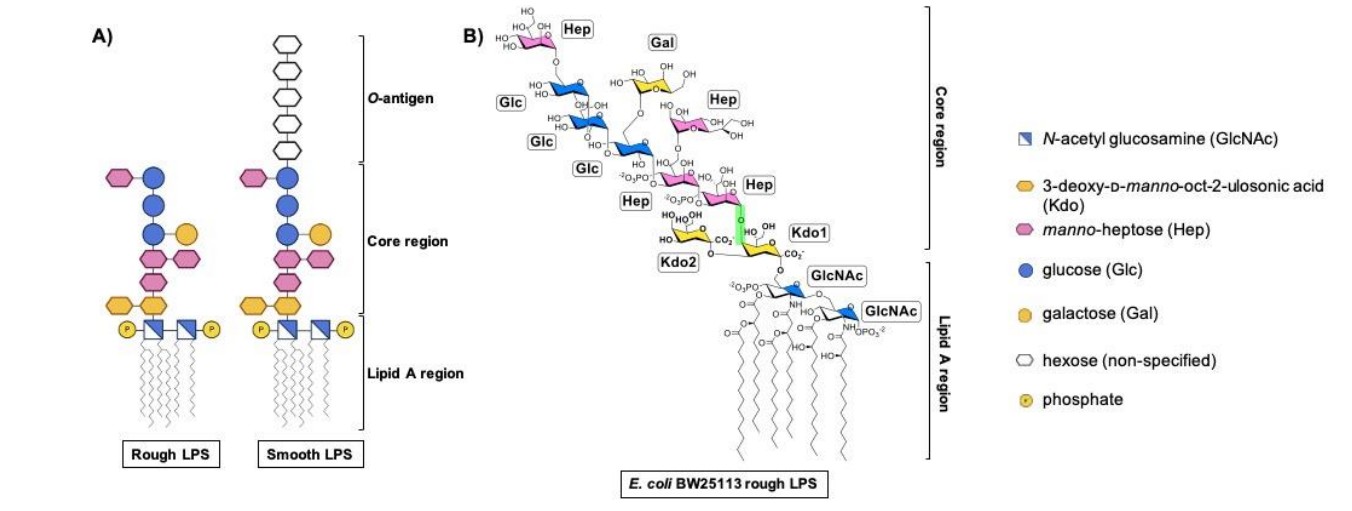 Figure 1. (A) Schematic representation of rough- and smooth-LPS structures of Gram-negative bacteria. (B) Structural representation of the rough LPS structure from E. coli BW25113 (K-12 strain) with an approximate molecular weight of 3806 Da. (Source: Ziylan, 2024)
The core oligosaccharide (OS) of lipopolysaccharide (LPS) serves as the essential component which upholds both structural stability and operational capabilities of the bacterial outer membrane in Gram-negative bacteria including E. coli. The core oligosaccharide consists of a strong sugar residue network which links lipid A to the O-antigen and contains two distinct sections known as inner core and outer core regions with Kdo (3-deoxy-D-manno-oct-2-ulosonic acid) and heptose as conserved sugars.
The core oligosaccharide serves as a structural element which binds lipid A to the outer membrane while lipid A functions as the immunogenic component that triggers robust immune reactions through host receptor detection. The core region serves dual purposes because it provides structural support and determines how LPS interacts with the immune system. The immune response of an organism depends on the specific structure of its core oligosaccharide because different modifications in this region produce distinct immune reactions. The core oligosaccharide structure determines TLR4 recognition levels which controls the intensity of inflammatory responses.
The O-antigen component of lipopolysaccharide (LPS) serves as a vital structural element for Gram-negative bacteria including Escherichia coli. The O-antigen consists of polysaccharide chains made from repeating oligosaccharide units which create different serotypes. The bacteria achieve immune system evasion through their ability to modify their sugar composition and linkage structures which results in different serological characteristics.
The rfb (O-antigen biosynthesis) gene cluster functions as a genetic unit to direct O-antigen subunit assembly onto lipid carriers followed by polymerization. The O-antigen biosynthesis process depends on specific gene clusters which direct the construction of O-antigen subunits onto lipid carriers and their subsequent polymerization. E. coli has developed different O-antigen classes through evolutionary processes which help the bacteria survive in various environments. The virulence level and serum sensitivity of certain bacterial strains depends on their semirough O-antigen structures which result from altered O-antigen lengths and chemical compositions.
View more E. coli O Antigens
The biological functions of E. coli lipopolysaccharides (LPS) serve multiple purposes which enable the bacteria to cause disease and interact with the immune system and maintain its structural integrity. The endotoxin LPS contains lipid A and core oligosaccharide and O-antigen components which perform separate functions that affect bacterial operations and host immune reactions.
E. coli LPS functions primarily to trigger innate immune system activation. The lipid A component of LPS functions as a strong Toll-like receptor 4 (TLR4) agonist which triggers a signaling pathway that results in the production of TNF-α and IL-6 pro-inflammatory cytokines. The immune system uses this activation to fight bacterial infections but excessive activation results in dangerous systemic inflammation that causes septic shock. The immune response strength from E. coli serotypes depends on lipid A acylation patterns and structural arrangements.
The outer membrane component LPS makes E. coli more pathogenic. The outer membrane LPS protects E. coli from phagocytosis and prevents complement-mediated lysis. The O-antigen component of LPS enables E. coli to resist serum components which helps the bacterium evade host immune responses. During pneumonia and sepsis LPS causes additional tissue damage while intensifying the body's inflammatory response. E. coli LPS demonstrates its importance by controlling neutrophil responses which becomes vital for successful pathogen elimination during infections.
Structural Role and Membrane Stability The outer membrane structure of bacteria depends on LPS to maintain its stability. The outer membrane barrier function of LPS protects bacteria from toxic substances and antibiotics which helps maintain membrane stability. The outer membrane of E. coli depends on LPS to control substance entry because it creates a protective barrier that blocks dangerous compounds while allowing beneficial substances to pass through.
Creative Diagnostics provides researchers with E. coli LPS research products that include high-quality antibodies and purified antigens and sensitive ELISA kits for endotoxin detection and LPS-related studies. The products undergo strict quality control procedures to deliver specific results with consistent performance between batches for applications including immunology research and microbial pathogenesis and vaccine development and endotoxin analysis. Creative Diagnostics delivers dependable research solutions through its advanced manufacturing systems and expert technical assistance to help scientists achieve better results in their E. coli LPS research.
References
| Target | Cat. No. | Product Name | Host | Isotype | Application | |
| E. coli LPS | DMABT-Z60640 | Anti-E. coli LPS Monoclonal antibody, Clone 4F9/3 | Mouse | IgG2b | ELISA, WB | Inquiry |
| DPAB-CS24677 | Goat Anti-E. coli (K-235) LPS Polyclonal antibody | Goat | IgG | ELISA | Inquiry | |
| DPAB-CS24678 | Goat Anti-E. coli (O:157) LPS Polyclonal antibody | Goat | IgG | ELISA | Inquiry | |
| DPATB-H83378 | Anti-E. coli J5 LPS Polyclonal antibody | Sheep | IgG | ELISA | Inquiry | |
| DCABY-057 | Anti-E. coli J5 LPS Monoclonal antibody, Clone 3E8/2 | Mouse | IgG2b | ELISA, IF, WB | Inquiry | |
| CABT-CS527 | Mouse Anti-E. coli LPS Monoclonal antibody, Clone 2D7 | Mouse | IgG1 | ELISA | Inquiry | |
| CABT-CS528 | Mouse Anti-E. coli LPS Monoclonal antibody, Clone 2F2G21 | Mouse | IgG2a | ELISA | Inquiry | |
| CABT-CS529 | Mouse Anti-E. coli LPS Monoclonal antibody, Clone 3I21 | Mouse | IgG2b | ELISA | Inquiry | |
| CABT-CS530 | Mouse Anti-E. coli LPS Monoclonal antibody, Clone 3B6 | Mouse | IgG3 | ELISA | Inquiry | |
| DPABY-066 | Anti-E. coli LPS Polyclonal antibody | Sheep | IgG | ELISA | Inquiry |
| Target | Cat. No. | Product Name | Host | |
| E. coli LPS | DAGB137 | E. coli O55:B5 LPS | E. coli | Inquiry |
| DAGB131 | E. coli O113 LPS | E. coli | Inquiry | |
| DAGB132 | E. coli O157:H7 LPS | E. coli | Inquiry | |
| DAGB133 | E. coli J5 LPS | E. coli | Inquiry | |
| DAGB134 | E. coli K12 strain LCD25 LPS | E. coli | Inquiry | |
| DAGB135 | E. coli K12, D31m4 LPS | E. coli | Inquiry | |
| DAGB136 | E. coli O111:B4 LPS | E. coli | Inquiry | |
| DAG-WT4215 | E. coli O8:K27 LPS | E. coli | Inquiry |
| Target | Cat. No. | Product Name | Size | Species | Application | Detection Sample | |
| E. coli LPS | DEIA-LL289 | LPS (Lipopolysaccharides) ELISA Kit | 96T | Universal | Quantitative | Bacterial cell walls of gramnegative bacteria, tissue homogenates, other biological fluids | Inquiry |
Loading ......
