
Inquiry Basket
 Loading ......
Biopharmaceutical advancements over recent years have propelled macromolecular drugs like monoclonal antibodies (mAbs) into a central position within the industry. Precise and sensitive detection methods that are also cost-effective are crucial to optimize treatment plans and assess drug levels and immunogenic responses. ELISA distinguishes itself in drug testing because of its straightforward operation and combined benefits of high sensitivity and cost efficiency which establish it as the best method for PK analysis and ADA detection in macromolecular drugs.
 Figure 1. Modes of Action of Monoclonal Antibodies (Source: Dostalek M, et al. 2013)
Principle:
ELISA utilizes antigen-antibody binding specificity by fixing either the capture antibody or antigen onto a solid-phase platform which commonly includes microplates built from rigid materials like polystyrene, polyethylene, or polypropylene. The detection antibody which is conjugated with an enzyme gets added once the target drug within the sample connects with the capture molecule. When researchers add suitable substrate to the enzyme, the enzyme generates a reaction that creates a colorimetric signal detectable at approximately 450 nm which allows precise drug measurement across a broad dynamic range. This technique yields essential information about how the drug moves through the body from absorption to excretion.
Comparison with Other Methods:
Principle:
ADA commonly develop in patients receiving macromolecular therapies such as monoclonal antibodies which represents a crucial immune response that affects treatment effectiveness and patient safety. The standard ELISA method for ADA detection uses a bridging assay technique in which the target drug or its unique antibody is pre-coated onto a solid phase platform. ADAs from patient samples create bivalent bridges with the drug after addition and a detection antibody linked with an enzyme measures the resulting immune complexes.
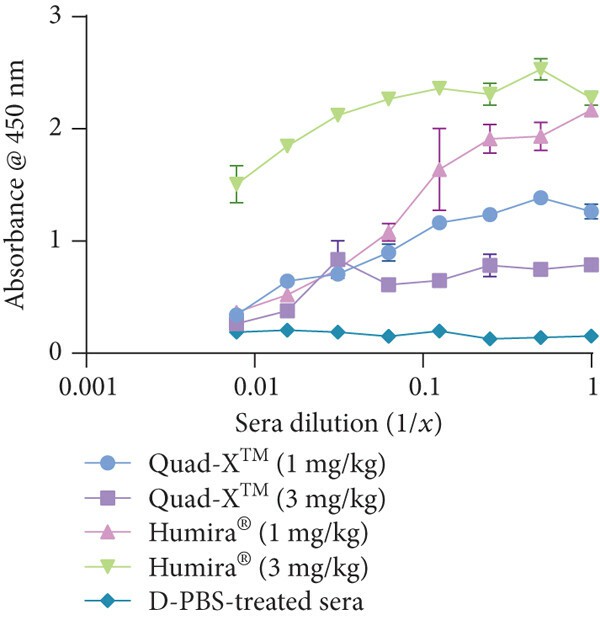 Figure 2. Detection of Anti-Drug Antibodies (ADAs) Using Indirect Capture ELISA in a Mouse Model (Source: Ubah OC, et al. 2020)
Comparison with Other Methods:
Optimization Steps for ELISA Detection of ADA
| Specific Step | Description |
| Sample Preparation | |
| Serum/Plasma Collection | Collect blood using anticoagulant tubes, and try to avoid drug interference. When drug concentration is high, samples can be collected before drug administration to reduce drug interference. |
| Drug Interference Handling | For samples containing drug-ADA complexes, perform acid dissociation treatment (e.g., by adding acid or using an antigen binding test (ABT)) to separate drug-antibody complexes, reducing the drug's impact on ADA detection. |
| Storage | Samples should be stored at -80°C to maintain stability and avoid ADA level changes caused by temperature fluctuations. |
| Plate Coating | |
| Coating Conditions | Coat the biopharmaceutical drug onto the surface of a 96-well plate. The coating concentration of the drug should be optimized to ensure sufficient capture capacity, usually by incubating overnight at 4°C to maximize the coating effect. |
| Coating Concentration | The concentration of the coating drug needs to be optimized based on the drug's affinity and the strength of the antibody response. |
| Blocking | |
| Choice of Blocking Buffer | Use 1–5% bovine serum albumin (BSA) or casein to block the wells, reducing non-specific binding. The blocking buffer should be incubated at room temperature for 1 hour to ensure effective blocking. |
| Blocking Time and Temperature | Ensure that the time and temperature are sufficient to help reduce background noise. |
| Addition of Samples and Standards | |
| Sample Dilution | Add diluted serum or plasma samples, as well as standards or controls. For ADA detection, a positive control should be added. |
| Incubation Conditions | Incubate at 37°C for 1–2 hours to improve the binding efficiency of ADA with the drug. This step is crucial for enhancing sensitivity. |
| Antibody Addition | |
| Choice of Detection Antibody | Based on the type of target ADA, add the appropriate enzyme-labeled anti-human IgG (or other immunoglobulin subtypes, such as IgM/IgE). The detection of ADA should target both free ADA and drug-bound ADA. |
| Incubation Conditions | Incubate at room temperature for 1 hour to ensure the detection antibody binds with the ADA. |
| Enzyme-Substrate Reaction | |
| Choice of Colorimetric Substrate | Add TMB (tetramethylbenzidine) or another colorimetric substrate, and incubate in the dark for 10–30 minutes. The enzyme reaction product will reflect the presence and level of ADA through a color change. |
| Optimization of Color Development Time | The time for the colorimetric reaction should be adjusted according to the experimental conditions to avoid signal saturation due to overreaction. |
| Reaction Termination and Reading | |
| Termination of Reaction | Use sulfuric acid or another stop solution to halt the enzyme reaction. |
| Absorbance Measurement | Read the absorbance (OD value) at 450 nm, and calculate the ADA concentration based on the standard curve. |
Managing Drug Interference: Drug-ADA complexes can lead to an underestimation of free ADA levels. When drug concentrations rise, acid dissociation treatment along with antigen-binding tests (ABT) serve as powerful methods to minimize interference. The employment of competitive ELISA or bridging ELISA methods can improve specificity and sensitivity which helps in decreasing false-positive results.
ADA Subtype Detection: The standard ELISA approach focuses on IgG-type ADAs but occasionally requires analysis of different immunoglobulin subtypes to completely understand the ADA profile and its impact. Bridging ELISA is particularly effective in detecting bivalent ADAs, offering more precise quantitative analysis.
Sensitivity and Specificity: False positives in ADA detection can occur due to the presence of rheumatoid factor (RF) or heterophilic antibodies. Employing highly sensitive ELISA techniques like sandwich or bridging ELISA leads to improved accuracy. To achieve consistent results across different batches and laboratories ELISA protocols require strict standardization due to inherent variability.
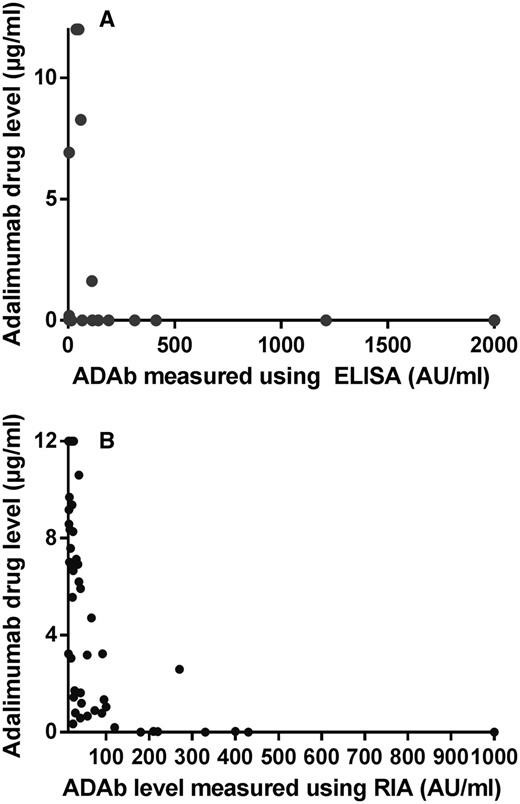 Figure 3. Drug Tolerance of Bridging ELISA vs. RIA in Adalimumab-Treated RA Patients (Source: Jani M, et al. 2016)
ELISA achieves accurate PK parameter estimation through rigorous quality control measures and optimized solid-phase materials, enzyme-substrate systems, and incubation conditions while efficiently detecting ADA formation. Integrating acid dissociation treatment alongside ABT and standardized protocols will be essential to achieve better ADA detection accuracy in future advancements. Creative Diagnostics supplies high-quality ELISA kits that are tailored for PK and ADA analysis of macromolecular drugs enabling reliable and fast solutions which advance pharmacokinetic studies and immunogenicity assessments.
References
| Target | Cat. No. | Product Name | Size | Species | Application | Detection Sample | |
| Exendin-4 | DEIABL206 | Exendin-4 ADA ELISA kit | 96T | Human | Quantitative | Serum, plasma | Inquiry |
| TNF | DEIA068J | TNF α-Blocker ADA, Antibodies against infliximab ELISA Kit | 96T | Human | Qualitative | serum, EDTA plasma | Inquiry |
| DEIA069J | TNF α-Blocker ADA, Total Antibodies against infliximab ELISA Kit | 96T | Human | Qualitative | serum, EDTA plasma | Inquiry | |
| DEIA018J | TNF α-Blocker ADA, Antibodies against etanercept ELISA Kit | 96T | Human | Qualitative | EDTA plasma, serum | Inquiry | |
| DEIA019J | TNF α-Blocker ADA, Antibodies against infliximab ELISA Kit | 96T | Human | Qualitative | EDTA plasma, serum | Inquiry | |
| DEIA020J | TNF α-Blocker ADA, Total Antibodies against infliximab ELISA Kit | 96T | Human | Qualitative | EDTA plasma, serum | Inquiry |
| Target | Cat. No. | Product Name | Size | Species | Application | Detection Sample | |
| Semaglutide | DEIASL092 | Semaglutide ELISA Kit | 96T | NA | Quantitative | Serum, plasma | Inquiry |
| Ramucirumab | DEIAZ0009 | Anti-Ramucirumab ELISA Kit | 96T | Human | Qualitative | Serum, plasma | Inquiry |
| Filgrastim | DEIABL228 | Filgrastim Elisa kit | 2 x 96T | Human | Quantitative | Serum, plasma | Inquiry |
| Liraglutide | DEIA-XYZ95 | Liraglutide High Sensitivity Elisa Kit | 96T | NA | Quantitative | Serum, plasma | Inquiry |
| MMAE | DEIABL314 | Intact MMAE ADC ELISA Kit | 96T | Human | Quantitative | Serum, plasma | Inquiry |
| DM1 | DEIABL311 | DM1 ADC ELISA Kit | 96T | Human | Quantitative | Serum, plasma | Inquiry |
| SN38 | DEIABL316 | SN38 ADC ELISA Kit | 96T | Human | Quantitative | Serum, plasma | Inquiry |
| Eculizumab | DEIAZ0063 | Eculizumab ELISA kit | 96T | NA | Quantitative | Serum, plasma, cell culture samples | Inquiry |
Loading ......
