
Inquiry Basket
 Loading ......
Biomolecular Interaction Analysis is a bioanalytical approach that is used to detect molecular interactions in biological samples. Creative Diagnostics has significant experience in assay development and can offer you customized Biomolecular Interaction Analysis Services to clients using our advanced assay development platform. We optimize assay conditions, improve detection sensitivity, reduce background interference, and provide robust and reproducible interaction analysis assays based on the client's requirements. Biomolecular Interaction Analysis is critical in binding kinetics studies, affinity characterization, and safety evaluation of biologics. We provide support to our clients by providing high quality and reliable bioanalytical data.

Biacore™ T200 SPR system
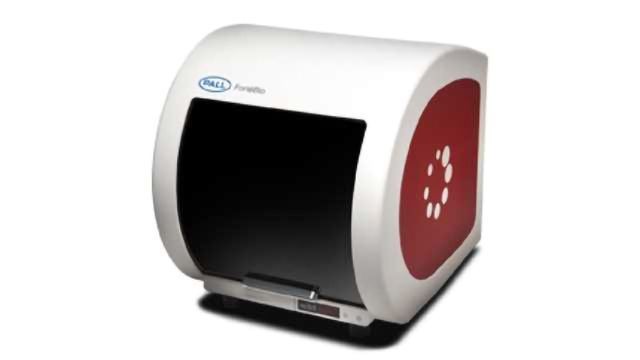
Octet RED96e

NanoTemper Monolith NT.115
Creative Diagnostics is your trusted partner in offering Biomolecular Interaction Analysis Services to characterize and quantify molecular binding events and evaluate their impact on drug efficacy and safety. Our extensive scientific experience over the last few decades helps us offer personalized interaction analysis solutions. We have a full portfolio of biomolecular interaction technologies to choose from, with the best sensitivity, specificity, and reproducibility for your purpose. We develop interaction analysis assays with a focus on high performance and regulatory compliance for reliable results for research. We provide:
To meet the diverse needs in antibody analysis and diagnostic applications, we provide comprehensive Biomolecular Interaction Analysis Services, covering a variety of detection strategies and advanced technologies. Our services can support downstream functional research, structural characterization, quantitative detection, and the development of therapeutic drugs. Relying on mature detection methods and strict quality control systems, we ensure that the test results are highly sensitive, specific, and stable. Our core services include:
Highly sensitive and label-free. Monitors biomolecular interactions in real time. Perfect for kinetic analysis to determine association/dissociation rates and for affinity constants and epitope binning.
Label-free technology to detect molecular interactions in real time. Perfect for screening and characterization of binding specificity and affinity under multiple experimental conditions.
ITC directly measures the thermodynamic parameters of a reaction (ΔH, ΔS, Kd) without the need for labeling. ITC is ideal for determining molecular binding strength and stoichiometry.
MST measures interactions in free solution with minute sample amounts. Can be used to detect even weak and transient interactions in complex biological fluids.
Small molecule-protein and protein-DNA interactions amenable to FP analysis. Ideal for determining quantitative binding affinity information with high sensitivity.
Allows the real-time observation of biomolecular conformational changes that occur during binding. Provides structural information in addition to affinity data.
Real-time mass measurement of a sensor surface in real time. Ideal for the detection of binding events involving large biomolecules or cells.
Specialized for high-affinity interactions, enabling ultra-low detection limits of picomolar Kd values, particularly for antibody-antigen pairs.
Combines covalent crosslinking with mass spectrometry for structural mapping of interaction sites and protein complexes.
Uses impedance or optical sensing technologies to monitor live cell interaction with ligands, antibodies, or drugs under physiological conditions.
Confirm the analysis mode and ensure the feasibility of the experiment.
Customize the detection plan by combining PR, BLI, ITC and other technologies.
Build the system and complete the verification.
Improve accuracy and ensure reliability.
Large-scale detection and provide technical support.
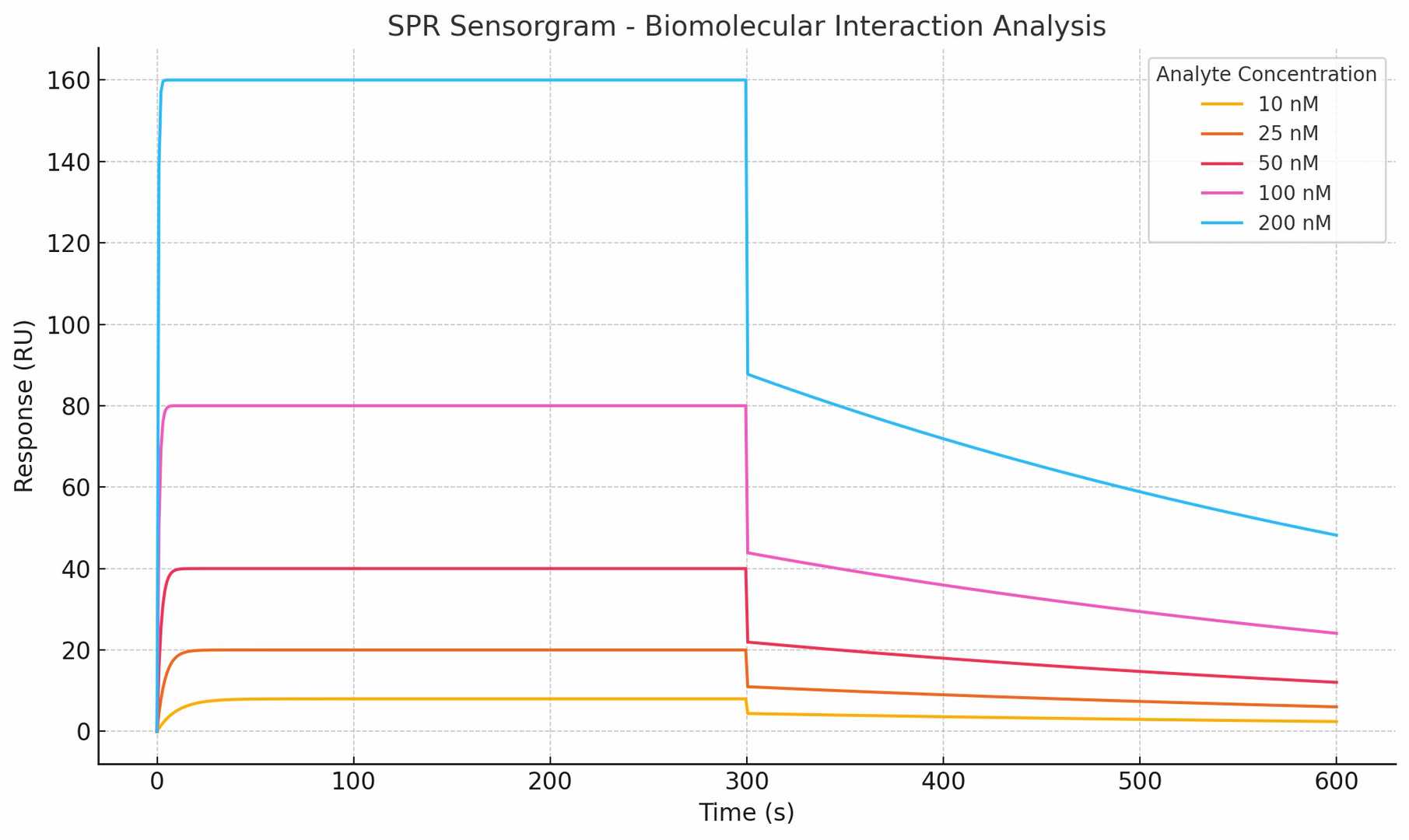
Creative Diagnostics uses standards to validate the SPR Biomolecular Interaction Analysis platform. The SPR sensor response curve (Sensorgram) shows the binding kinetics between different concentrations of analytes and target proteins. Each curve corresponds to analyte concentrations of 10, 25, 50, 100, and 200 nM, showing rapid binding in the injection phase (first 300 seconds), followed by a concentration-dependent dissociation process in the dissociation phase (300–600 seconds). The response unit (RU) increases with increasing concentration, reflecting good concentration dependence and system response consistency. The data is fitted based on the first-order binding model, and the curve is smooth and well-fitted, verifying the high sensitivity and repeatability of the experimental system for the binding-dissociation kinetics process.
This is an analytical method to study how molecules bind to each other, which is very critical for drug development, disease mechanism research and the establishment of diagnostic methods.
We often use SPR, BLI, ITC, MST, FRET, etc., each with its own advantages, such as high sensitivity, no label required, and suitable for high throughput.
Affinity (Kd) indicates the tightness of binding; kinetics (kon/koff) indicates the speed of binding and separation. These two data combined can better understand the relationship between molecules.
Sample purity, experimental buffer, temperature, instrument calibration and nonspecific binding may affect the accuracy of the final data.
It can retain the natural state of molecules without interfering with their original behavior, and can monitor the binding process in real time, so the data is more real and reliable.
To use our biomolecular interaction analysis services, please contact Creative Diagnostics, your expert immunology service provider. From research-scale biomolecular interaction analysis services to industrial scale-up, our team is ready to support your R&D innovation.
Loading ......
