
Inquiry Basket
 Loading ......
Antigen retrieval (AR) is a technique used in immunohistochemistry (IHC) to restore the identifiability of antigen epitopes in fixed tissues. Fixatives such as formaldehyde form crosslinks with proteins, resulting in the masking of antigen epitopes, which affects antibody binding. Antigen retrieval is the process of breaking these crosslinks and re-exposing the antigen epitopes by heating or enzymatic hydrolysis. Creative Diagnostics has extensive expertise in protein antigen extraction and retrieval, and has original antigen retrieval solutions to support customers' antigen retrieval. With our extensive experience in protein antigen expression retrieval, we provide efficient retrieval methods to meet various needs for extracting antigens/proteins from FFPE tissues.


BenchMark ULTRA

PT Link

Microwave Tissue Processor 36125
As a trusted immunology service provider, Creative Diagnostics provides customized antigen retrieval solutions with decades of experience. Its professional technical capabilities cover the entire industry chain of antibody and antigen production, antigen retrieval, innovative diagnostic component development, and key detection reagent research and development, and continue to provide solid technical support to the industry. We provide:
To meet scientists' diverse needs for antigen retrieval, Creative Diagnostics provides professional antigen retrieval solutions. We utilize cutting-edge technologies and innovative antigen retrieval methods to ensure reliable, accurate, and efficient antigen retrieval. Our services include:
The heat repair method is one of the most commonly used antigen repair methods and is suitable for most cases where antigen shielding is caused by formalin fixation. Its different heating methods are suitable for different needs:
Microwave Repair Method
This method is easy to operate and has high repair efficiency. It is suitable for medium to large sample processing and is suitable for common cytoplasmic or membrane antigens (such as CD series, cytokeratin, etc.).
High-Pressure Repair Method
The high-pressure repair method is thorough and time-saving. It is suitable for situations that require strong repair and is suitable for antigens with strong thermal stability, especially some nuclear antigens that are difficult to expose (such as Ki-67, p53).
Water Boiling Method
The water boiling method has low cost, but the temperature control is not accurate and the repeatability is poor. It is suitable for initial screening of tests and for antibodies with good thermal stability, such as cytoskeletal proteins, etc.
Water Bath Method
The water bath method has precise temperature control and less tissue damage. It is suitable for experiments with high requirements for morphological retention, and is suitable for samples with high requirements for temperature-sensitive antigens and tissue structure, such as brain tissue and soft tissue sections.
The enzymatic hydrolysis method often uses trypsin, pepsin, and proteinase K for antigen repair. It is suitable for heat-sensitive antigens (such as certain membrane receptors and some extracellular matrix proteins), especially for antibodies that are ineffective for heat repair. It should be noted that over-digestion will destroy the tissue structure; enzyme concentration and time need to be strictly optimized.
Receive tissue sections and evaluate their type and target antigen to determine the need for repair.
Select heat or enzyme repair methods based on antigen characteristics, and optimize buffers and repair conditions.
Perform antigen repair using the selected method, slowly cool and wash sections, and prepare for subsequent staining.
Verify the repair effect through quality control samples to ensure good tissue morphology.
Provide repair plans and image reports for customer reference and copying.
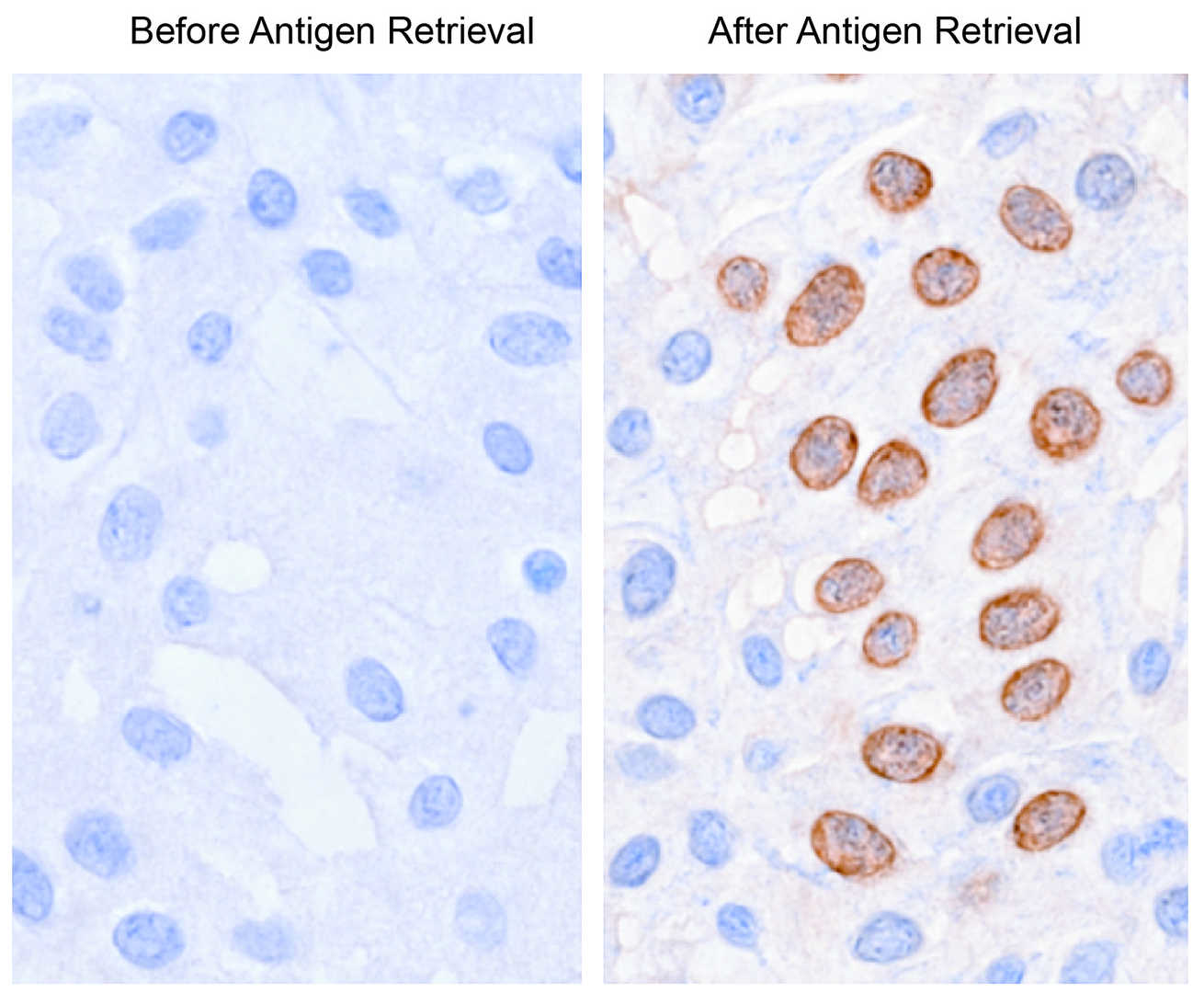
The difference in staining of tissue sections before and after antigen retrieval in immunohistochemistry (IHC): Antigen retrieval is not performed and as a result the target antigen becomes cross-linked within the tissue section which prevents antibodies from recognizing and binding effectively leading to a weak or nearly invisible staining signal. Right image (After Antigen Retrieval): Antigen retrieval processes like heat repair break the cross-linked structure to expose target antigens which allows antibodies to bind effectively and produce a distinct brown staining signal that reveals the antigen distribution.
Antigen retrieval is a technique used in immunohistochemistry (IHC) to unmask antigenic sites in formalin-fixed, paraffin-embedded (FFPE) tissue sections, enabling antibody binding and improving staining quality.
During fixation, formalin forms cross-links between proteins, which can mask epitopes and hinder antibody access. Retrieval methods break these cross-links and restore epitope recognition.
We offer multiple retrieval methods, including:
Heat-Induced Epitope Retrieval (HIER) using citrate, EDTA, or Tris-EDTA buffers.
Enzymatic retrieval using proteolytic enzymes like proteinase K or trypsin.
Selection depends on the tissue type, fixation protocol, target antigen, and primary antibody. We provide customized method development to ensure optimal conditions.
Common buffers include:
If not optimized, retrieval conditions can lead to tissue damage or antigen loss. Our protocols are carefully calibrated to balance antigen exposure with tissue integrity.
To use our antigen retrieval services, please contact Creative Diagnostics, your professional immunology service provider. From research-grade retrieval to bulk antigen retrieval, our team is ready to support your R&D innovation.
Loading ......
