
Inquiry Basket
 Loading ......
Duocarmycins, derived from Streptomyces bacteria, are a group of potent toxins with antitumor properties. They are a class of DNA minor groove-binding alkylating molecules. In recent years, researchers have utilized duocarmycin analogues as payloads in the creation of antibody-drug conjugates (ADCs). These ADCs combine the tumor-targeting ability of antibodies with the cytotoxic effects of duocarmycins. Promisingly, over 15 duocarmycin-based ADCs have undergone preclinical studies, and some, like SYD985, have received Fast-Track Designation status, highlighting their potential as effective cancer therapies.
Browse all Duocarmycin products
ADCs are a type of targeted cancer therapy that combines specific antibodies with potent cytotoxic drugs. Over 80 ADCs are currently in clinical trials. Nine ADCs have been approved, targeting various cancers, such as lymphoma, myeloma, breast cancer, and urothelial tumors.
The success of ADCs relies on factors like target validation, antibody manipulation, linker chemistry, and cytotoxic drug potency. ADC payloads should have balanced properties, be chemically tractable, and display appropriate cytotoxicity. They should effectively kill cancer cells while minimizing harm to healthy tissues. Currently, the cytotoxic agents that have been used in ADCs are characterized as microtubule inhibitors and DNA-damaging agents. Other payload types under development include DNA synthesis disruptors and inhibitors of protein synthesis or metabolic processes. The utilization of potent compounds in ADCs enhances the diversity of pharmaceutical options, enabling different mechanisms of action. This broadens the effectiveness of ADCs in treating various cancer types with distinct characteristics like proliferation, invasiveness, metastasis, chemoresistance, and tumorigenic stemness. Among them, duocarmycin-based ADCs have shown promise in preclinical studies, with some advancing to later stages of clinical trials.
Duocarmycins, including the first duocarmycin CC-1065 isolated from Streptomyces zelensis, have been extensively studied for their potential in cancer therapy. They exhibit high potency in killing cancer cells, targeting both dividing and nondividing cells. Duocarmycins are effective against cancer cells with hypoxic, chemoresistant, and stemness characteristics. Efforts have been made to improve duocarmycin properties, resulting in various analogs that can be used as ADC payloads. Duocarmycin analogs are active against drug-resistant cancer cells and are not easily pumped out by drug-resistant pumps. Moreover, chemical linkage technology has allowed the development of different duocarmycin-linker combinations for ADCs. Both cleavable and non-cleavable linkers have been used successfully. The selection of specific linker types depends on the individual drug's characteristics and the targeted tumor types. Duocarmycins possess unique features that make them suitable as cytotoxic payloads for diverse ADC formulations.
Duocarmycin-based ADCs function by utilizing the unique characteristics of both the antibody and the cytotoxic payload. The antibody component specifically recognizes and binds to cancer cell surface antigens, facilitating internalization of the ADC. Once inside the cell, the ADC undergoes intracellular processing, leading to the release of the Duocarmycin payload.
Once released, the Duocarmycin payload exerts its cytotoxic effects by binding to DNA in the nucleus of the cancer cell. Duocarmycins are capable of binding to the minor groove of DNA, which is the narrow space between the DNA helix strands. This binding is highly specific and occurs in a sequence-dependent manner, with a preference for AT-rich sequences. Upon binding to DNA, the Duocarmycin induces irreversible alkylation of adenine at the N3 position. This alkylation disrupts the normal structure and integrity of the DNA molecule, leading to various downstream effects. The altered DNA structure hinders important cellular processes, such as DNA replication, transcription, and repair, ultimately causing DNA damage and cell death.
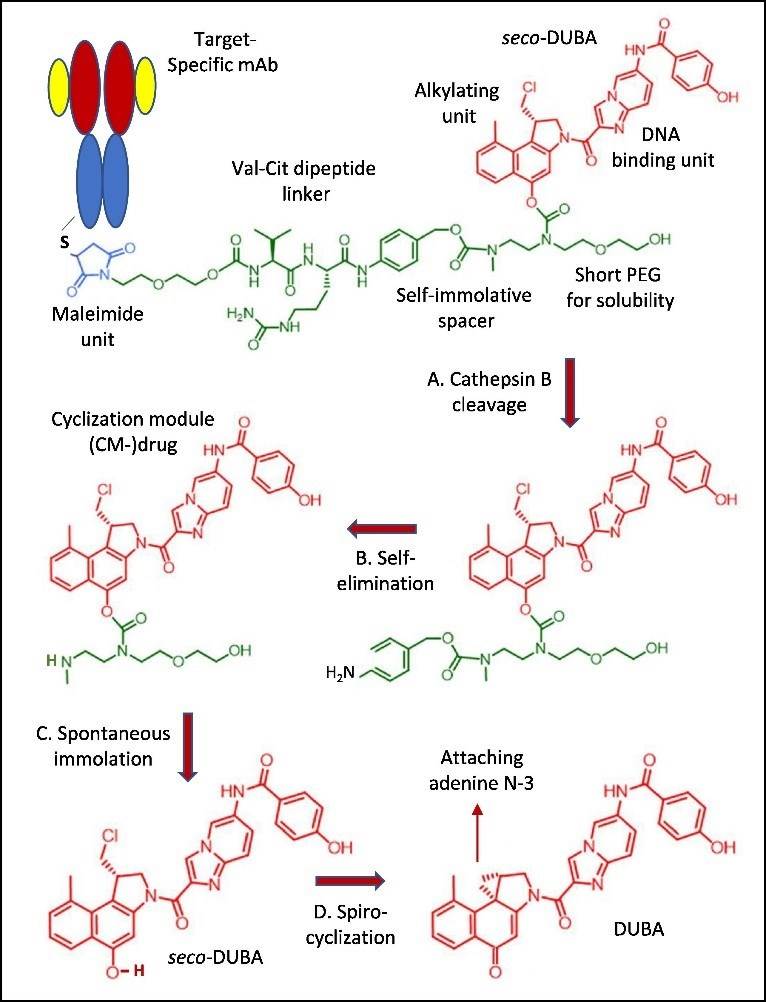 Figure 1. Chemical and biological processes for a duocarmycin-based ADC after internalization by cancer cells.
(Source: Yao, H. P. et al., 2021)
Duocarmycin analogs have shown promise as potential drugs for cancer therapy, with excellent stability, solubility, PK profile, and cytotoxic potency against various cancer phenotypes. However, their clinical trials have revealed limitations such as a narrow therapeutic window and significant toxicity, making them unsuitable as free drugs for cancer treatment. Despite these drawbacks, duocarmycin's high potency makes them ideal candidates for ADCs.
Selecting appropriate therapeutic targets is crucial, with clinically validated targets like HER-2, EGFR, MET, PSMA, CD19, and CD22 having a higher chance of success. Careful consideration is needed for targets that lack proven agents or have only been studied preclinically.
Moreover, the monoclonal antibodies (mAbs) used for duocarmycin conjugation must meet specific criteria. They should be highly specific, able to recognize different forms of the same antigen and induce target internalization for effective payload delivery. Ideally, mAbs should possess biological activities and exhibit high efficacy in animal models. However, many mAbs used in ADCs lack intrinsic biological or immunoregulatory activities. And the intact Fc may also contribute to safety issues. Therefore, significant improvement is required if these duocarmycin-based ADCs are to be pharmaceutically competitive.
In addition, suitable linkers are crucial for the stability, solubility, and therapeutic efficacy of duocarmycin-based ADCs. Advanced linker chemistries, such as the maleimide-based Val-Cit-linker and cBu-Cit peptidomimetic cleavable linker, have shown promise in improving duocarmycin-based ADCs' pharmacokinetic profiles and therapeutic efficacy.
Reference
| Target | Cat. No. | Product Name | Expression System | Tag/Conjugate | Application | |
| Duocarmycin | DAG-WZ1006 | Duocarmycin[BSA] | BSA | ELISA, LFIA | Inquiry | |
| EGFR | DAGA-812 | Synthetic Epidermal Growth Factor Receptor phospho-Tyr 1173 Peptide | N/A | Unconjugated | BL | Inquiry |
| DAGC301 | Recombinant Human EGFR Protein [His] | HEK293 Cells | His | SDS-PAGE, ELISA | Inquiry | |
| CDBP1098 | Human EGFR blocking peptide | N/A | Unconjugated | BL | Inquiry | |
| MET | DAG-P1788 | Human MET peptide | N/A | Unconjugated | ELISA | Inquiry |
| DAG3301 | D-Methionine [BSA] | N/A | BSA | IHC, ICC | Inquiry | |
| DAG-KO221 | MET Knockout Cell Lysate | WB | Inquiry |
| Target | Cat. No. | Product Name | Size | Species | Application | Detection Sample | |
| EGFR | DEIA-BJ06 | Human Epidermal Growth Factor Receptor 2 Extracellular Domain ELISA kit | 96T | Quantitative | Serum, plasma, cell culture supernatants, body fluid and tissue homogenate | Inquiry | |
| DEIA094J | Epidermal-Growth-Factor-Receptor ELISA Kit | 96T | Quantitative | Tissues | Inquiry | ||
| DIA-XYA176 | EGFR ELISA Kit | 96T | Quantitative | Cell lysates, serum, plasma | Inquiry | ||
| DEIA2833 | Human EGF R ELISA Kit | 96T | Human | Quantitative | Cell culture supernatants, serum, plasma, milk | Inquiry | |
| DEIA3348 | Human/Mouse/Rat EGFR (pS1070) ELISA Kit | 96T | Human, Mouse, Rat | Quantitative | Cell lysates, tissues lysates | Inquiry | |
| DEIA3349 | Human/Mouse/Rat EGFR (pS1070)/ Pan EGFR ELISA Kit | 96T | Human, Mouse, Rat | Quantitative | Cell lysates, tissues lysates | Inquiry | |
| DEIA3350 | Human EGFR (pY1045) ELISA Kit | 96T | Human | Quantitative | Cell lysates, tissues lysates | Inquiry | |
| DEIA3351 | Human EGFR (pY1045)/Pan EGFR ELISA Kit | 96T | Human | Quantitative | Cell lysates, tissues lysates | Inquiry | |
| DEIA3352 | Human EGFR (pY1068) ELISA Kit | 96T | Human | Quantitative | Cell lysates, tissues lysates | Inquiry | |
| DEIA3353 | Human EGFR (pY1068)/Pan EGFR ELISA Kit | 96T | Human | Quantitative | Cell lysates, tissues lysates | Inquiry | |
| DEIA3354 | Human EGFR (pY1086) ELISA Kit | 96T | Human | Quantitative | Cell lysates, tissues lysates | Inquiry | |
| DEIA3355 | Human EGFR (pY1086)/Pan EGFR ELISA Kit | 96T | Human | Quantitative | Cell lysates, tissues lysates | Inquiry | |
| DEIA3356 | Human EGFR (pY992) ELISA Kit | 96T | Human | Quantitative | Cell lysates, tissues lysates | Inquiry | |
| DEIA3357 | Human EGFR (pY992)/Pan EGFR ELISA Kit | 96T | Human | Quantitative | Cell lysates, tissues lysates | Inquiry | |
| ABPR-ZB274 | Human EGFR Antibody Pair Set | 5 Plates, 15 Plates | Human | sELISA | Inquiry | ||
| DEIA-XYA936 | EGFR (Phospho-Ser1026) ELISA Kit | 2 x 96T | Qualitative | Cultured cells | Inquiry | ||
| DEIA-XYA937 | EGFR (Phospho-Ser1071) ELISA Kit | 2 x 96T | Qualitative | Cultured cells | Inquiry | ||
| DEIA-XYA938 | EGFR (Phospho-Ser695) ELISA Kit | 2 x 96T | Qualitative | Cultured cells | Inquiry | ||
| DEIA-XYA939 | EGFR (Phospho-Thr678) ELISA Kit | 2 x 96T | Qualitative | Cultured cells | Inquiry | ||
| DEIA-XYA940 | EGFR (Phospho-Thr693) ELISA Kit | 2 x 96T | Qualitative | Cultured cells | Inquiry | ||
| DEIA-XYA941 | EGFR (Phospho-Tyr1016) ELISA Kit | 2 x 96T | Qualitative | Cultured cells | Inquiry | ||
| DEIA-XYA942 | EGFR (Phospho-Tyr1069) ELISA Kit | 2 x 96T | Qualitative | Cultured cells | Inquiry | ||
| DEIA-XYA943 | EGFR (Phospho-Tyr1092) ELISA Kit | 2 x 96T | Qualitative | Cultured cells | Inquiry | ||
| DEIA-XYA944 | EGFR (Phospho-Tyr1110) ELISA Kit | 2 x 96T | Qualitative | Cultured cells | Inquiry | ||
| DEIA-XYA945 | EGFR (Phospho-Tyr1172) ELISA Kit | 2 x 96T | Qualitative | Cultured cells | Inquiry | ||
| DEIA-XYA946 | EGFR (Phospho-Tyr1197) ELISA Kit | 2 x 96T | Qualitative | Cultured cells | Inquiry | ||
| DEIA-XYA947 | EGFR (Phospho-Tyr869) ELISA Kit | 2 x 96T | Qualitative | Cultured cells | Inquiry | ||
| DEIA-XYA1851 | EGFR (Phospho-Ser1070) ELISA Kit | 2 x 96T | Qualitative | Cultured cells | Inquiry | ||
| MET | DEIA-BJ2061 | Rat C-met Proto-Oncogene Protein ELISA Kit | 96T | Quantitative | Serum, plasma, cell culture supernatants, body fluid and tissue homogenate | Inquiry | |
| DEIA7180 | Human MET proto-oncogene, receptor tyrosine kinase ELISA Kit | 96T | Human | Quantitative | Serum, EDTA plasma, heparin plasma | Inquiry | |
| DEIA10993 | Mouse C-MET/HGFR ELISA Kit | 96T | Mouse | Quantitative | Cell culture supernatants, serum, EDTA plasma, heparin plasma | Inquiry | |
| ABPR-ZB377 | Human c-MET Antibody Pair Set | 5 Plates, 15 Plates | Human | sELISA | Inquiry | ||
| DEIA-XYA1886 | Met (Phospho-Tyr1234) ELISA Kit | 2 x 96T | Qualitative | Cultured cells | Inquiry | ||
| DEIA-XYA1887 | Met (Phospho-Tyr1349) ELISA Kit | 2 x 96T | Qualitative | Cultured cells | Inquiry | ||
| DEIA-XYA1888 | Met (Phospho-Tyr1356) ELISA Kit | 2 x 96T | Qualitative | Cultured cells | Inquiry | ||
| DEIABL535 | Met Kinase Inhibitor Screening Assay Kit | 96T | Inquiry | ||||
| CD22 | DEIA-XYA288 | BL-CAM ELISA Kit | 96T | Qualitative | Cultured cells | Inquiry | |
| DEIA-XYA289 | BL-CAM (Phospho-Tyr807) ELISA Kit | 2 x 96T | Qualitative | Cultured cells | Inquiry |
Loading ......
