
Inquiry Basket
 Loading ......
Nowadays, at least 17 and 160 types of chemical modifications have been discovered in DNA and RNA, respectively. Among the known RNA modifications, more than 70 contain methyl groups, so the importance of methylation modification is obvious. Analysis of nucleic acid methylation and their functional effects are critical to epigenetics researchers. Methylation profiles of epigenome are used for disease identification and for research and therapeutic development. Specifically, the detection of methylation in DNA and RNA is essential for the diagnosis and treatment of a wide range of tumor diseases.
| Structure | Name | Description |
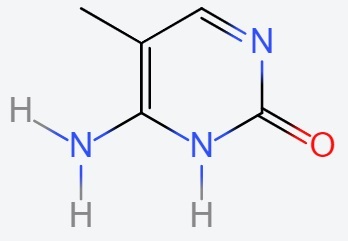 | 5mc | 5-methylcytosine (5mc) is a major form of DNA modification in the mammalian genome. It is also called the "fifth base". The reaction is catalyzed by DNA methyltransferases (DNMTs) and mostly found in the context of symmetrical CpG dinucleotides. |
 | 5hmC | 5-hydroxymethylcytosine (5hmC) in mammalian genome is now widely accepted as the "sixth base". The ten-eleven translocation 1 (TET1) enzyme catalyses the conversion of 5Mc to 5hmC. |
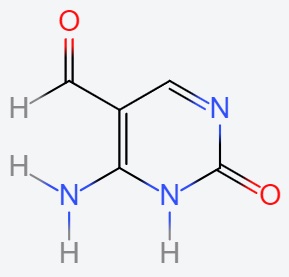 | 5fc | 5-formylcytosine (5fc) might be considered as the "seventh base" of the genome. This nucleotide has been implicated in active demethylation mediated by the base excision repair enzyme thymine DNA glycosylase (TDG). |
 | 5caC | 5-carboxylcytosine (5caC) is the final oxidized derivative of 5-methylcytosine (5Mc). Further successive oxidations mediated by TET result in formation of 5caC. |
| Name | Short name | Typical location |
| 2'-O-methyladenosine | Am | Cap1, Cap2 |
| 2'-O-methylcytidine | Cm | Cap1, Cap2 |
| 2'-O-methylguanosine | Gm | Cap1, Cap2 |
| 2'-O-methyluridine | Um | Cap1, Cap2 |
| N6,2'-O-dimethyladenosine | m6Am | Cap1 |
| N2,N2,7-trimethylguanosine | m2,2,7G | Cap structure (snRNA) |
| 1-methyladenosine | m1A | Internal |
| 1-methylguanosine | m1G | Internal |
| 5-methylcytidine | m5C | Internal |
| N6-methyladenosine | m6A | Internal |
| 1-methylinosine | m1I | |
| 3-methylcytidine | m3C | |
| N4-methylcytidine | m4C | |
| N6,N6-dimethyladenosine | m6,6A |
CpG island DNA methylation plays critical roles in X-chromosome inactivation, imprinting and cancers and it is rare in normal cells and increases with age. Evidence shows that the existence of CpG island promoter hypermethylation of tumour suppressor genes such as p16INK4a in melanoma, SET9 in cervical cancer and p15INK4b in hematologic malignancies. In addition, it was also reported that the tumourigenesis of some cancers is caused by the hypermethylation of one copy of a tumour suppressor gene whereas the other copy is naturally mutated or lost, supporting the role of DNA hypermethylation in driving tumourigenesis.
RNA methylation has impact on tissue development, DNA damage repair, as well as tumour initiation and progression through largely regulating RNA stability. The m6A methyltransferase METTL3 is over-expressed in gastric, colon and liver cancers and promotes cancer cell proliferation via suppressing the tumour suppressor SOCS2. The m5C methyltransferase NSUN2 is over-expressed in breast and colorectal malignancies.
Antibodies against nucleic acid modifications have played an important role in the fields of epigenetics and epitranscriptomics. For instance, enrichment of DNA containing 5mC by methylated DNA immunoprecipiatation (MeDIP) has been a widely used technique in epigenetics for decades. Also, antibody-based sequencing technologies has been widely used in transcriptome studies of several RNA modifications, including m6A, m1A, m5C and m7G, etc.
The antibody-based methods are relatively simple, fast, and cost-effective, but rely on highly specific antibodies to recognize methylated DNA/RNA. The key to producing antibodies that can effectively detect RNA modification lies in antigen design and antibody validation. Antibodies against single nucleosides can be generated by coupling them to an immunogenic carrier protein. Generally, A stable covalent coupling of ribonucleosides can be achieved by oxidation of the ribose ring with sodium periodate followed by a reductive condensation of the resulting aldehyde groups to the NH2-group of the lysine side chain.
Creative Diagnostics offers a range of highly validated antibodies for DNA/RNA methylation analysis. These antibodies have been thoroughly validated in many immunological applications. Please check out our highly sensitive and specific antibodies in the product list.
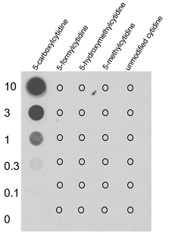 |  |  |  |
| Fig. 1 Dot blot analysis of 5-Carboxylcytosine pAb (Cat. No DPABB-JX157) | Fig. 2 Dot blot analysis of Am pAb (Cat. No DPABB-JX168) | Fig. 3 Dot blot analysis of 3-mC pAb (Cat. No DPABB-JX159) | Fig. 4 Dot blot analysis of m6A mAb (Cat. No DMABB-JX258) |
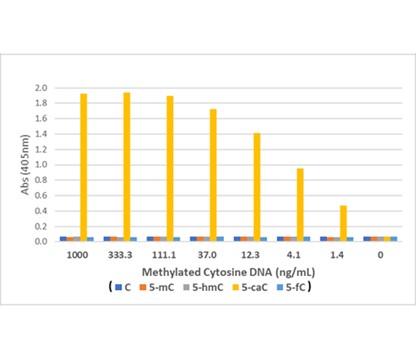 |  |
| Fig. 5 ELISA analysis of 5-caC mAb (Cat. No DMABB-JX344) | Fig. 6 IF analysis of DARPP-32 in normal rat ciliary epithelium. (Cat. No CABT-L1171) |
References
| Anti-5-methylcytosine (5-mC) Antibodies | |||
| Cat. No. | Product Name | Application | |
| DMABB-JX274 | Rabbit Anti-5-methylcytosine (5-mC) monoclonal antibody, clone SN342 | ELISA, Dot, ICC, FC | Inquiry |
| DMABT-H21873 | Mouse Anti-5-Methylcytosine monoclonal antibody, clone 44E4 | Dot, IF, SB, ICC, IHC-P, FC | Inquiry |
| CABT-B354 | Sheep Anti-5-Methylcytosine polyclonal antibody | Dot, FC, ICC/IF, IHC, IP, WB | Inquiry |
| Anti-Methylcytidine (Cm) Antibodies | |||
| Cat. No. | Product Name | Application | |
| DMABB-JX352 | Rabbit Anti-2'-O-methylcytidine/Cm monoclonal antibody, clone BSD61740 | ELISA, Dot | Inquiry |
| DPABB-JX167 | Rabbit Anti-2'-O-methylcytidine/Cm polyclonal antibody | ELISA, Dot | Inquiry |
| Anti-5-Hydroxymethylcytosine (5-hmC) Antibodies | |||
| Cat. No. | Product Name | Application | |
| CABT-L1171 | Rabbit Anti-5-Hydroxymethylcytosine monoclonal antibody, clone SN347 | ELISA, ICC, IHC, IP, IF | Inquiry |
| DMABB-JX232 | Mouse Anti-5-Hydroxymethylcytosine monoclonal antibody, clone 5E0 | ELISA, Dot | Inquiry |
| DMABT-H21877 | Rat Anti-5-hydroxymethylcytosine monoclonal antibody, clone BC4/74.4 | Dot, ICC | Inquiry |
| CABT-L6445Z | Rabbit Anti-5-hydroxymethylcytidine polyclonal antibody | IP, ICC/IF, IHC, WB, Dot, ELISA | Inquiry |
| Anti-Methylguanosine (Gm) Antibodies | |||
| Cat. No. | Product Name | Application | |
| DMABB-JX350 | Rabbit Anti-2'-O-Methylguanosine(Gm) monoclonal antibody, clone BSD61883 | ELISA, Dot | Inquiry |
| DPABB-JX165 | Rabbit Anti-2'-O-Methylguanosine(Gm) polyclonal antibody | ELISA, Dot | Inquiry |
| DMABB-JX52 | Mouse Anti-2,2,7-trimethylguanosine monoclonal antibody, clone 340 | IF, IP | Inquiry |
| Anti-5-Formylcytosines (5-fC) Antibodies | |||
| Cat. No. | Product Name | Application | |
| DMABB-JX273 | Rabbit Anti-5-Formylcytosines (5-fC) monoclonal antibody, clone SN588 | Dot | Inquiry |
| DPABB-JX158 | Rabbit Anti-5-Formylcytosine (5-fC) polyclonal antibody | WB, IF/ICC, DB | Inquiry |
| Anti-Methyluridine (Um) Antibodies | |||
| Cat. No. | Product Name | Application | |
| DMABB-JX351 | Rabbit Anti-2'-O-methyluridine(Um) monoclonal antibody, clone BSD61861 | ELISA, Dot | Inquiry |
| DPABB-JX166 | Rabbit Anti-2'-O-methyluridine(Um) polyclonal antibody | ELISA, Dot | Inquiry |
| Anti-5-Carboxylcytosine (5-caC) Antibodies | |||
| Cat. No. | Product Name | Application | |
| DMABB-JX344 | Rabbit Anti-5-Carboxylcytosine (5-caC) Monoclonal Antibody, clone SN572 | Dot, ELISA | Inquiry |
| DPABB-JX157 | Rabbit Anti-5-Carboxylcytosine (5-caC) polyclonal antibody | Dot, IF/ICC | Inquiry |
| Anti-N6-methyladenosine (m6A) Antibodies | |||
| Cat. No. | Product Name | Application | |
| DMABB-JX258 | Rabbit Anti-N6-Methyladenosine monoclonal antibody, clone SN473 | Dot, ELISA | Inquiry |
| CABT-CS610 | Rabbit Anti-M6A Monoclonal antibody, clone 3I7 | ELISA, DB, IF | Inquiry |
| CABT-B1203 | Mouse Anti-M6A monoclonal antibody (m6A), clone 28-4-5-2 | Dot, RIP | Inquiry |
| DPABH-27237 | Rabbit Anti-N6-methyladenosine polyclonal antibody | PepArr | Inquiry |
| DPABB-JX05 | Rabbit Anti-N6-methyladenosine (m6A) polyclonal antibody | Dot, RIP | Inquiry |
| Anti-3-Methylcytosine (3-mC) Antibodies | |||
| Cat. No. | Product Name | Application | |
| DPABB-JX159 | Rabbit Anti-3-Methylcytosine (3-mC) polyclonal antibody | Dot | Inquiry |
| Anti-N6N6-dimethyladenosine (m66A) Antibodies | |||
| Cat. No. | Product Name | Application | |
| DPABB-JX04 | Rabbit Anti-N6N6-dimethyladenosine polyclonal antibody | Dot, RIP | Inquiry |
| Anti-1-methylinosine (m1I) Antibodies | |||
| Cat. No. | Product Name | Application | |
| DPABB-JX03 | Rabbit Anti-1-methylinosine polyclonal antibody | Dot | Inquiry |
| Anti-N6,2'-O-dimethyladenosine (m6Am) Antibodies | |||
| Cat. No. | Product Name | Application | |
| DPABB-JX164 | Rabbit Anti-N6,2'-O-dimethyladenosine/m6Am polyclonal antibody | ELISA, Dot | Inquiry |
| Anti- Methyladenosine (Am) Antibodies | |||
| Cat. No. | Product Name | Application | |
| DPABB-JX168 | Rabbit Anti-2'-O-methyladenosine/Am polyclonal antibody | ELISA, Dot | Inquiry |
| Anti-N4-Methylcytidine (m4C) Antibodies | |||
| Cat. No. | Product Name | Application | |
| DPABB-JX163 | Rabbit Anti-N4-Methylcytidine polyclonal antibody | ELISA, WB | Inquiry |
Loading ......
