
Inquiry Basket
 Loading ......
DNA gyrase forms a dynamic complex with DNA (>100bp), which plays an important role in compressing the genome and solving the topological problems related to replication and transcription by introducing negative superhelix to reshape bacterial chromosomes.
The DNA gyrase structure consists of two GyrA and two GyrB subunits and is a heterotetramer with a three-dimensional symmetrical structure. GyrA is responsible for the binding and encapsulation of DNA. It also contains a tyrosine active site, which is located in a helix turn helix (HTH) motif within the catabolite activator protein (CAP)-like domain. GyrB contains ATP binding site and hydrolysis site, as well as a Topoisomerase-Primase (TOPRIM) domain, which provides a binding site for divalent cations involved in DNA cleavage and reconnection. In the process of phosphodiester bond cleavage, the 5-terminal of DNA is covalently linked with the enzyme through the active site tyrosine to form a cleavage complex.
DNA gyrase in bacteria is a conservative enzyme, which can induce DNA double-stranded negative superhelix by ATP hydrolysis. This phenomenon has been found in vitro experiments of E. coli, B. subtilis, C. crescentus, M. tuberculosis and many other bacteria. In addition, the enzyme can relax the positive superhelix of DNA double strand and decatenate circular DNA. The use of inhibitors to inhibit gyrase activity can significantly reduce the cell survival rate, showing that cells cannot divide in different bacteria.
Gyrase maintains the DNA double-stranded negative superhelix and promotes the initiation of transcription and replication, in which it is responsible for relaxing the positive superhelix in front of the elongation polymerase. It was found that the catalytically active DNA gyrase in E. coli is located at the end of the region downstream of the active gene and transcription terminator. In the absence of gyrase, DNA transcription slows rapidly due to topological constraints and eventually stops due to the accumulation of positive superhelix. In addition, DNA gyrase can activate or inhibit transcriptional initiation by introducing negative supercoil.
The negative superhelix induced by gyrase and gyrase also influence the spatial organization of bacterial genome. Fluoroquinolone induces gyrase to split the genomic DNA of E. coli into fragments equal to the length of superhelix chromosome domain in vivo. The activity of DNA gyrase in bacteriophage Mu at the high affinity site will locally increase the negative superhelix, resulting in the plectonemic compaction of the chromosome region with the bacteriophage. After inhibition of enzyme activity, the spatial structure of chromosomes became looser.
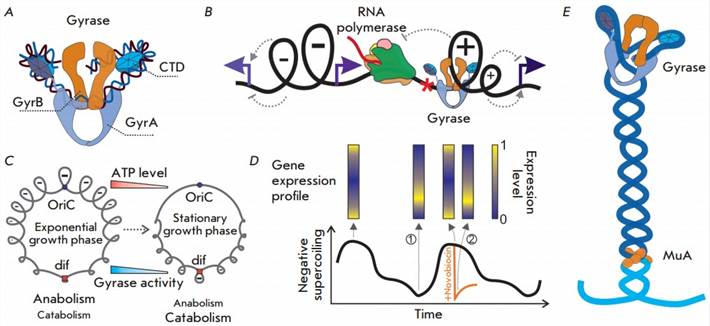 Figure 1. DNA gyrase and its function
(Source: Sutormin DA, et al. 2021)
Gyrase is a kind of A2B2 tetramer, which has the same core domain and double strand passing mechanism as the IIA topoisomerase family. DNA is allowed to pass through gates formed by three protein-protein interfaces. The TOPRIM domain and the Winged Helix Domain (WHD) form the central DNA gate. WHD contains tyrosine residues at the active site, and the DNA double strand (G fragment) to be cut binds to it to form a transient 5-phosphotyrosyl- protein-DNA connection. DNA-bound structures in the gyrase-bound and cleaved cores show obvious bend at the G-terminal. The second DNA fragment, called T fragment or transfer fragment, enters the upper cavity formed by the GHKL ATPase domain through the N gate, which can be dimerized after binding to ATP and may transfer the nucleotide state to the DNA gate through conformational changes involving intermediate transduction domains. After the instantaneous cleavage of the G segment and the opening of the DNA gate, the DNA double strand enters the lower cavity composed of a coiled-coil domain, and the T segment can exit through the final reversible interface (C gate). In the closed ring molecule, the whole reaction process reverses a node between the T fragment and the G fragment, thus changing the connection number of DNA.
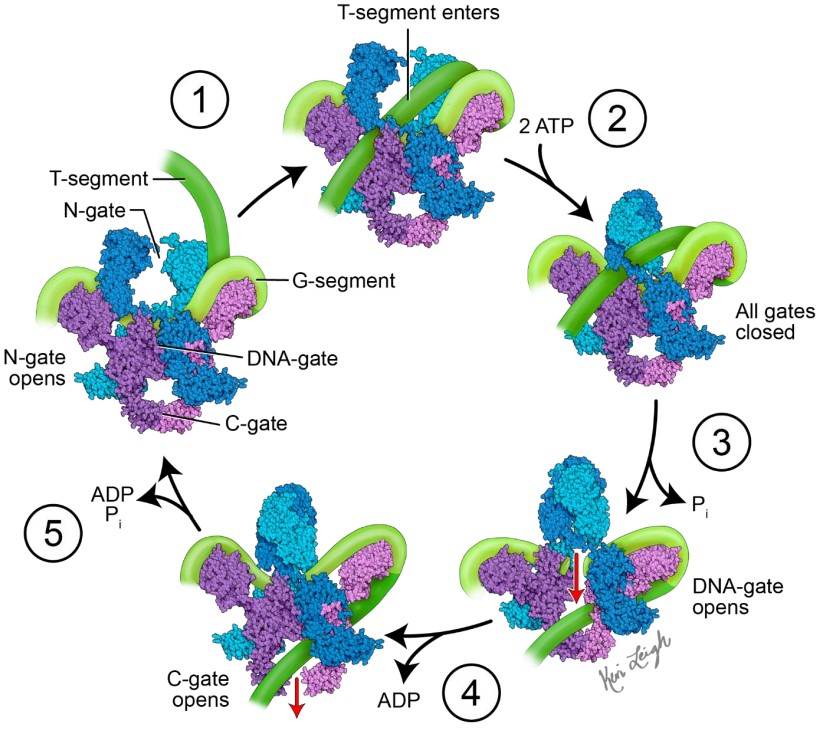 Figure 2. Mechanism of action of DNA gyrase
(Source: Spencer AC, et al. 2023)
Topoisomerases are required to maintain or change the topological state of DNA during cellular replication, transcription, and recombination. Topoisomerases include type I and type II enzymes, which differ in their structure and catalytic mechanism. Type I topoisomerases alter the topological state of DNA by cutting single-stranded DNA, rotating double-stranded DNA around a second intact strand, changing the shape of the superhelix, or allowing the intact strand to pass through gaps in the single-stranded breaks. Type II topoisomerases cleave DNA double strands (G fragments) by hydrolyzing two ATPs and causing a second double strand (T fragment) to cross at the cut. If the two fragments come from the same molecule, the DNA superhelix is altered, and if they come from different DNA, the DNA is catenated or decatenated.
Type II topoisomerase can also be divided into IIA and IIB according to its structure and catalytic cycle characteristics. The N gate is formed by the conservative ATP hydrolysis region GHKL. The DNA gate, formed by Toprim and WHD, is the site where the G fragment of DNA binds to the enzyme and is cleaved. The C gate exists only in type IIA enzymes and is formed by a coiled-coil domain. The C-terminal domain (CTD) is located at the C-terminal of subunit A, which determines the specificity of topoisomerase IIA to DNA structure, and post-translational modification occurs in eukaryotes to regulate enzyme activity.
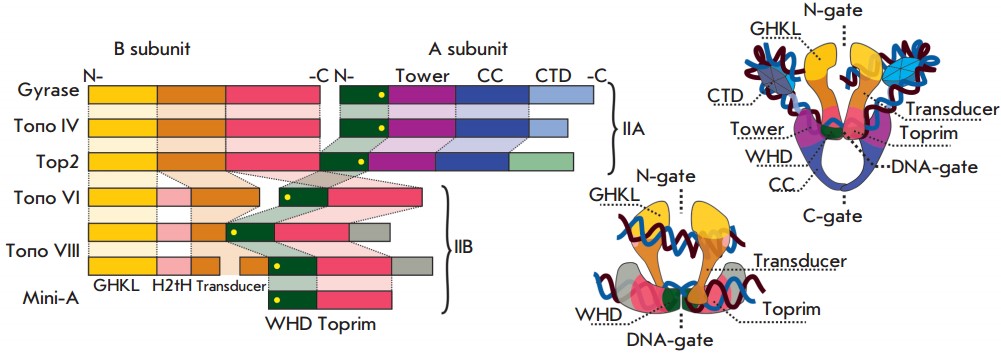 Figure 3. Type II topoisomerase structure
(Source: Sutormin DA, et al. 2021)
Eubacterial DNA gyrase belongs to the DNA topoisomerase subfamily II, a subfamily II topoisomerase characterized by the production of double-strand breaks in DNA. DNA gyrase, together with eukaryotic topoisomerase IV (Topo IV) and eukaryotic DNA topoisomerase II (Topo II), belongs to type IIA topoisomerase, in which the structure and mechanism of DNA gyrase and topoisomerase IV are very similar, but DNA gyrase can produce negative superhelix driven by ATP hydrolysis, while Topo IV leads to ATP-driven DNA degradation and Topo II leads to ATP-dependent DNA relaxation.
The globular C-terminal domain (CTD) of DNA gyrase is different from other IIA topoisomerases in that DNA gyrase needs to introduce a superhelix. The direction of the superhelix can be achieved by chiral wrapping the DNA between the G-segment and the T-segment, capturing (+) twisting and presenting a (+) node, whose reversal will change the number of connections by -2. Gyrase-coated DNA does not limit (+) distortion without nucleotides. The CTD is essential to ensure that the DNA gyrase is different from the rest of the topoisomerases, and the absence of the CTD results in the loss of uniqueness of the gyrase and its conversion to a conventional type II topoisomerase. Isolating the CTD alone and analyzing the structural features revealed that it has a beta pinwheel-like fold with a basic patch at the outer edge that binds and bends DNA.
The main vaccination series of DTP include doses for 6, 10 and 14 weeks, and enhanced doses for 12-23 months, 4-7 years, 9-15 years, and adults every 10 years. A meta-analysis of diphtheria cases and vaccine efficacy showed that the effective rate of complete vaccination (≥ 3 doses) was 87% and that of incomplete vaccination was 71% (1-2 doses).
DTP has good safety and low immunogenicity. Clinical trials found that adults treated with DTP had no increased risk of adverse events compared with adults who received DTP 10 years after the first dose of DTP. Few adverse reactions were reported in pregnant women who received multiple doses of DTP during one pregnancy and those who received additional doses of vaccine. The most common adverse reactions were pain at the injection site, fatigue, and headache.
The immunity brought by the vaccine gradually weakens over time. In the population with low enhanced vaccination rate, the effective rate of full vaccination against symptomatic diseases is 96% in children aged 0-4 years old, 92% in children aged 5-19 years old, and 63% in children aged ≥ 20 years old. Serological studies have also shown that immunity is weakening, and the proportion of individuals with fully protective antibody levels (≥ 0.1 IU/mL) has decreased by 0.6% a year since vaccination, consistent with the decline in vaccine effectiveness.
Quinolones are broad-spectrum antibiotics, which mainly target DNA gyrase and topoisomerase IV in topoisomerase to cause DNA damage, in which DNA gyrase is the main toxic target and Topo IV is the minor target. Quinolones have both bacteriostatic and bactericidal effects, slowing bacterial growth by stabilizing the gyrase-DNA cleavage complex to block replication forks. The bactericidal effect of quinolones becomes stronger with increasing concentration, and high concentrations can lead to chromosome fragmentation and rapid cell death. It stabilizes the cleavage complex in such a way that the quinolone noncovalently binds the DNA gyrase in the active site, and interacts with DNA bases to be cleaved on both sides through base stacking interaction, thus stabilizing the cleavage complex and finally inhibiting the reconnection of DNA.
A water-metal ion bridge in GyrA mediates the binding of quinolone to DNA gyrase. Non-catalytic Mg2+ chelates the C-3/C-4 ketoacid region of the quinolone while coordinating to four water molecules. Coordination water forms hydrogen bond with Ser83 and nearby acidic residue Asp87. Water-metal ion bridge is also a common mutation site in drug-resistant strains. The region between amino acids 67-106 in GyrA is called quinolone resistance determination region (QRDR). Mutations in serine and acidic residues can prevent quinolone from effectively binding or inhibiting the enzyme. According to crystallographic studies, the C-7 loop system of quinolones extends to the B subunit of DNA gyrase, where residues form a beneficial but nonspecific environment for C-7 molecules. The mutation of gyrase B subunit is also related to drug resistance.
 Figure 4. Binding of quinolones to DNA gyrase
(Source: Spencer AC, et al. 2023)
References
| Target | Cat. No. | Product Name | Host | Isotype | Application | |
| DNA Gyrase A | DCABH-9628 | Anti-E. coli Gyrase A Monoclonal antibody, Clone 5E4 | Mouse | IgG2b | WB | Inquiry |
| DNA Gyrase A | DCABH-9630 | Anti-E. coli Gyrase A Monoclonal antibody, Clone 8G22 | Mouse | IgG2b | WB | Inquiry |
| DNA Gyrase A | DPABH-00207 | Anti-E. coli Gyrase A Polyclonal antibody | Rabbit | IgG | WB | Inquiry |
| DNA Gyrase B | DCABH-9629 | Anti-E. coli Gyrase B Monoclonal antibody, Clone 8E4 | Mouse | IgG2a | WB | Inquiry |
| DNA Gyrase B | DCABH-9631 | Anti-E. coli Gyrase B Monoclonal antibody, Clone 0H9 | Mouse | IgG2a | WB | Inquiry |
| DNA Gyrase B | DPABH-00208 | Anti-E. coli GYRB Polyclonal antibody | Rabbit | IgG | WB | Inquiry |
| Target | Cat. No. | Product Name | Size | Species Reactivity | Application | Detection Sample | |
| TOP1 | DEIA-FN1556 | Human TOP1 (DNA topoisomerase 1) ELISA Kit | 96T | Quantitative | Serum, plasma, cell culture supernatants, tissue homogenate | Inquiry | |
| DEIA-FN1557 | Mouse Top1 (DNA topoisomerase 1) ELISA Kit | 96T | Quantitative | Serum, plasma, cell culture supernatants, tissue homogenate | Inquiry | ||
| TOP2A | DEIA-XYA1775 | TOP2A ELISA Kit | 96T | Qualitative | Cultured cells | Inquiry | |
| TOP2B | DEIA-XYA1779 | TOP2B ELISA Kit | 96T | Qualitative | Cultured cells | Inquiry |
| Target | Cat. No. | Product Name | Expression System | Tag/Conjugate | Application | |
| DNA Topoisomerase I (Scl-70) | DAG4856 | Human DNA Topoisomerase I [His] | Insect cells | His | WB | Inquiry |
| DAG4857 | Bovine DNA Topoisomerase I | N/A | Unconjugated | WB | Inquiry | |
| TOP1 | DAG612 | Human Topoisomerase [His] | Insect cells | His | WB, ELISA | Inquiry |
| Target | Cat. No. | Product Name | Host | Isotype | Application | |
| TOP1 | CABT-B9195 | Mouse anti-Human DNA Topoisomerase I monoclonal antibody, clone D-32 | Mouse | IgM | WB | Inquiry |
| TOP2A | DPABH-01591 | Magic™ Anti-Topoisomerase II alpha (Phospho S1525) polyclonal antibody | Rabbit | IgG | WB, IHC-P | Inquiry |
| DMAB7027 | Anti-Topoisomerase II monoclonal antibody, clone 4G7 | Mouse | IgG1 | IHC-P | Inquiry | |
| TOP2B | DPAB2008RH | Anti-TOP2B (C-terminal) polyclonal antibody | Rabbit | IgG | IHC | Inquiry |
| DPABH-22217 | Anti-TOP2B (aa 1-100) polyclonal antibody | Rabbit | IgG | IHC-P, WB | Inquiry |
Loading ......
